Inuit TraditionThe Moon
Anningan (the Moon Man)
ᑕᖅᑭᖅ (Taqqiq)(Taqqiq; Greenlandic Aningaaq)
Also known as Aningaaq (Greenland), Taqqiq, the Moon Spirit (Iglulik), Igaluk (Alaska, in some sources)
- the moon
- the tides and hunting
- the fertility of women
- the enforcement of taboos
The brother who became the moon after pursuing his sister, the sun, across the sky; in Iglulik tradition the Moon Spirit also helps angakkuit, watches over hunting and the birth of children, and punishes those who break taboos.
About Anningan (the Moon Man)
The brother in the sky
Across the Inuit Arctic the moon is a man and the sun is his sister. The story of how they came to the sky, told in slightly different forms from Greenland to Alaska, begins with a brother who visits his sister in the dark and a sister who discovers who he is; she flees with a burning torch and becomes the sun, and he chases her with a torch that goes out to embers and becomes the moon. His pursuit never ends, which is why the moon follows the sun and sometimes catches her, in an eclipse. The name Anningan, common in English-language books, reflects the Greenlandic Aningaaq; in Iglulik he is Taqqiq, the Moon Spirit.
The Moon Spirit's work
In Iglulik accounts recorded by Rasmussen, the Moon Spirit is a powerful and on the whole benevolent figure. He lives in a house in the sky, travels by dog-sled, helps angakkuit who visit him in spirit, can give luck in hunting, and is linked with the conception of children. He also punishes people who break taboos. The moon's monthly disappearance is explained in some tellings as his absence while he hunts.
Regional differences
In Greenland, Aningaaq's house in the sky and his neighbours are described in detail in Rink's collections; in parts of Alaska the moon is linked with a man called Igaluk in popular sources, though those accounts are less securely documented. As with the Sea Woman, the moon's name and role differ by region, and this entry reports those differences rather than choosing one.
Across traditions
Parallel figures
Figures who play a role like Anningan (the Moon Man)'s in other traditions.
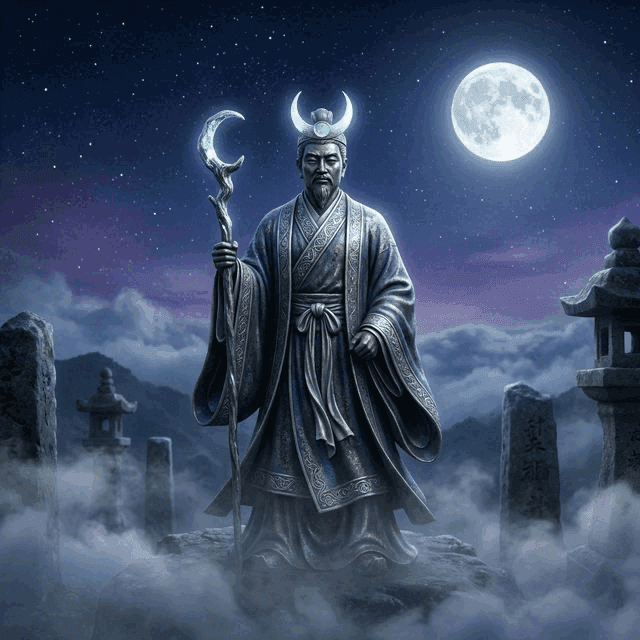 JapaneseTsukuyomi
Both are male moon figures whose separation from the sun explains why sun and moon are never together; the stories are otherwise unrelated.
Compare Anningan (the Moon Man) and Tsukuyomi side by side
Worship and cult
Temples, festivals, and practices recorded for Anningan (the Moon Man)
This is part of a living tradition. Inuit relationships with these figures today range from continued respect and storytelling to Christian faith that sets older practice aside, and they vary by family and community; this site does not describe angakkuq (shamanic) practice beyond what elders and Inuit-led publishers have chosen to make public.
Family
Anningan (the Moon Man)'s family at a glance
- Who are Anningan (the Moon Man)'s siblings?
- Siblings of Anningan (the Moon Man) recorded in the atlas: Malina (the Sun Woman).
In the atlas
Where Anningan (the Moon Man) appears
Sources and further reading
Source notes
These references are recorded in the catalog. Their passage wording and translation have not been checked, so quotations are not displayed here.
- Franz Boas, The Central Eskimo
- Knud Rasmussen, Intellectual Culture of the Iglulik Eskimos (Report of the Fifth Thule Expedition 1921-24, vol. 7, no. 1)
Appears in
Ancient and classical works featuring this figure.
Report of the Fifth Thule Expedition 1921-24
the Moon Spirit (Taqqiq) and the story of the sun and moon siblings (Intellectual Culture of the Iglulik Eskimos)
the brother who becomes the moon (traditions, the sun and moon)
Further reading
Report of the Fifth Thule Expedition 1921-24
The Iglulik Moon Spirit
The sun and moon siblings on Baffin Island
Read online: The Central Eskimo (opens in new tab)
About this entry
By Elizabeth Stein for Mythos Atlas. About the author. Editorial notes are grounded in the site's cited sources and can be challenged through the contact page.
Parallels are editorial comparisons across traditions: a shared role does not, by itself, establish a shared origin.
Family relationships come from the atlas's kinship records. Ancient sources often disagree on divine genealogy.
Genealogy
Family tree
Anningan (the Moon Man)'s parents, consorts, children and rivals, as recorded in the atlas.