Inuit TraditionMother of the Sea Animals
Sedna (the Sea Woman)
ᓄᓕᐊᔪᒃ (Nuliajuk)(Nuliajuk)
Also known as Nuliajuk (Netsilingmiut), Takannaaluk or Takanaaluk arnaaluk (Iglulik), Uinigumasuittuq (Iglulik, 'the one who did not want a husband'), Sassuma Arnaa (West Greenland, 'mother of the deep'), Arnarquagssaq (Greenland), Sanna / Sedna (Baffin Island)
- the sea and its animals
- the success or failure of hunting
- the observance of taboos
The woman at the bottom of the sea who keeps the seals, walrus, and whales, known by different names across the Arctic (Sedna on Baffin Island, Nuliajuk among the Netsilingmiut, Takannaaluk in Iglulik, Sassuma Arnaa in Greenland); when people break taboos, the animals are held back until an angakkuq combs her hair.
About Sedna (the Sea Woman)
Many names, one great power
Across the Inuit Arctic there is a woman who lives at the bottom of the sea and keeps the sea mammals on which people depend. Her names differ by region, and so do her stories. Franz Boas recorded her as Sedna in Cumberland Sound, Baffin Island, in the 1880s, and that is the name most outsiders know; the Netsilingmiut call her Nuliajuk; in Iglulik she is Takannaaluk and, in the telling of elders interviewed for Nunavut Arctic College, Uinigumasuittuq, "the one who did not want a husband"; in West Greenland she is Sassuma Arnaa, "mother of the deep". This site uses "Sedna" only as the most widely recognised name.
How she came to the sea
The stories of her origin vary. In Boas's Baffin Island account she is a young woman who refuses every suitor, is lured away by a fulmar disguised as a man, and is rescued by her father, who, when the fulmar raises a storm, throws her into the sea and cuts off her fingers as she clings to the boat; the joints become the whales, seals, and ground seals. In other tellings, including one Boas also recorded, she marries a dog. Among the Netsilingmiut, as Rasmussen recorded, Nuliajuk is an orphan girl whom no one wants, pushed off a raft of kayaks during a crossing; her fingers are cut as she holds on, and she sinks to become the mother of the sea animals. The different beginnings lead to the same place: a woman wronged, maimed, and enthroned beneath the sea.
Keeper of the animals
Because she has no fingers, she cannot comb her own hair. When people break the rules that govern relations with animals and with birth and death, the misdeeds gather in her hair as dirt and tangles, and she keeps the animals back, so that hunters come home empty-handed. In the Iglulik accounts recorded by Rasmussen, an angakkuq travels in spirit to her house at the bottom of the sea, combs and cleans her hair, and persuades her to release the animals, and people confess the breaches that caused the trouble.
Today
The Sea Woman remains one of the most widely told Inuit stories and one of the most frequent subjects of Inuit art, from Cape Dorset prints to contemporary sculpture. Many Inuit tellers stress her dignity and the justice of her anger; she is not a monster but the guardian of a relationship between people and animals that must be kept.
Across traditions
Parallel figures
Figures who play a role like Sedna (the Sea Woman)'s in other traditions.
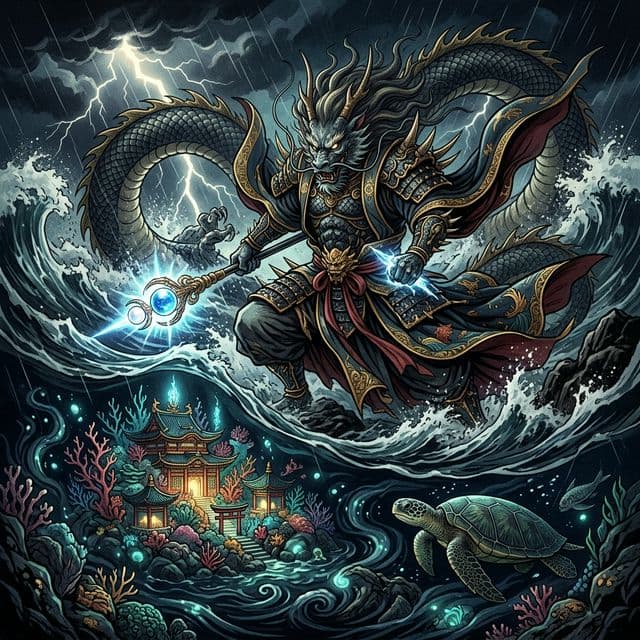 JapaneseRyujin
Both are powers beneath the sea who control the sea's creatures and bounty; the Sea Woman's relationship with hunters and taboos is distinctively Inuit, and the comparison is typological only.
Compare Sedna (the Sea Woman) and Ryujin side by side
Worship and cult
Temples, festivals, and practices recorded for Sedna (the Sea Woman)
This is part of a living tradition. Inuit relationships with these figures today range from continued respect and storytelling to Christian faith that sets older practice aside, and they vary by family and community; this site does not describe angakkuq (shamanic) practice beyond what elders and Inuit-led publishers have chosen to make public.
Festivals
- Autumn Sedna feasts recorded by Boas in Baffin Island in the 1880s
Family
In the atlas
Where Sedna (the Sea Woman) appears
Sources and further reading
Source notes
These references are recorded in the catalog. Their passage wording and translation have not been checked, so quotations are not displayed here.
- Franz Boas, The Central Eskimo
- Knud Rasmussen, Intellectual Culture of the Iglulik Eskimos (Report of the Fifth Thule Expedition 1921-24, vol. 7, no. 1)
Appears in
Ancient and classical works featuring this figure.
Report of the Fifth Thule Expedition 1921-24
the Sea Woman, as Takanaaluk (Iglulik) and Nuliajuk (Netsilingmiut) (Intellectual Culture of the Iglulik Eskimos; The Netsilik Eskimos)
mistress of Adlivun and the sea animals (section on religious ideas and traditions)
Interviewing Inuit Elders, Volume 4: Cosmology and Shamanism
the Sea Woman as Uinigumasuittuq and Takannaaluk (chapters on cosmology)
Further reading
Report of the Fifth Thule Expedition 1921-24
Iglulik and Netsilik accounts of Takanaaluk and Nuliajuk
Interviewing Inuit Elders, Volume 4: Cosmology and Shamanism
Iglulik elders on the Sea Woman, in their own words
The Baffin Island account that made 'Sedna' widely known
Read online: The Central Eskimo (opens in new tab)- Laugrand, Frédéric, and Jarich Oosten. Inuit Shamanism and Christianity (McGill-Queen's University Press, 2010).
- Fienup-Riordan, Ann. Hunting Tradition in a Changing World (Rutgers University Press, 2000), on Yup'ik and Inuit relations with animals.
About this entry
By Elizabeth Stein for Mythos Atlas. About the author. Editorial notes are grounded in the site's cited sources and can be challenged through the contact page.
Parallels are editorial comparisons across traditions: a shared role does not, by itself, establish a shared origin.
Family relationships come from the atlas's kinship records. Ancient sources often disagree on divine genealogy.
Genealogy
Family tree
Sedna (the Sea Woman)'s parents, consorts, children and rivals, as recorded in the atlas.