Inuit TraditionThe Sun
Malina (the Sun Woman)
ᓯᕿᓂᖅ (Siqiniq)(Siqiniq ('sun'); Greenlandic Malina)
Also known as Siqiniq (the sun), The Sun Sister
- the sun
- light and warmth
The sister who became the sun: when she discovered that the visitor in the dark was her brother, she fled with a burning torch into the sky, and he has pursued her ever since as the moon.
About Malina (the Sun Woman)
The sister's torch
In the widely told Inuit story of the sun and moon, a young woman is visited in the dark by a man she cannot see. To find out who he is, she blackens her hands with soot from the lamp and marks him. When the lamps are lit she sees the marks on her brother. In anger and shame she flees with a burning torch; he follows with his own, but his falls or burns down to embers. Both rise into the sky, where she becomes the sun and he, with his faint light, becomes the moon.
Why she has a name
The name Malina, now common in English-language books, comes from Greenlandic tellings. In many Canadian Inuit versions the sister is simply the sun, Siqiniq. The name is used here because readers will meet it in general reference works, not because it is universal.
A story about boundaries
The story is told as an explanation of the sky, but also as a story about kinship rules and their violation, and about the lasting consequences of a wrong. Boas noted in the 1880s that the Baffin Island version corresponded closely to the Greenlandic one, showing how widely the story had travelled.
Across traditions
Parallel figures
Figures who play a role like Malina (the Sun Woman)'s in other traditions.
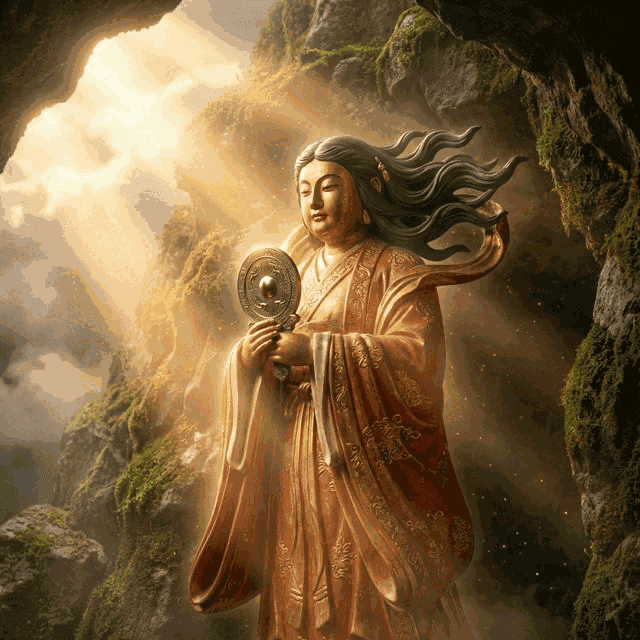 JapaneseAmaterasu
Both are female sun figures separated from a male moon; Amaterasu's separation from Tsukuyomi follows a different story entirely.
Compare Malina (the Sun Woman) and Amaterasu side by side
Worship and cult
Temples, festivals, and practices recorded for Malina (the Sun Woman)
This is part of a living tradition. Inuit relationships with these figures today range from continued respect and storytelling to Christian faith that sets older practice aside, and they vary by family and community; this site does not describe angakkuq (shamanic) practice beyond what elders and Inuit-led publishers have chosen to make public.
Family
Malina (the Sun Woman)'s family at a glance
- Who are Malina (the Sun Woman)'s siblings?
- Siblings of Malina (the Sun Woman) recorded in the atlas: Anningan (the Moon Man).
In the atlas
Where Malina (the Sun Woman) appears
Sources and further reading
Source notes
These references are recorded in the catalog. Their passage wording and translation have not been checked, so quotations are not displayed here.
- Franz Boas, The Central Eskimo
Appears in
Ancient and classical works featuring this figure.
the sister who becomes the sun (traditions, the sun and moon)
Further reading
The Baffin Island telling of the sun and moon
Read online: The Central Eskimo (opens in new tab)
About this entry
By Elizabeth Stein for Mythos Atlas. About the author. Editorial notes are grounded in the site's cited sources and can be challenged through the contact page.
Parallels are editorial comparisons across traditions: a shared role does not, by itself, establish a shared origin.
Family relationships come from the atlas's kinship records. Ancient sources often disagree on divine genealogy.
Genealogy
Family tree
Malina (the Sun Woman)'s parents, consorts, children and rivals, as recorded in the atlas.