Japanese Pantheon
Hachiman
Also known as Hachiman-jin, Yawata
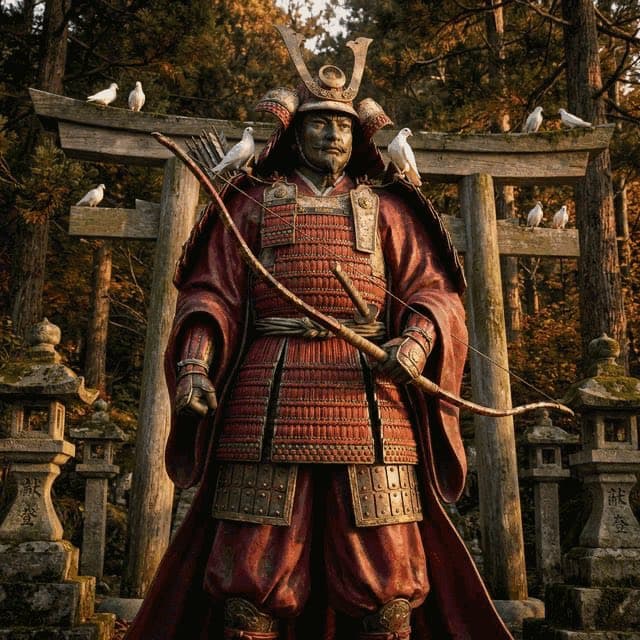
- war
- archery
- protection
- samurai
Syncretic god of war, archery, and protector of Japan and warriors. Originally Emperor Ojin deified. Patron of the samurai clans.
About Hachiman
Hachiman, god of the bow
Hachiman is a war god, an archery god, and a protector of Japan who began as a deified emperor. Tradition identifies him with Emperor Ojin. The great shrine at Usa in Kyushu is his oldest major seat. From there his cult spread with the Minamoto and other warrior houses, until samurai banners carried his name into battle.
Syncretism
He is also a protector of Buddhist establishments, addressed as Hachiman Daibosatsu. That double language, kami and bodhisattva, is ordinary in medieval Japan and essential to him. Oracles at Usa could speak in both registers. The god of warriors became, without contradiction, a guardian of temples.
Not only war
Hachiman protects communities, childbirth in some local forms, and the state as well as the fight. The bow is his sign because archery was a noble skill, not because he is a Japanese Ares. He is closer to a tutelary emperor who never quite left the human world.
Origin story
Originally Emperor Ojin, deified as Hachiman. Over time, led to becoming protector of Buddhism in Japan and guardian deity of warriors.
Across traditions
Parallel figures
Figures who play a role like Hachiman's in other traditions.
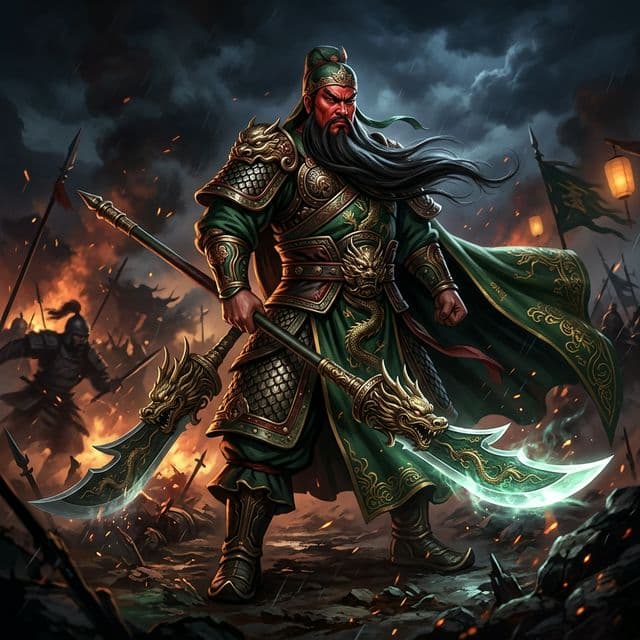 ChineseGuan YuIllustration
Both are patron gods of warriors, honored for loyalty, protection, and martial virtue
Compare Hachiman and Guan Yu side by side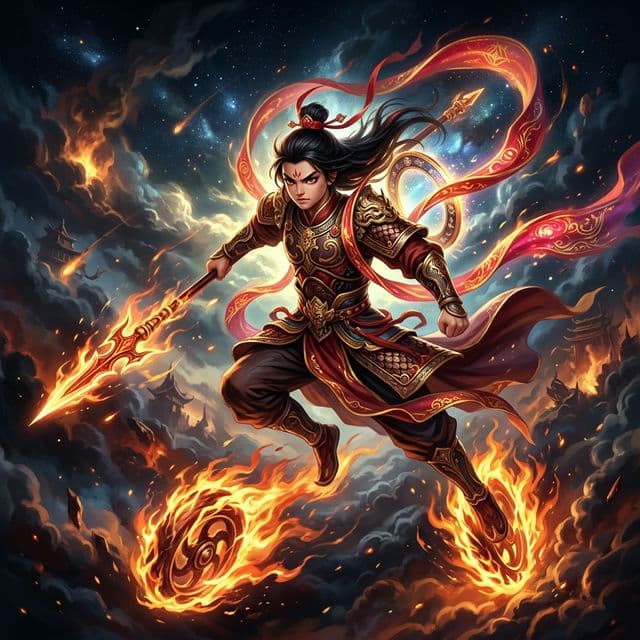 ChineseNezhaIllustration
Both are youthful, fiercely protective war deities associated with martial prowess and defense
Compare Hachiman and Nezha side by side
Worship and cult
Temples, festivals, and practices recorded for Hachiman
Oracles at Usa could speak for the court. Warrior houses carried his name on banners. Doves are his messengers. He is addressed as kami and as Hachiman Daibosatsu, a bodhisattva guardian of temples, without the cult treating those as two different gods.
Sacred sites
- Usa Jingu in Kyushu, the oldest great Hachiman seat
- Iwashimizu Hachimangu southwest of Kyoto
- Tsurugaoka Hachimangu in Kamakura, raised by the Minamoto
Festivals
- Hachiman matsuri
- Yabusame (mounted archery)
- Hōjō-e at Usa
Sources and further reading
Source notes
These references are recorded in the catalog. Their passage wording and translation have not been checked, so quotations are not displayed here.
- Usa Hachiman oracle, Shoku Nihongi, Tenpyō 21 (749 CE entry, English paraphrase)
About this entry
By Elizabeth Stein for Mythos Atlas. About the author. Editorial notes are grounded in the site's cited sources and can be challenged through the contact page.
Parallels are editorial comparisons across traditions: a shared role does not, by itself, establish a shared origin.
Keep exploring
One myth a week, with its sources in a short email. The sign-up form is just below.
Genealogy
Family tree
Hachiman's parents, consorts, children and rivals, as recorded in the atlas.