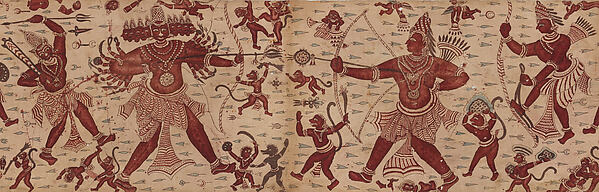
The Combat of Rama and Ravana, The Metropolitan Museum of Art
Hindu pantheon
Ravana
रावण(Ravana)
Also known as: Dashanan, Dashagriva (ten-necked)
rakshasa kingship
hubris
scholarship (per tradition)
the antagonist role in the Ramayana
The ten-headed rakshasa king of Lanka and principal antagonist of the Ramayana. A grandson of the sage Pulastya and devout worshipper of Shiva who won great boons through austerity, Ravana's abduction of Sita brings about his own destruction at the hands of Rama.
Ravana, in Valmiki's Ramayana, is the ten-headed, twenty-armed king of Lanka, born to the sage Vishrava and the rakshasi Kaikesi. Through his father, he is a grandson of Pulastya, one of the mind-born sons of Brahma, giving him a partly divine lineage despite his rakshasa nature. Through prolonged, severe austerities directed at Brahma, Ravana won a boon of near-invulnerability against gods, demons, and spirits — but, in his pride, did not think to ask for protection against humans or animals, a omission that becomes his fatal weakness.
Conqueror of the Three Worlds
Armed with his boon, Ravana conquered the three worlds, humbled the gods, and ruled Lanka in tremendous splendor from a city said to be built of gold. He is also described in the epic as a formidable scholar, a skilled player of the veena, and a devoted worshipper of Shiva, complicating any simple reading of him as merely a monstrous villain.
The Abduction of Sita
After his sister Shurpanakha was mutilated by Lakshmana following her advances toward Rama, Ravana resolved to avenge her by abducting Rama's wife, Sita. Using the rakshasa Maricha disguised as a golden deer to lure Rama and Lakshmana away, Ravana seized Sita and carried her to Lanka in his flying chariot, confining her in the Ashoka grove and repeatedly, unsuccessfully, pressing her to marry him.
Defeat and Death
Rama, aided by the monkey armies of Sugriva and the devoted Hanuman, built a causeway to Lanka and waged war against Ravana's forces. Ravana's own brother Vibhishana, disapproving of the abduction, defected to Rama's side, providing counsel that helped Rama ultimately defeat Ravana in single combat. Rama killed Ravana with the Brahmastra, a decisive weapon, ending his rule and freeing Sita. In some later devotional traditions Ravana is honored as a great devotee whose death at Vishnu's avatar's hands granted him liberation (moksha) despite his villainy, a theological reading elaborated well after Valmiki's original text.
Origin Story
Ravana was born to the sage Vishrava and the rakshasi princess Kaikesi, making him a grandson of the sage Pulastya. Through fierce austerities he won from Brahma a boon of near-invulnerability, which he used to conquer the three worlds before his abduction of Sita brought Rama's forces against him and led to his death.
Editorial notes for deeper study (not a full bibliography).
Valmiki (trans. Robert P. Goldman, gen. ed.). *The Ramayana of Valmiki: An Epic of Ancient India* (Princeton University Press, multi-volume).
Richman, Paula (ed.). *Many Ramayanas: The Diversity of a Narrative Tradition in South Asia* (University of California Press, 1991) — on regional traditions that complicate Ravana's villainy, including Jain and some South Indian readings.
Browse representative texts and policies on the Sources page.
Worship & Cult
How Ravana was venerated in ancient times
Sacred Temples
•A small number of Ravana temples exist in India, notably at Kanpur and Vidisha, reflecting his status as a Shiva devotee in some regional traditions
Festivals & Celebrations
Effigies of Ravana are burned across North India during Dussehra/Vijayadashami, marking Rama's victory
Worship Practices
Ravana is overwhelmingly commemorated through his defeat rather than propitiated as a benevolent deity: the burning of towering Ravana effigies at Dussehra is one of the most widespread public rituals in North Indian Hinduism. A small minority of regional and Jain traditions honor him more positively, as a scholar-king or even a tragic devotee.
Domains
rakshasa kingship
hubris
scholarship (per tradition)
the antagonist role in the Ramayana
Symbols
ten heads
twenty arms
the flying chariot Pushpaka Vimana
In the museums
Ravana in art
Real objects in public collections, released into the public domain by the museums that hold them. Dates refer to when each object was made. Objects made within the tradition come first, later depictions after.
India, Coromandel Coast · late 18th century · Painted and mordant-dyed cotton
A painted and dyed cotton hanging from the Coromandel Coast depicting the battle between Rama and Ravana. The museum's own title names both figures directly.
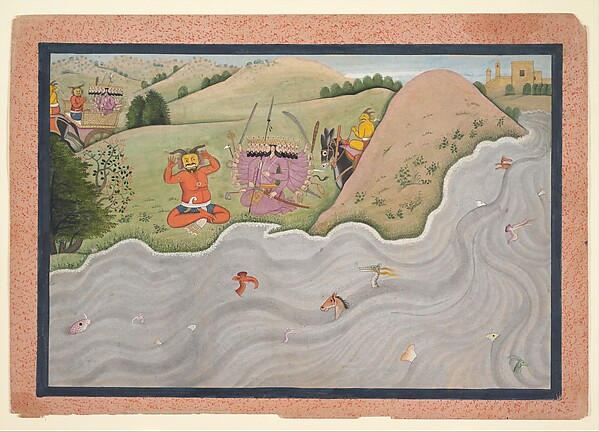
The Demon Marichi Tries to Dissuade Ravana; Illustrated folio from a dispersed Ramayana series
India (Himachal Pradesh, Kangra) · ca. 1780 · Ink, opaque watercolor, silver, and gold on paper
A Kangra-school folio from a dispersed Ramayana series showing the demon Marichi trying to talk Ravana out of his plan. The museum's title names Ravana explicitly as the recipient of the advice.