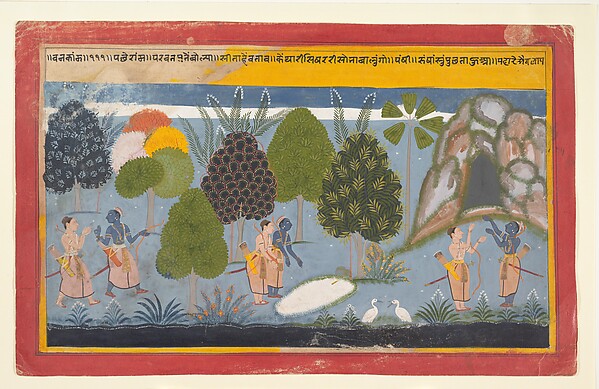
Rama and Lakshmana Search in Vain for Sita: Illustrated folio from a dispersed Ramayana series, The Metropolitan Museum of Art
Hindu pantheon
Sita
सीता(Sita)
Also known as: Janaki, Vaidehi, Maithili
devotion
chastity
steadfastness
the earth (later identification)
Wife of Rama and central heroine of the Ramayana. Found by King Janaka in a ploughed furrow, Sita is abducted by the demon king Ravana, endures captivity with unwavering fidelity, and is later identified in Puranic tradition as an avatar of the goddess Lakshmi.
According to Valmiki's Ramayana, King Janaka of Mithila found the infant Sita while ploughing a field in preparation for a sacrifice, and raised her as his own daughter. Her name, meaning "furrow," preserves this origin. She won her hand in marriage through a swayamvara in which Rama, prince of Ayodhya, alone succeeded in stringing and breaking the great bow of Shiva that Janaka had set as the contest's test.
Exile and Abduction
When Rama was exiled from Ayodhya for fourteen years by a court intrigue, Sita insisted on accompanying him into the forest rather than remain behind, along with his brother Lakshmana. During their exile, the demon king Ravana, ruler of Lanka, became infatuated with Sita after his sister Shurpanakha was humiliated by Rama and Lakshmana. Ravana lured Rama and Lakshmana away using the golden deer Maricha, then abducted Sita and carried her to Lanka, where he held her captive in the Ashoka grove, repeatedly pressing her to become his queen.
Steadfastness and Rescue
Throughout her captivity, Sita refused Ravana absolutely, remaining devoted to Rama. Hanuman, Rama's monkey general, located her in Lanka and delivered Rama's ring as a token before the war that followed. After Rama defeated and killed Ravana, he was reunited with Sita, who underwent a trial by fire (agni pariksha) to publicly demonstrate her chastity before the assembled army, emerging unburned.
The Later Uttara Kanda
The Uttara Kanda, widely regarded by scholars as a later addition to the epic rather than part of its earliest core, relates that Rama, hearing continued public doubt about Sita's fidelity after their return to Ayodhya, exiled her while pregnant. She took refuge in the sage Valmiki's ashram, where she raised her twin sons Lava and Kusha alone. When Rama later sought her return, Sita instead called upon her mother, the earth goddess Bhumi, who opened the ground and received her back. In later devotional and Puranic tradition, Sita is identified as an incarnation of the goddess Lakshmi, born to accompany Vishnu's avatar Rama, though this theological identification is a development beyond Valmiki's earliest text.
Origin Story
Sita was discovered as an infant by King Janaka of Mithila while he ploughed a field, and was raised as his daughter. She married Rama after he alone succeeded in stringing Shiva's great bow at her swayamvara, and her subsequent abduction by Ravana sets the central conflict of the Ramayana in motion.
Editorial notes for deeper study (not a full bibliography).
Valmiki (trans. Robert P. Goldman, gen. ed.). *The Ramayana of Valmiki: An Epic of Ancient India* (Princeton University Press, multi-volume) — standard scholarly translation.
Richman, Paula (ed.). *Many Ramayanas: The Diversity of a Narrative Tradition in South Asia* (University of California Press, 1991) — on the many regional and devotional variants of Sita's story.
Browse representative texts and policies on the Sources page.
Worship & Cult
How Sita was venerated in ancient times
Sacred Temples
•Janaki Mandir at Janakpur, Nepal, her traditional birthplace
•Worshipped jointly with Rama at Ram temples across India, including Ayodhya
Festivals & Celebrations
Sita Navami (her birth)Worshipped alongside Rama during Ram Navami and Diwali
Worship Practices
Sita is almost always worshipped jointly with Rama, as the ideal devoted wife (Sita-Rama images and icons are paired), rather than through an independent cult of her own; Janakpur remains a major pilgrimage site specifically tied to her birth.
Domains
devotion
chastity
steadfastness
the earth (later identification)
Symbols
the lotus
the furrow
fire (agni pariksha)
In the museums
Sita in art
Real objects in public collections, released into the public domain by the museums that hold them. Dates refer to when each object was made. Objects made within the tradition come first, later depictions after.
Rama and Lakshmana Search in Vain for Sita: Illustrated folio from a dispersed Ramayana series
India, Rajasthan, Mewar · ca. 1680–90 · Ink and opaque watercolor on paper
A Rajasthani manuscript illustration from a dispersed Ramayana series showing Rama and Lakshmana searching for Sita after her abduction. It reflects the story's reception in Mewar court painting rather than an ancient attestation.