Roman PantheonLake
Lake Nemi
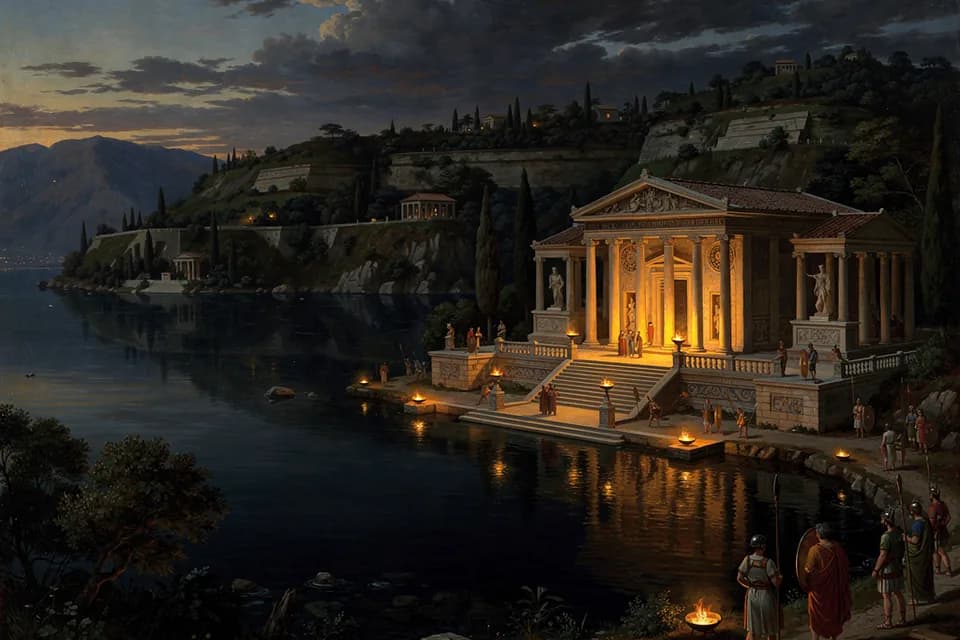
The volcanic crater lake in the Alban Hills called Diana's Mirror, beside the sanctuary of Diana Nemorensis, whose priest, the rex Nemorensis, won his office by killing his predecessor.
About Lake Nemi
Diana of the grove
On the north shore of the small crater lake near Aricia stood the sanctuary of Diana Nemorensis, 'Diana of the woodland', a cult shared by the Latin towns and later famous across the Roman world. The lake was called Speculum Dianae, Diana's Mirror. Women whose prayers were answered came in procession by torchlight, a scene Ovid mentions in the Fasti.
The king of the grove
Ancient writers, among them Strabo (5.3.12) and Suetonius (Caligula 35), describe the strange rule of the priesthood: the priest, called the rex Nemorensis, was a runaway slave who won the office by killing the man who held it, and so lived always on guard, sword in hand. Strabo connects the custom with the Scythian cult of Artemis.
Frazer's golden bough
James George Frazer opened The Golden Bough (1890) with this priesthood and linked it to the golden bough of Virgil's Aeneid Book 6, building a sweeping theory of dying and reviving kings. The link between Nemi and Virgil's bough is Frazer's own, drawn from a remark by the late-antique commentator Servius, and his theory is not accepted today.
The ships
Two enormous ceremonial ships built under Caligula were raised from the lake in 1928 to 1932 and destroyed by fire in 1944.
On the map
Lake Nemi among other places of the Roman Pantheon.
Sources and further reading
Source notes
These references are recorded in the catalog. Their passage wording and translation have not been checked, so quotations are not displayed here.
- Strabo, Geography 5.3.12
- Suetonius, Caligula 35
About this entry
By Elizabeth Stein for Mythos Atlas. About the author. Editorial notes are grounded in the site's cited sources and can be challenged through the contact page.
Coordinates mark where the myths place a site, or where the tradition locates it today. Mythic realms are left off the map or marked as symbolic placements.