Roman PantheonTemple
Temple of Vesta
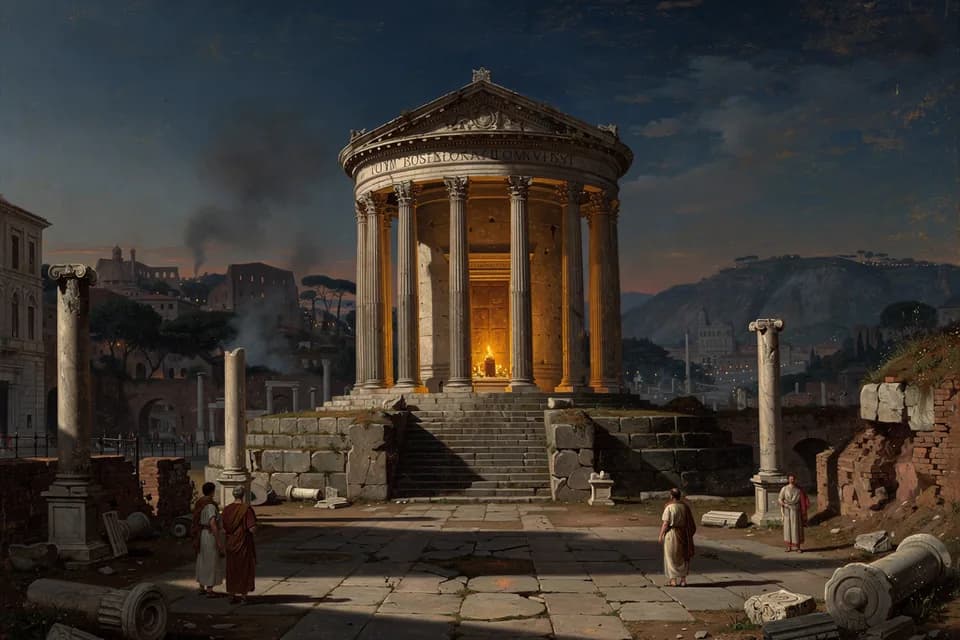
The small round temple in the Roman Forum where the Vestal Virgins kept the eternal fire of the state burning and guarded sacred objects, among them, tradition said, the Palladium brought from Troy.
About Temple of Vesta
The hearth of Rome
The Aedes Vestae was not a temple in the strict sense but a round shrine, recalling, the Romans said, the round huts of early Rome. Inside burned the fire of Vesta, the hearth of the whole city, tended day and night by the six Vestal Virgins. If it went out, the Vestal responsible was flogged and the fire rekindled by an ancient method. There was no cult statue; Ovid, in the Fasti (Book 6), says that Vesta is nothing other than living flame.
The storeroom
An inner space, the penus, held sacred objects that only the Vestals could see. Among them, according to tradition reported by Livy, Dionysius of Halicarnassus, and others, was the Palladium, the image of Pallas that Aeneas was said to have rescued from Troy. When the Gauls sacked Rome around 390 BCE, Livy says, the Vestals carried the sacred objects away to safety at Caere.
The ruins
The shrine burned and was rebuilt several times; the partial reconstruction seen today in the Forum dates to the rebuilding after a fire in 191 CE under Julia Domna, restored in the 1930s. The House of the Vestals stands beside it. The fire was extinguished and the order disbanded under Theodosius I at the end of the 4th century.
On the map
Temple of Vesta among other places of the Roman Pantheon.
Sources and further reading
Source notes
These references are recorded in the catalog. Their passage wording and translation have not been checked, so quotations are not displayed here.
- Ovid, Fasti, Book 6
- Livy, Ab Urbe Condita 5.40
About this entry
By Elizabeth Stein for Mythos Atlas. About the author. Editorial notes are grounded in the site's cited sources and can be challenged through the contact page.
Coordinates mark where the myths place a site, or where the tradition locates it today. Mythic realms are left off the map or marked as symbolic placements.