Persian (Iranian) Traditionlegend
Zal and the Simurgh
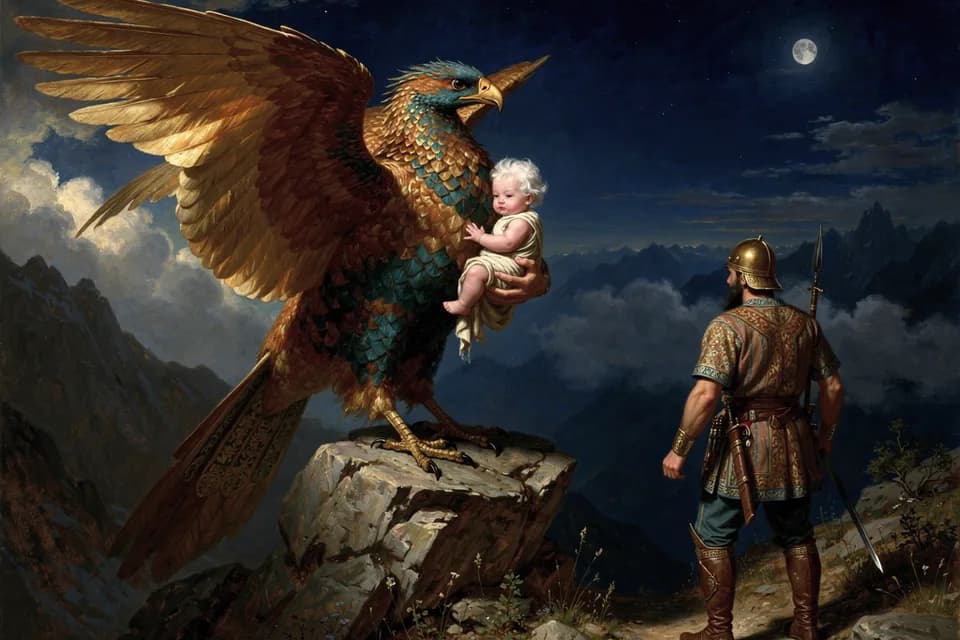
The hero Sam abandons his newborn son on Mount Alborz because the child's hair is white as an old man's; the great bird Simurgh carries him to her nest and raises him, and when the repentant father comes for him, she gives the boy a feather to burn whenever he needs her.
An editorial retelling
The story
A child with white hair
In the reign of King Manuchehr, the great warrior Sam, lord of Zabulistan, longed for a son. When at last a boy was born, beautiful in face and body but with hair as white as an old man's, no one dared tell Sam until his child's nurse did. Sam, seeing the white-haired child, was ashamed and afraid of what people would say: was this the child of a demon? He ordered the baby taken far away and left on the slopes of Mount Alborz.
The nest of the Simurgh
On the heights of Alborz the Simurgh had her nest. Seeking food for her young, she saw the infant crying on the bare rock and swooped down to take him. But God put compassion in her heart, and instead of feeding him to her chicks she raised him with them. The boy grew strong and tall in the nest, and travelers who passed the mountain began to speak of a young man living with the great bird.
The father's repentance
Years later Sam dreamed that a rider came from India bringing news that his son was alive, and in a second dream he was rebuked by a wise man for abandoning the child: how could he call the boy a demon's son when he himself had rejected him? Ashamed, Sam went to Alborz and prayed at the foot of the mountain. The Simurgh saw him and knew why he had come. She told the young man that it was time to return to his father and his inheritance. When he protested that he did not want to leave her, she gave him one of her feathers and told him to keep it: if ever he were in danger or distress he should burn it, and she would come at once. She named him Dastan, and his father called him Zal, 'the white-haired'.
The feather
The feather's promise is kept twice in the Shahnameh. When Zal's wife Rudabeh cannot give birth to their enormous child, Zal burns the feather; the Simurgh appears and tells them to open her side while she is drugged with wine, and to heal the wound with herbs and the touch of her feather. The child born is Rostam. Much later, when Rostam and his horse Rakhsh are gravely wounded in combat with the invulnerable prince Esfandiyar, Zal burns the feather again. The Simurgh heals them and tells Rostam to cut a branch of tamarisk and shape it into an arrow aimed at Esfandiyar's eyes, warning him that whoever kills Esfandiyar will suffer for it.
Behind the bird
The Simurgh's name derives from the Avestan saena meregha, the bird Saena, and Middle Persian texts place the Senmurw on the tree of all seeds in the middle of the cosmic sea. In Ferdowsi she is a wise and protective power, and in later Persian mystical poetry, above all Attar's Conference of the Birds (1177), she becomes a symbol of the divine sought by the soul.
Listen or change reading mode
Highlights
Sam abandons his white-haired son on Mount Alborz; the Simurgh raises him in her nest; the repentant father comes for him, and the Simurgh gives Zal a feather to burn in need, which later brings her to guide Rostam's birth and his combat with Esfandiyar.
Why it matters
The origin of the bond between the house of Sam and the Simurgh, which runs through the Shahnameh's central heroic cycle, and one source of the Simurgh's long life in Persian literature and art.
Sources and further reading
By Elizabeth Stein for Mythos Atlas. About the author. Editorial notes are grounded in the site's cited sources and can be challenged through the contact page.
Works cited
Shahnameh, reign of Manuchehr (Zal and the Simurgh)
Abolqasem Ferdowsi; trans. A. G. and E. Warner (1905); Dick Davis (2006)