Persian (Iranian) TraditionMountain
Mount Damavand
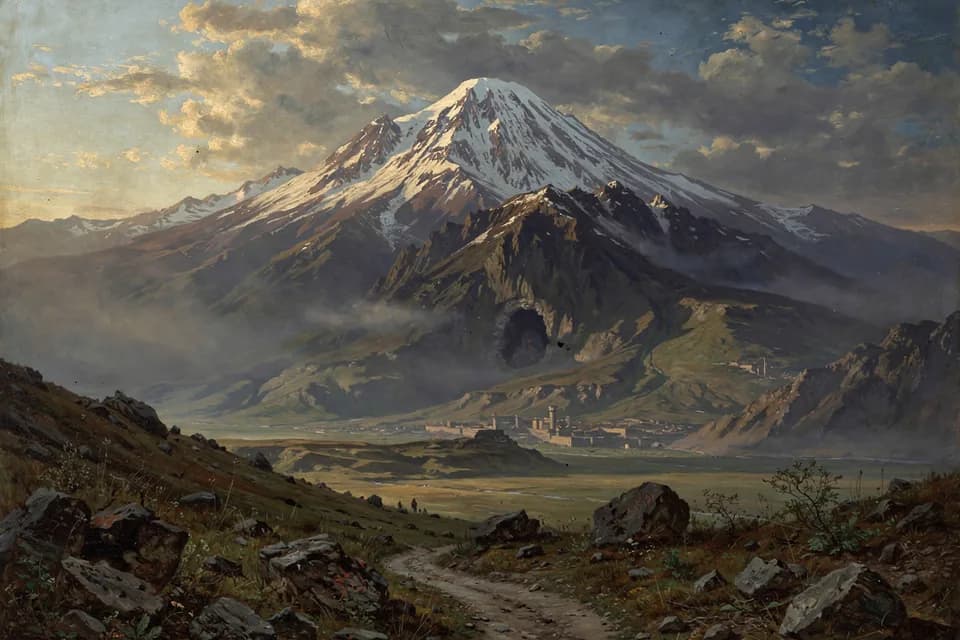
The volcanic peak in the Alborz range northeast of Tehran, the highest mountain in Iran, in which the Shahnameh's tyrant Zahhak lies chained in a cave, and which Middle Persian tradition connects with the binding of the dragon Azhi Dahaka.
About Mount Damavand
Iran's highest mountain
Damavand is a dormant stratovolcano rising to about 5,600 meters above the Caspian slope of the Alborz range, northeast of Tehran, and its snow-capped cone is a national symbol of Iran, pictured on banknotes and in poetry.
The prison of the dragon
In Ferdowsi's Shahnameh, Fereydun, told by the heavenly messenger Sorush not to kill the defeated Zahhak, carries him to Mount Damavand and chains him in a cave inside the mountain, where he is to remain until the end of time. The tradition is older than Ferdowsi: the Vendidad names the land of Varena as the birthplace of Thraetaona, who smote Azhi Dahaka, and Darmesteter noted that the Greater Bundahishn identifies it with Damavand, where the dragon was bound with iron bonds. Local folklore held that the fumes from the mountain's vents were the breath of the imprisoned tyrant.
At the end of time
Middle Persian eschatology foretells that Dahag will break free near the end of the world before the hero Keresaspa kills him.
On the map
Mount Damavand among other places of the Persian (Iranian) Tradition.
Sources and further reading
Source notes
These references are recorded in the catalog. Their passage wording and translation have not been checked, so quotations are not displayed here.
- Ferdowsi, Shahnameh, reign of Fereydun (paraphrase)
- Avesta, Vendidad 1.17 (trans. Darmesteter)
About this entry
By Elizabeth Stein for Mythos Atlas. About the author. Editorial notes are grounded in the site's cited sources and can be challenged through the contact page.
Coordinates mark where the myths place a site, or where the tradition locates it today. Mythic realms are left off the map or marked as symbolic placements.