Persian (Iranian) TraditionTemple
Takht-e Soleyman
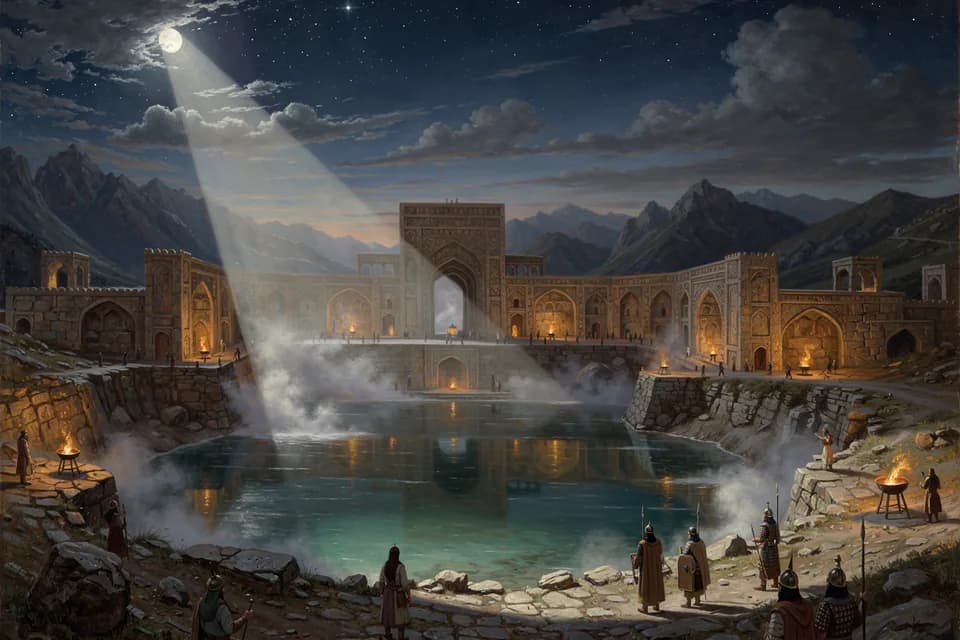
The Sasanian royal sanctuary in northwestern Iran built around a crater lake, home of Adur Gushnasp, the great fire of the warriors and kings, one of the three most sacred fires of Sasanian Zoroastrianism.
About Takht-e Soleyman
The fire of the kings
In the mountains of West Azerbaijan province, a walled Sasanian complex surrounds a spring-fed lake in a limestone crater. Excavations have identified it with Shiz, site of Adur Gushnasp, the sacred fire of the warrior class and of the kings, one of the three great fires named in Sasanian tradition alongside Adur Farnbag (the fire of priests) and Adur Burzen-Mihr (the fire of farmers). Sasanian kings made gifts to it, and tradition says they came there after their accession.
Fire and water
The site joins a fire temple with a sacred lake, the two elements most honored in Zoroastrian ritual, and scholars have connected its water with the cult of Anahita. The Byzantine emperor Heraclius sacked it in 624 CE during his war with Khosrow II.
The later name
The name 'Throne of Solomon' was given in the Islamic period, linking the site to the prophet-king of Islamic legend. It is a UNESCO World Heritage Site.
On the map
Takht-e Soleyman among other places of the Persian (Iranian) Tradition.
Sources and further reading
Source notes
These references are recorded in the catalog. Their passage wording and translation have not been checked, so quotations are not displayed here.
- James Darmesteter, note to Avesta, Yasht 19.35 (paraphrase of the commentary tradition)
About this entry
By Elizabeth Stein for Mythos Atlas. About the author. Editorial notes are grounded in the site's cited sources and can be challenged through the contact page.
Coordinates mark where the myths place a site, or where the tradition locates it today. Mythic realms are left off the map or marked as symbolic placements.