Persian (Iranian) TraditionPalace
Persepolis
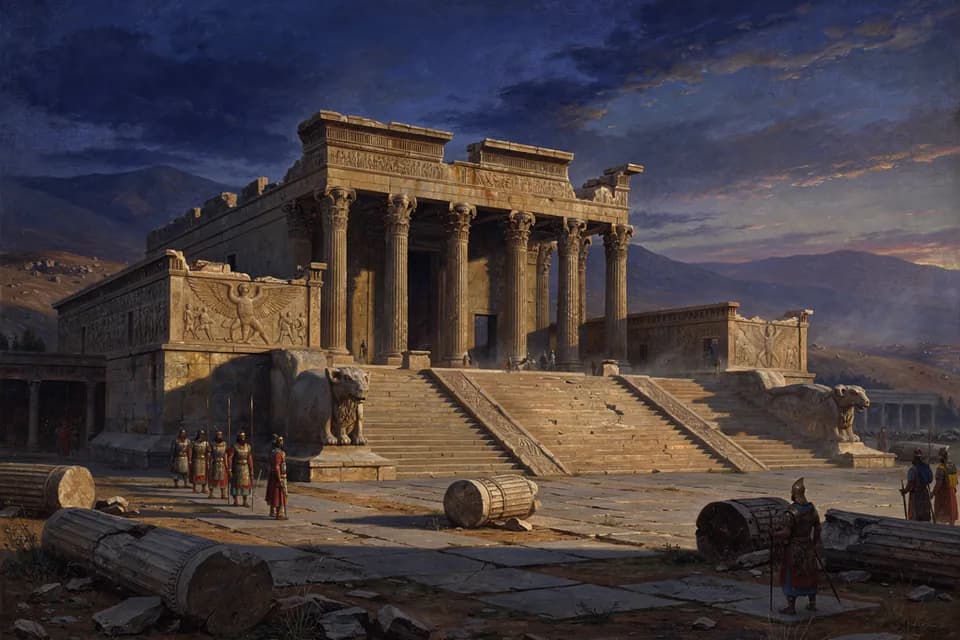
The ceremonial capital of the Achaemenid kings in Fars, begun by Darius I around 518 BCE and burned by Alexander in 330 BCE, whose reliefs show the winged figure in a disc; later called Takht-e Jamshid, 'the Throne of Jamshid'.
About Persepolis
Parsa
Persepolis (Old Persian Parsa) stands on a great terrace at the foot of a mountain in the Marvdasht plain of Fars, southwestern Iran. Darius I began it around 518 BCE, and his successors Xerxes and Artaxerxes I added audience halls, palaces, and a treasury. Its staircases carry reliefs of delegations from across the empire bringing gifts to the king, and its inscriptions invoke Ahuramazda's protection over the land. Alexander of Macedon burned it in 330 BCE.
The winged figure
Above royal figures on the reliefs hovers a figure emerging from a winged disc, now popularly called the Faravahar. It is often identified as Ahuramazda, but scholars also argue that it represents the royal glory (khvarenah) or the king's guardian spirit (fravashi); the identification is disputed.
Jamshid's Throne
Long after its fall, Persians called the ruins Takht-e Jamshid, 'the Throne of Jamshid', linking them with the legendary king of the Shahnameh. Persepolis is a UNESCO World Heritage Site.
On the map
Persepolis among other places of the Persian (Iranian) Tradition.
Sources and further reading
Source notes
These references are recorded in the catalog. Their passage wording and translation have not been checked, so quotations are not displayed here.
- Darius I, inscription at Persepolis (DPd) (paraphrase)
About this entry
By Elizabeth Stein for Mythos Atlas. About the author. Editorial notes are grounded in the site's cited sources and can be challenged through the contact page.
Coordinates mark where the myths place a site, or where the tradition locates it today. Mythic realms are left off the map or marked as symbolic placements.