Persian (Iranian) TraditionRealm
Chinvat Bridge
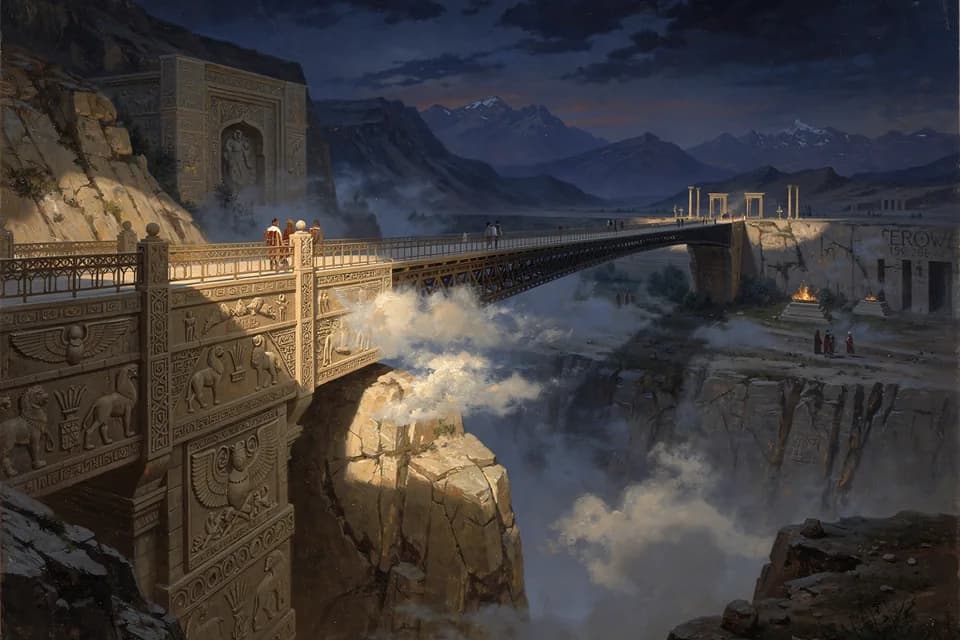
The Bridge of the Separator, which every soul must cross on the fourth dawn after death: broad for the righteous, who are met by a beautiful maiden, and narrow as a blade for the wicked, who fall into the House of the Lie.
About Chinvat Bridge
The bridge of judgment
The Gathas already speak of the 'Bridge of the Separator' (cinvato peretu) where each soul is judged by its deeds. Later Avestan and Middle Persian texts describe the scene in detail. For three nights after death the soul remains near the body, guarded by Sraosha. On the fourth dawn it comes to the bridge, which stretches from the peak of Mount Hara to the heavens, and its deeds are weighed by Mithra, Sraosha, and Rashnu.
Maiden or hag
The soul of a righteous person is met by its own daena, its conscience or religious self, in the form of a beautiful maiden who says she is the embodiment of its good thoughts, words, and deeds; the bridge becomes broad, and the soul passes over to the House of Song. The wicked soul meets a hideous hag, the bridge narrows to the width of a blade, and the soul falls into the House of the Lie. The ninth-century Book of Arda Viraf describes a priest's visionary journey across the bridge to see heaven and hell.
A lasting image
The image of a narrow bridge over the abyss that the righteous cross and the wicked fall from appears also in Islamic tradition (the sirat), and its possible Iranian background is widely discussed.
Sources and further reading
Source notes
These references are recorded in the catalog. Their passage wording and translation have not been checked, so quotations are not displayed here.
- Hadokht Nask, ch. 2 (paraphrase)
About this entry
By Elizabeth Stein for Mythos Atlas. About the author. Editorial notes are grounded in the site's cited sources and can be challenged through the contact page.
Coordinates mark where the myths place a site, or where the tradition locates it today. Mythic realms are left off the map or marked as symbolic placements.