Persian (Iranian) TraditionMonument
Behistun
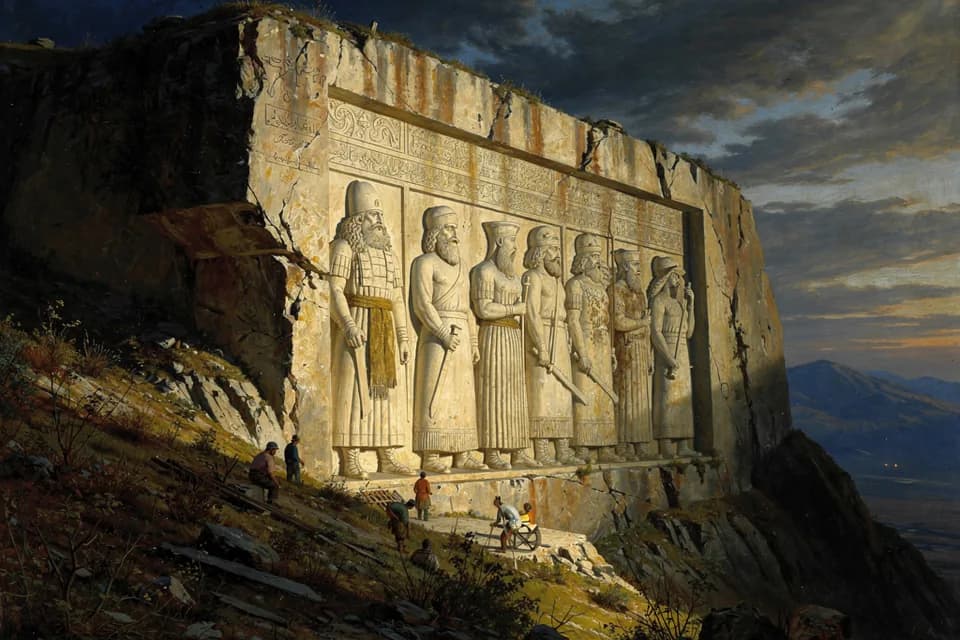
The cliff at Bisotun in western Iran where Darius I carved a trilingual inscription and relief around 520 BCE, attributing his rise to 'the favor of Ahuramazda'; the key to the decipherment of cuneiform.
About Behistun
The inscription
High on a cliff above the ancient road from Mesopotamia to the Iranian plateau, Darius I had his account of his seizure of power carved in Old Persian, Elamite, and Babylonian. It tells how he overthrew the usurper Gaumata and put down rebellions across the empire in a single year, and it repeatedly credits his success to 'the favor of Ahuramazda', while condemning his enemies as followers of the Lie (drauga), a word related to the Avestan druj.
The relief
Above the text, Darius stands with his foot on the prostrate Gaumata before a line of bound rebel kings, beneath the winged figure in a disc. The scene joins royal power, divine favor, and the triumph of truth over falsehood.
Decipherment
In the 1830s and 1840s the British officer Henry Rawlinson copied the inscription at great risk from the cliff face; his work on the Old Persian text, and then on the Babylonian, opened Mesopotamian cuneiform to modern scholarship. Behistun is a UNESCO World Heritage Site.
On the map
Behistun among other places of the Persian (Iranian) Tradition.
Sources and further reading
Source notes
These references are recorded in the catalog. Their passage wording and translation have not been checked, so quotations are not displayed here.
- Behistun Inscription, col. I (paraphrase)
About this entry
By Elizabeth Stein for Mythos Atlas. About the author. Editorial notes are grounded in the site's cited sources and can be challenged through the contact page.
Coordinates mark where the myths place a site, or where the tradition locates it today. Mythic realms are left off the map or marked as symbolic placements.