Persian (Iranian) TraditionTomb
Naqsh-e Rostam
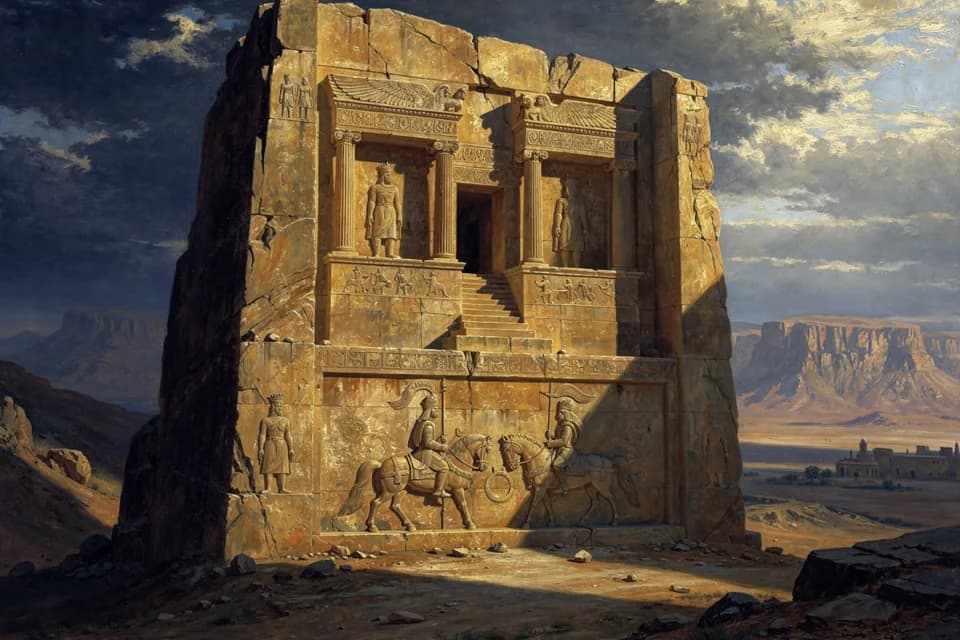
The cliff near Persepolis bearing the rock-cut tombs of Darius I and other Achaemenid kings and the Sasanian relief of Ardashir I receiving the ring of kingship from Ohrmazd, whose horse tramples Ahriman.
About Naqsh-e Rostam
Royal tombs
A few kilometers north of Persepolis, four cross-shaped tombs are cut high in the cliff: those of Darius I, whose inscription praises Ahuramazda as the great god who created earth, sky, man, and happiness for man, and of three of his successors. Each façade shows the king before a fire altar, beneath the winged figure in a disc.
The investiture of Ardashir
Below the tombs, the Sasanian kings carved their own reliefs. In the most famous, Ardashir I (r. 224-242 CE), founder of the dynasty, receives the ring of kingship from Ohrmazd, both on horseback; beneath Ardashir's horse lies his defeated predecessor, the Parthian king Artabanus IV, and beneath Ohrmazd's lies Ahriman, identified by the snakes in his hair. Trilingual inscriptions name the figures.
Why 'Rostam'
The site's name, 'Picture of Rostam', comes from later Persians' belief that the carved Sasanian warriors depicted the hero of the Shahnameh.
On the map
Naqsh-e Rostam among other places of the Persian (Iranian) Tradition.
Sources and further reading
Source notes
These references are recorded in the catalog. Their passage wording and translation have not been checked, so quotations are not displayed here.
- Darius I, tomb inscription at Naqsh-e Rostam (DNa), §1 (paraphrase)
About this entry
By Elizabeth Stein for Mythos Atlas. About the author. Editorial notes are grounded in the site's cited sources and can be challenged through the contact page.
Coordinates mark where the myths place a site, or where the tradition locates it today. Mythic realms are left off the map or marked as symbolic placements.