Persian (Iranian) TraditionCreature
Simurgh
- healing
- wisdom and foreknowledge
- summoned by burning her feather
- carrying a person in flight
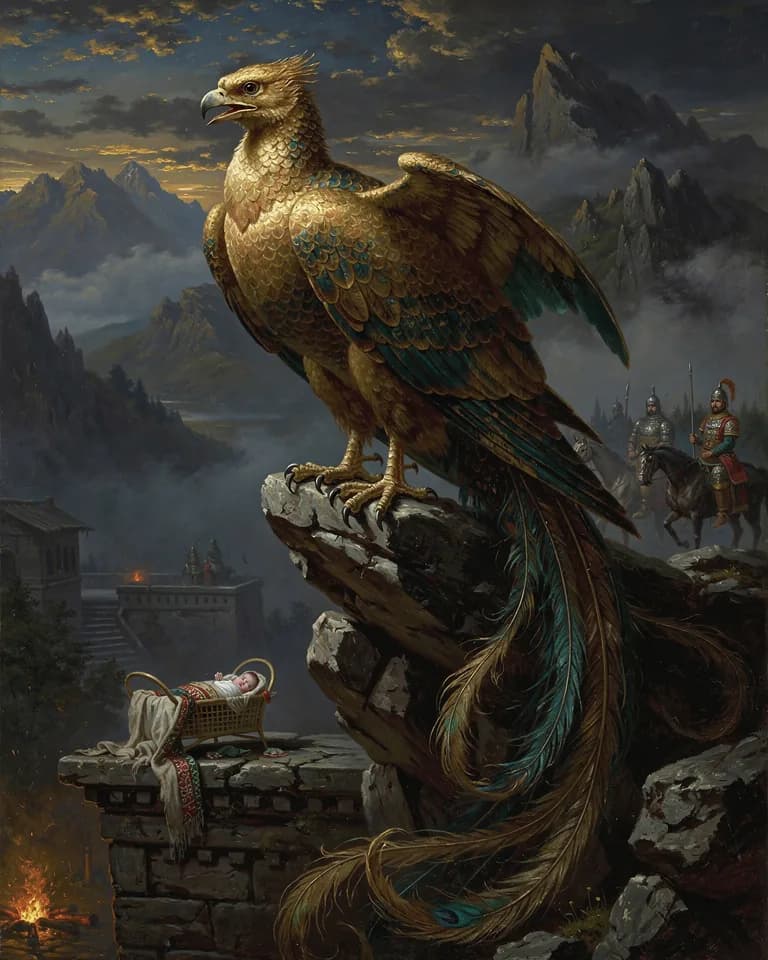
The great wise bird of Persian tradition, who in the Shahnameh raises the abandoned Zal on Mount Alborz, guides the birth of Rostam, and heals him in his combat with Esfandiyar; descended from the Avestan bird Saena.
About Simurgh
From Saena to Simurgh
The name Simurgh (Middle Persian Senmurw) comes from the Avestan saena meregha, 'the bird Saena', a great bird mentioned in the Yashts. Middle Persian texts make the Senmurw a being of cosmic scale nesting in the tree of all seeds that stands in the middle of the sea Vouru-Kasha; when it rises from the tree, seeds are scattered to be carried by the rains over the world.
In the Shahnameh
Ferdowsi's Simurgh is the protector of Zal and his family. She finds the white-haired infant abandoned on Mount Alborz and raises him with her chicks, and when his father comes to reclaim him she gives Zal a feather to burn in need. Later she guides the difficult birth of Rostam by instructing a surgical delivery, and she heals Rostam and his horse Rakhsh after their near-fatal combat with Esfandiyar, revealing to Rostam how the invulnerable prince can be killed. The Shahnameh also knows a hostile Simurgh, killed by Esfandiyar in his seven trials, which suggests more than one tradition behind the figure.
A symbol of the divine
In Attar's twelfth-century Sufi allegory The Conference of the Birds, the birds of the world set out to find the Simurgh as their king; only thirty (si murgh, 'thirty birds') arrive, and they discover that the Simurgh they sought is themselves, a famous play on the name. The Simurgh appears widely in Persian painting and textiles.
Sources and further reading
Source notes
These references are recorded in the catalog. Their passage wording and translation have not been checked, so quotations are not displayed here.
- Ferdowsi, Shahnameh, reign of Manuchehr (paraphrase)
About this entry
By Elizabeth Stein for Mythos Atlas. About the author. Editorial notes are grounded in the site's cited sources and can be challenged through the contact page.
The danger rating is an editorial shorthand for how the myths portray the creature, not a claim made by the sources.