Norse PantheonCreature
Kraken
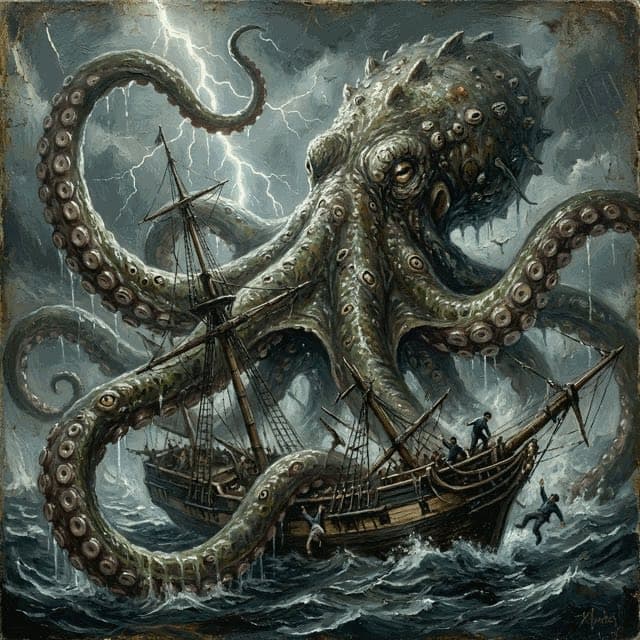
- Ship Destruction
- Whirlpool Creation
- Massive Tentacles
A colossal sea monster capable of dragging entire ships to the ocean depths. Its body is so vast it was often mistaken for an island by unwary sailors.
About Kraken
A Modern Sea-Horror
The kraken is not in the Poetic Edda. Bishop Pontoppidan's 1752 Natural History of Norway popularized a mile-wide cephalopod that fishermen took for an island. Older Norse hafgufa and lyngbakr in the King's Mirror are cousins, not the same name.
Cataloging it under the Norse pantheon follows later popular memory. The honest source is early-modern natural history grafted onto northern seas.
Sea-monsters before the kraken
The Old Norwegian King's Mirror (Konungs skuggsjá, c. 1250) describes the hafgufa, a sea creature so large that sailors might take it for an island, which feeds by belching out food to lure fish into its mouth. Pontoppidan's kraken popularised the idea for a European audience, and naturalists later suggested that sightings of giant squid, first confirmed scientifically in the 19th century, lay behind the stories.
Quick answers about Kraken
- What is Kraken?
- A colossal sea monster capable of dragging entire ships to the ocean depths. Its body is so vast it was often mistaken for an island by unwary sailors.
- Where does Kraken live?
- The atlas lists Kraken's habitat as The Northern Seas.
- What abilities does Kraken have?
- The atlas lists these abilities for Kraken: Ship Destruction, Whirlpool Creation, and Massive Tentacles.
Sources and further reading
Source notes
These references are recorded in the catalog. Their passage wording and translation have not been checked, so quotations are not displayed here.
- Erik Pontoppidan, Natural History of Norway
About this entry
By Elizabeth Stein for Mythos Atlas. About the author. Editorial notes are grounded in the site's cited sources and can be challenged through the contact page.
The danger rating is an editorial shorthand for how the myths portray the creature, not a claim made by the sources.
Keep exploring
One myth a week, with its sources in a short email. The sign-up form is just below.