Norse PantheonCreature
Nidhogg
- Corpse Consumption
- Root Gnawing
- Decay Aura
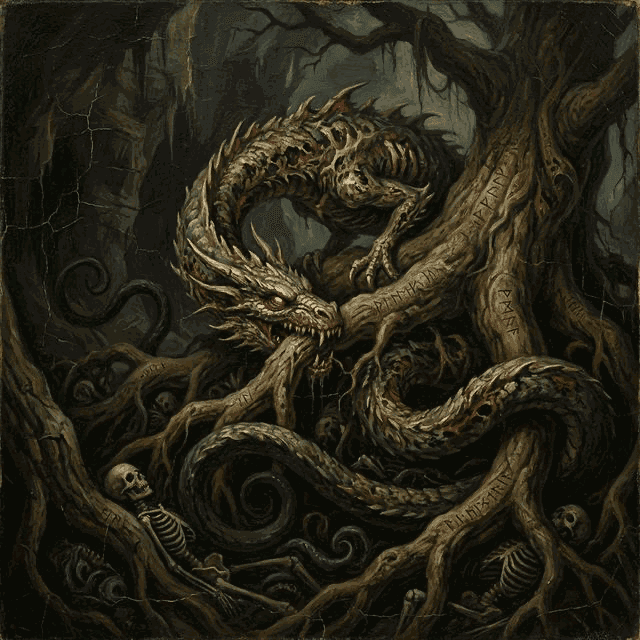
A dragon that gnaws at the roots of Yggdrasil, the World Tree. It feeds on the corpses of the dishonorable dead and represents destruction and decay in the cosmic order.
About Nidhogg
Gnawer at the Root
Nidhogg is the dragon under Yggdrasil who chews the tree's root and, in Voluspa, flies up from Nidafjoll bearing corpses at the end of the world. Snorri parks him at Nastrond among oath-breakers. He is decay with a name, not a hoard-dragon of the Sigurd type.
The squirrel Ratatoskr carries insults between Nidhogg and the eagle above — a postal service of spite.
Under the tree
The Eddic poem Grímnismál lists Níðhöggr among the serpents gnawing Yggdrasil's roots and names Ratatoskr as the squirrel who runs up and down the trunk carrying the words of the eagle above to the dragon below. In the last stanza of Völuspá the seeress sees the dark dragon flying up, bearing corpses in its feathers, even as the new world rises; readers still debate whether its appearance marks a lingering threat or the dragon's own end.
Quick answers about Nidhogg
- What is Nidhogg?
- A dragon that gnaws at the roots of Yggdrasil, the World Tree. It feeds on the corpses of the dishonorable dead and represents destruction and decay in the cosmic order.
- Where does Nidhogg live?
- The atlas lists Nidhogg's habitat as Nastrond (beneath Yggdrasil).
- What abilities does Nidhogg have?
- The atlas lists these abilities for Nidhogg: Corpse Consumption, Root Gnawing, and Decay Aura.
Sources and further reading
Source notes
These references are recorded in the catalog. Their passage wording and translation have not been checked, so quotations are not displayed here.
- Poetic Edda, Voluspa
About this entry
By Elizabeth Stein for Mythos Atlas. About the author. Editorial notes are grounded in the site's cited sources and can be challenged through the contact page.
The danger rating is an editorial shorthand for how the myths portray the creature, not a claim made by the sources.
Keep exploring
One myth a week, with its sources in a short email. The sign-up form is just below.