Norse PantheonCreature
Sleipnir
- Realm Travel
- Supernatural Speed
- Flight
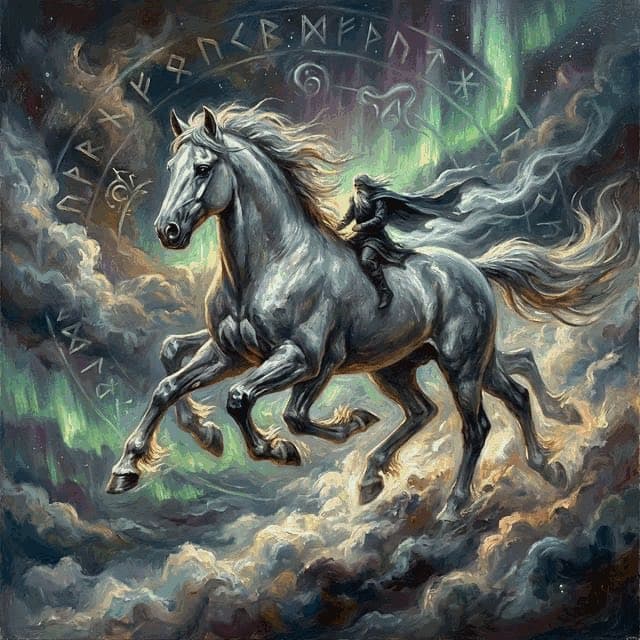
The eight-legged horse of Odin, born from Loki in mare form and the stallion Svadilfari. The fastest horse in existence, capable of traveling between the nine realms.
About Sleipnir
Eight Legs to Hel
Sleipnir is Odin's grey, the best of horses, born when Loki as a mare lured the stallion Svadilfari away from the mason who nearly won the sun and Freyja. Hermod rides him to Hel after Baldr's death. The eight legs are in the poems; they are not a later cartoon.
Danger is low because he is a mount, not a hunter — speed between worlds, not a bite.
The builder's wager
Snorri tells the story in Gylfaginning: a giant builder offers to wall Asgard in one winter in return for Freyja, the sun, and the moon, and nearly succeeds with the help of his stallion Svaðilfari. Loki, who advised the bargain, lures the stallion away in the shape of a mare and later gives birth to Sleipnir. Gotland picture stones, such as Tjängvide I, show an eight-legged horse with a rider, usually read as Odin.
Quick answers about Sleipnir
- What is Sleipnir?
- The eight-legged horse of Odin, born from Loki in mare form and the stallion Svadilfari. The fastest horse in existence, capable of traveling between the nine realms.
- Where does Sleipnir live?
- The atlas lists Sleipnir's habitat as Asgard.
- What abilities does Sleipnir have?
- The atlas lists these abilities for Sleipnir: Realm Travel, Supernatural Speed, and Flight.
Sources and further reading
Source notes
These references are recorded in the catalog. Their passage wording and translation have not been checked, so quotations are not displayed here.
- Prose Edda, Gylfaginning (trans. Anderson)
About this entry
By Elizabeth Stein for Mythos Atlas. About the author. Editorial notes are grounded in the site's cited sources and can be challenged through the contact page.
The danger rating is an editorial shorthand for how the myths portray the creature, not a claim made by the sources.
Keep exploring
One myth a week, with its sources in a short email. The sign-up form is just below.