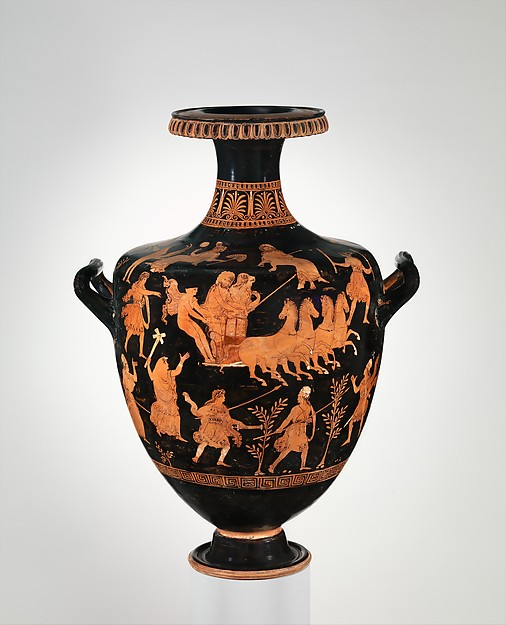
Terracotta hydria (water jar), The Metropolitan Museum of Art
Greek pantheon
Hecate
Ἑκάτη(Hekate)
Also known as: Hekate
crossroads
boundaries
night
magic (later tradition)
the moon (later tradition)
A Titan-descended goddess uniquely honored by Hesiod with power over earth, sea, and sky. In later Classical and Hellenistic tradition, Hecate's role narrowed and darkened into a chthonic goddess of crossroads, ghosts, and magic — a significantly different figure from Hesiod's expansive, benevolent Hecate.
In the Theogony, Hesiod devotes one of his longest passages to any single deity to praising Hecate, daughter of the Titans Perses and Asteria. He describes her as uniquely honored by Zeus above all other gods, retaining a share of power on earth, in the sea, and in the starry sky. Hesiod's Hecate grants prosperity to whom she favors: victory to warriors and athletes, luck to fishermen and herdsmen, and nurture to children. This portrait is overwhelmingly positive and has no association with magic, witchcraft, or the underworld.
A Companion in the Persephone Myth
The Homeric Hymn to Demeter gives Hecate a different but still sympathetic role: she alone (besides Helios) hears Persephone's cries when Hades abducts her, and after Persephone's return from the underworld, Hecate embraces her and becomes her attendant, going before and behind her from that day on.
The Later Chthonic Goddess
From the Classical period onward, and especially in Hellenistic and Roman-era sources, Hecate's character shifts markedly. She becomes associated with crossroads shrines (where offerings called deipna were left for her at the new moon), with ghosts and the restless dead, with dogs that howled at her approach, and with sorcery — most famously as the patron goddess invoked by Medea in Euripides's tragedy and in the later magical papyri. Hellenistic and Roman art frequently depicts her in triple form (Hecate triformis), facing three directions at a crossroads shrine, an image that postdates Hesiod by centuries.
Not to Be Read Backward
Hecate's later reputation as a witchcraft goddess, and especially her adoption as a patron figure in modern Wiccan and neopagan practice, are post-antique developments. They should not be projected back onto her earliest and most authoritative textual portrait in Hesiod, where she is a broadly honored, largely benevolent power.
Origin Story
Hecate was the daughter of the Titans Perses and Asteria. Hesiod records that Zeus honored her uniquely among the descendants of the Titans, allowing her alone to keep a share of power over earth, sea, and sky, a mark of extraordinary favor not extended to other Titan-descended deities after the Titanomachy.
Both are goddesses whose later cult centers on the underworld, night, and the uncanny, though this is a later development for Hecate rather than her original character
Ancient Sources
Original texts with translations - toggle to see the original language
Hecate, whom Zeus the son of Cronos honored above all... and gave her, as her portion, a share of the earth and of the barren sea.
Verification pending
Hesiod, Theogony, 411-413 (approximate)
trans. Hugh G. Evelyn-WhiteH. G. Evelyn-White, 1914; line range approximate, not independently re-checkedRead source
Ancient Texts
Theogony by Hesiod
c. 700 BCE·Ancient Greek
Hesiod's extended, largely positive praise of Hecate
Recommended translations:Hugh G. Evelyn-White (1914), Richmond Lattimore (1959)
The Oxford Dictionary of World Mythology by Arthur Cotterell
1986·English
Survey covering the shift from Hesiod's Hecate to the later chthonic goddess of magic
References & further reading
Editorial notes for deeper study (not a full bibliography).
Johnston, Sarah Iles. *Hekate Soteira: A Study of Hekate's Roles in the Chaldean Oracles and Related Literature* (Scholars Press, 1990) — traces the development of Hecate's later, darker role.
Burkert, Walter. *Greek Religion* (Harvard University Press, 1985) — on crossroads cult and the offerings called deipna.
Browse representative texts and policies on the Sources page.
Worship & Cult
How Hecate was venerated in ancient times
Sacred Temples
•Small crossroads shrines rather than major temples
•Sanctuary at Lagina in Caria, a significant later cult center
Festivals & Celebrations
Deipna (monthly offerings left at crossroads on the new moon)
Worship Practices
Later cult centered on crossroads shrines, where households left the deipna — food offerings such as eggs, fish, and garlic — for her and the restless dead at the dark of the moon. This crossroads and underworld-facing cult developed well after Hesiod's positive portrait and should be read as a distinct, later layer of her worship.
Domains
crossroads
boundaries
night
magic (later tradition)
the moon (later tradition)
Symbols
torches
keys
crossroads
dogs
triple form (later art)
In the museums
Hecate in art
Real objects in public collections, released into the public domain by the museums that hold them. Dates refer to when each object was made. Objects made within the tradition come first, later depictions after.
Greek, South Italian, Apulian · ca. 340–330 BCE · Terracotta
A South Italian water jar whose painted frieze the museum tags as showing Hecate alongside Zeus, Athena, Aphrodite, and Eros. It documents her place among the Olympian company in fourth-century Apulian vase painting.