Inca and Andean Tradition
Illapa
Illapa
Also known as Chuquilla, Catuilla
- thunder
- lightning
- rain
- hail
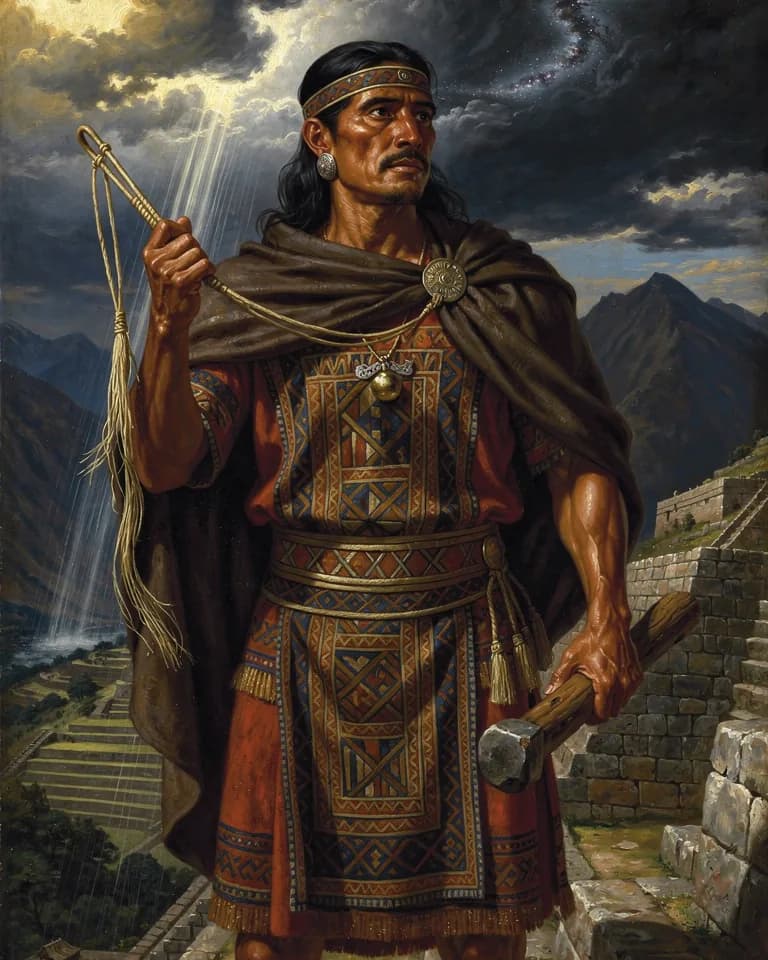
The Thunder of the Inca state cult, imagined as a man in the sky with a sling and club who draws rain from the heavenly river; after the conquest he was widely identified with Saint James (Santiago).
About Illapa
The Thunder in Cusco
Illapa was one of the principal powers of the Cusco state cult, with his own chamber in the Coricancha according to Garcilaso and his own image, lands, and servants according to Molina and Cobo. Bernabé Cobo (1653), summarizing earlier reports, says the Andeans imagined him as a man in the sky with a club in one hand and a sling in the other: the crack of the sling was the thunder, the flash of his clothing the lightning, and he drew water from the river of the sky, the Milky Way, and poured it down as rain.
Rain, hail, and the mountains
Because he controlled rain and hail, Illapa was petitioned in times of drought, often on mountaintops. Colonial extirpators report that people struck by lightning and survived were thought chosen for ritual office, and that twins, and children born feet-first, were considered children of the lightning.
Santiago
The Spanish battle cry to Saint James and the saint's thundering horse made an easy identification: in colonial and modern Andean usage Santiago became a name for the thunder itself. This fusion is a post-conquest development, well documented in the extirpation literature, and not evidence about pre-conquest belief.
Origin story
No birth narrative survives; the Thunder appears in the chronicles as one of the great powers of the sky, ranked after the Creator and the Sun.
Across traditions
Parallel figures
Figures who play a role like Illapa's in other traditions.
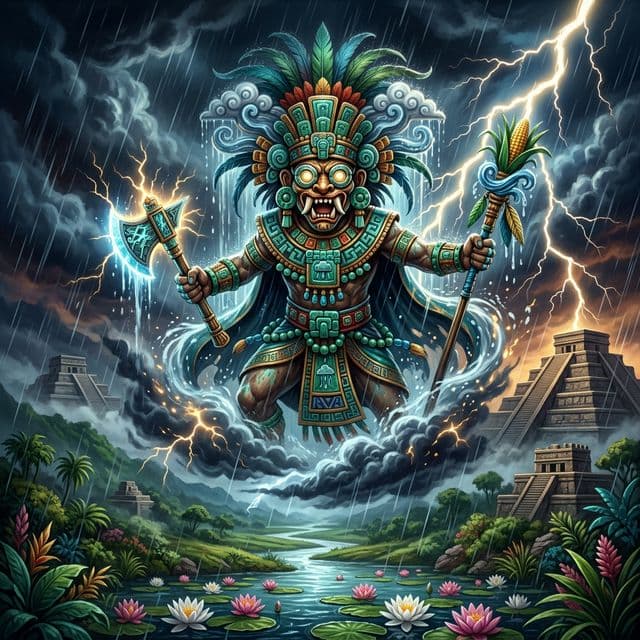 MesoamericanTlaloc
Both are storm and rain gods of American states, petitioned on mountains in time of drought; Illapa wields a sling, Tlaloc the lightning serpent. The resemblance is typological, not historical.
Compare Illapa and Tlaloc side by side
Worship and cult
Temples, festivals, and practices recorded for Illapa
Prayers and offerings for rain and against hail, often made on mountaintops; people who survived lightning strikes were thought chosen for ritual office, and twins were regarded as children of the lightning, according to seventeenth-century extirpation reports.
Sacred sites
- A chamber of the Coricancha in Cusco dedicated to thunder and lightning, according to Garcilaso.
In the atlas
Where Illapa appears
Artifacts
Sources and further reading
Source notes
These references are recorded in the catalog. Their passage wording and translation have not been checked, so quotations are not displayed here.
- Bernabé Cobo, Historia del Nuevo Mundo, Book 13 (paraphrase)
- Garcilaso de la Vega, Comentarios Reales, Part I, Book 3 (paraphrase)
About this entry
By Elizabeth Stein for Mythos Atlas. About the author. Editorial notes are grounded in the site's cited sources and can be challenged through the contact page.
Parallels are editorial comparisons across traditions: a shared role does not, by itself, establish a shared origin.