Greek Pantheon
Melinoë
Μηλινόη(Mēlinóē)
Also known as Melinoe
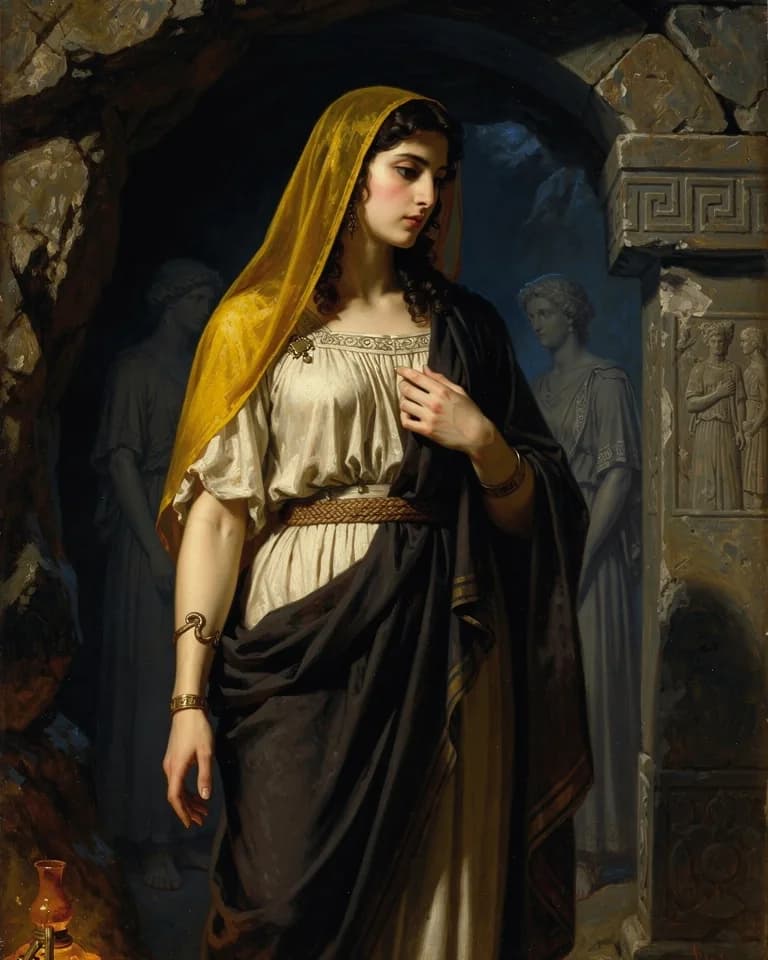
- ghosts
- night terrors
A chthonic goddess known from a single ancient text, Orphic Hymn 71: a saffron-veiled daughter of Persephone, fathered by Zeus in the guise of Plouton, who sends apparitions and night terrors to mortals. Almost nothing else is recorded of her.
About Melinoë
One Hymn
Melinoë is known from one ancient poem, the seventy-first of the Orphic Hymns, a collection of cult hymns usually dated to the Roman imperial period. The hymn calls her saffron-veiled and of the earth, born beside the mouth of the river Cocytus to Persephone, who lay with Zeus while he took the form of Plouton. It asks her to turn away the frenzy she sends: she drives mortals mad with airy phantoms, appearing to them in strange shapes in the darkness of night.
What Is Not Known
No myth about Melinoë survives, and she has no attested temple or festival. The hymn's language of night, ghosts and the underworld overlaps with the way Hecate is addressed, and some scholars have read the name as a title belonging to Hecate's circle rather than a separate goddess. Any fuller portrait, including her modern prominence, is later invention built on this one text.
Origin story
Orphic Hymn 71 makes Melinoë the daughter of Persephone, born by the river Cocytus after Zeus lay with Persephone in the guise of Plouton.
Family
Melinoë's family at a glance
- Who are Melinoë's parents?
- The atlas's kinship records name 2 parents of Melinoë: Persephone and Zeus. Ancient accounts do not always agree on divine parentage.
Sources and further reading
Source notes
These references are recorded in the catalog. Their passage wording and translation have not been checked, so quotations are not displayed here.
- Orphic Hymn 71 (Athanassakis numbering; 70 in Taylor), To Melinoë (paraphrase)
Appears in
Ancient and classical works featuring this figure.
sole ancient account of the goddess (Hymn 71)
About this entry
By Elizabeth Stein for Mythos Atlas. About the author. Editorial notes are grounded in the site's cited sources and can be challenged through the contact page.
Parallels are editorial comparisons across traditions: a shared role does not, by itself, establish a shared origin.
Family relationships come from the atlas's kinship records. Ancient sources often disagree on divine genealogy.
Genealogy
Family tree
Melinoë's parents, consorts, children and rivals, as recorded in the atlas.