Finnish Tradition (Kalevala)Region
Vuokkiniemi (Voknavolok)
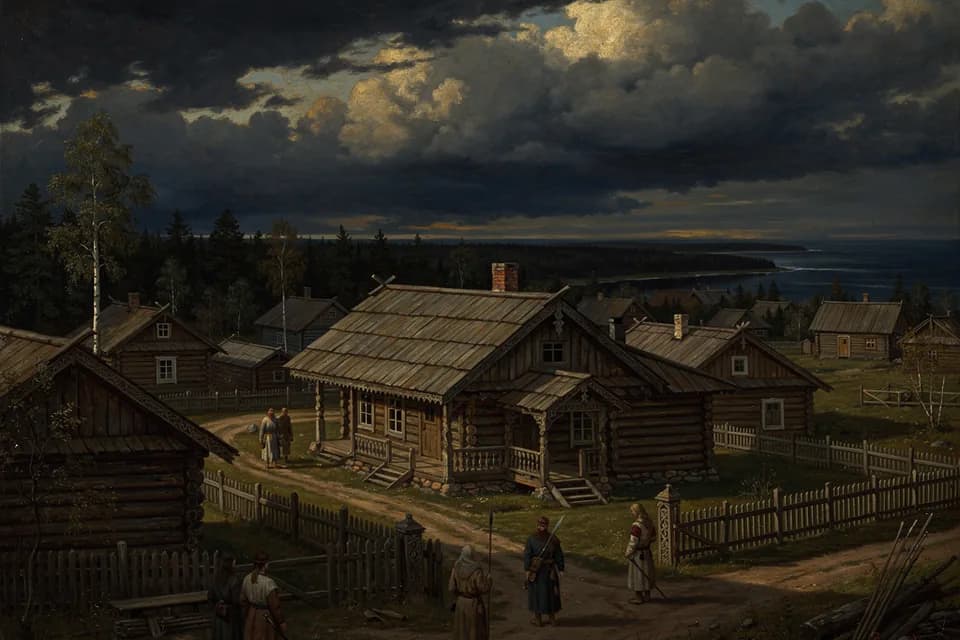
The village and parish in Viena (White Sea) Karelia, now in the Russian Republic of Karelia, whose runo-singers, above all Arhippa Perttunen of nearby Latvajärvi, sang thousands of lines to Elias Lönnrot in 1834.
About Vuokkiniemi (Voknavolok)
A singing parish
Vuokkiniemi (Russian Voknavolok) lies on a lake in Viena Karelia, near the present border with Finland. In the nineteenth century it and its surrounding villages were among the richest sources of Kalevala-metre epic poetry anywhere. The tradition survived there longer than in Finland itself, among Orthodox Karelian families in which singing passed from generation to generation.
Arhippa Perttunen
On his fifth collecting journey, in 1834, Elias Lönnrot visited the elderly singer Arhippa Perttunen at Latvajärvi in the Vuokkiniemi area. Over several days Perttunen sang him several thousand lines of epic poetry, including songs of Väinämöinen, the Sampo, and Lemminkäinen, and the material shaped the first Kalevala of 1835. Perttunen's son Miihkali Perttunen was later also recorded as a singer.
Today
Vuokkiniemi is a small village in the Kalevala district of the Republic of Karelia, and the region's runo-singing villages are remembered as the cradle of the Kalevala.
On the map
Vuokkiniemi (Voknavolok) among other places of the Finnish Tradition (Kalevala).
Sources and further reading
Source notes
These references are recorded in the catalog. Their passage wording and translation have not been checked, so quotations are not displayed here.
- Elias Lönnrot's travel notes of 1834, as summarized in Suomen Kansan Vanhat Runot (paraphrase)
About this entry
By Elizabeth Stein for Mythos Atlas. About the author. Editorial notes are grounded in the site's cited sources and can be challenged through the contact page.
Coordinates mark where the myths place a site, or where the tradition locates it today. Mythic realms are left off the map or marked as symbolic placements.