Mythos Atlas

Side by sideParallel across traditions

Anahita vs Aphrodite

Anahita
AnahitaPersian (Iranian)
Aphrodite
AphroditeGreek

Berossus, as quoted by Clement of Alexandria, calls the image Artaxerxes II set up 'Aphrodite Anaitis'; Greek writers also identified her with Artemis. The equations reflect Greek interpretation.

At a glance

Anahita and Aphrodite compared
AnahitaAphrodite
TraditionPersian (Iranian) TraditionGreek Pantheon
Domainsthe waters, fertility and birth, purity, victorylove, beauty, desire, sexuality
Symbolsthe heavenly river, a golden mantle, a crown of stars, beaver-skin robesdove, swan, rose, myrtle, sparrow
Also calledArdvi Sura Anahita, Anahid, Nahid, AnaitisVenus, Kypris

Where they meet

The atlas records no domain or symbol that Anahita and Aphrodite share.

They are compared for the part each plays in their own tradition rather than for any attribute in common.

Where they part

Only Anahita

Associated with the waters, fertility and birth, purity, and victory.

Only Aphrodite

Associated with love, beauty, desire, and sexuality.

How each was worshipped

Anahita

Cult sites
A fire temple of Anahid at Istakhr in Persis, whose custodian Sasan was remembered as the ancestor of the Sasanian kings (al-Tabari).; Images of Anahita set up by Artaxerxes II in Babylon, Susa, Ecbatana, Persepolis, Bactra, Damascus, and Sardis, according to Berossus as quoted by Clement of Alexandria.
Festivals
Abangan, the feast of the waters on the day Aban of the month Aban in the Zoroastrian calendar.

Libations and prayers at rivers and springs; invoked for fertility, safe childbirth, and the purity of water.

Aphrodite

Cult sites
Sanctuaries at Paphos and Amathus on Cyprus; Temple of Aphrodite on Acrocorinth; Aphrodite Pandemos at Athens
Festivals
Aphrodisia; Adonia

Cyprus is her oldest ground. Corinth mixed sailors, courtesans, and a high temple. Athens split Ourania from Pandemos: heavenly and of the whole people. Roses, doves, and the sea-foam story sit on top of a civic sex-and-luck cult.

The two figures

Persian (Iranian) Tradition

Anahita

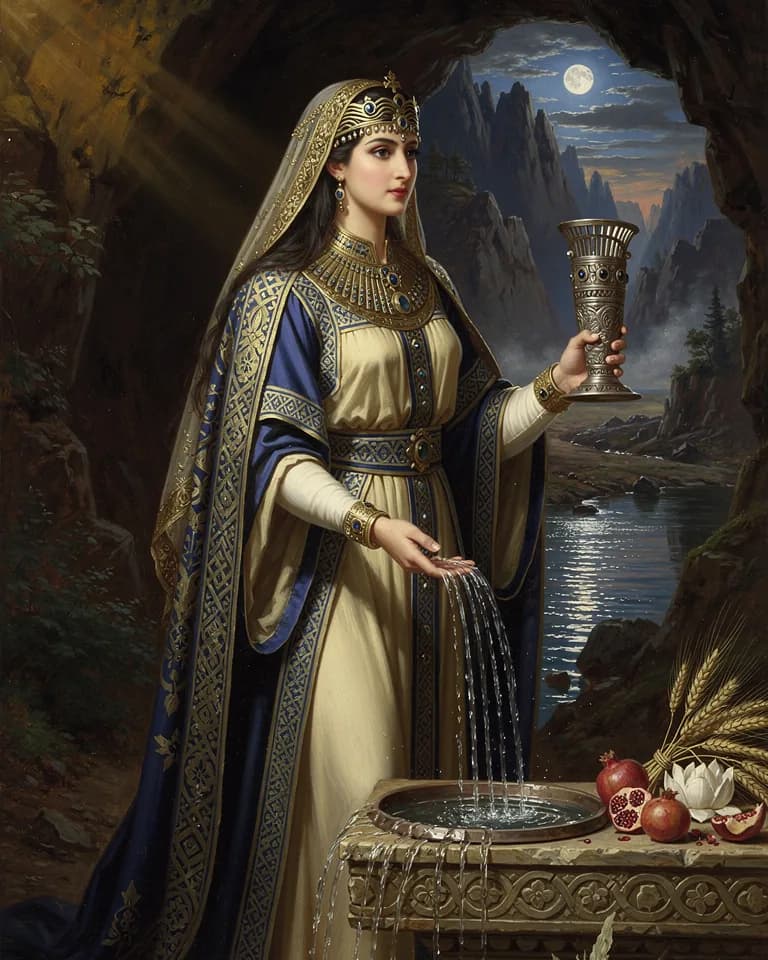
The yazata of the waters, the heavenly river that flows from Mount Hukairya into the sea Vouru-Kasha and feeds every stream on earth, invoked for fertility, safe childbirth, and victory, and honored by Achaemenid and Sasanian kings.

She 'proceeded forth from the Maker Mazda' (Yasht 5.7), who brought her waters down to the earth.

Yasht 5 is Anahita's hymn. Ahura Mazda commands sacrifice to 'this spring of mine', a river as large as all the waters on earth that runs from the height Hukairya down to the sea Vouru-Kasha, and from which all the waters of the seven regions of the world flow. She purifies the seed of males and the wombs of females and brings safe birth and milk. The hymn then catalogs heroes and villains who sacrificed to her, granting the prayers of the righteous and refusing the wicked, and it ends with a vivid description of her as a tall, strong maiden in a golden mantle, with golden earrings, a crown of stars, and robes of beaver skins.

Read the full Anahita entry

Greek Pantheon

Aphrodite

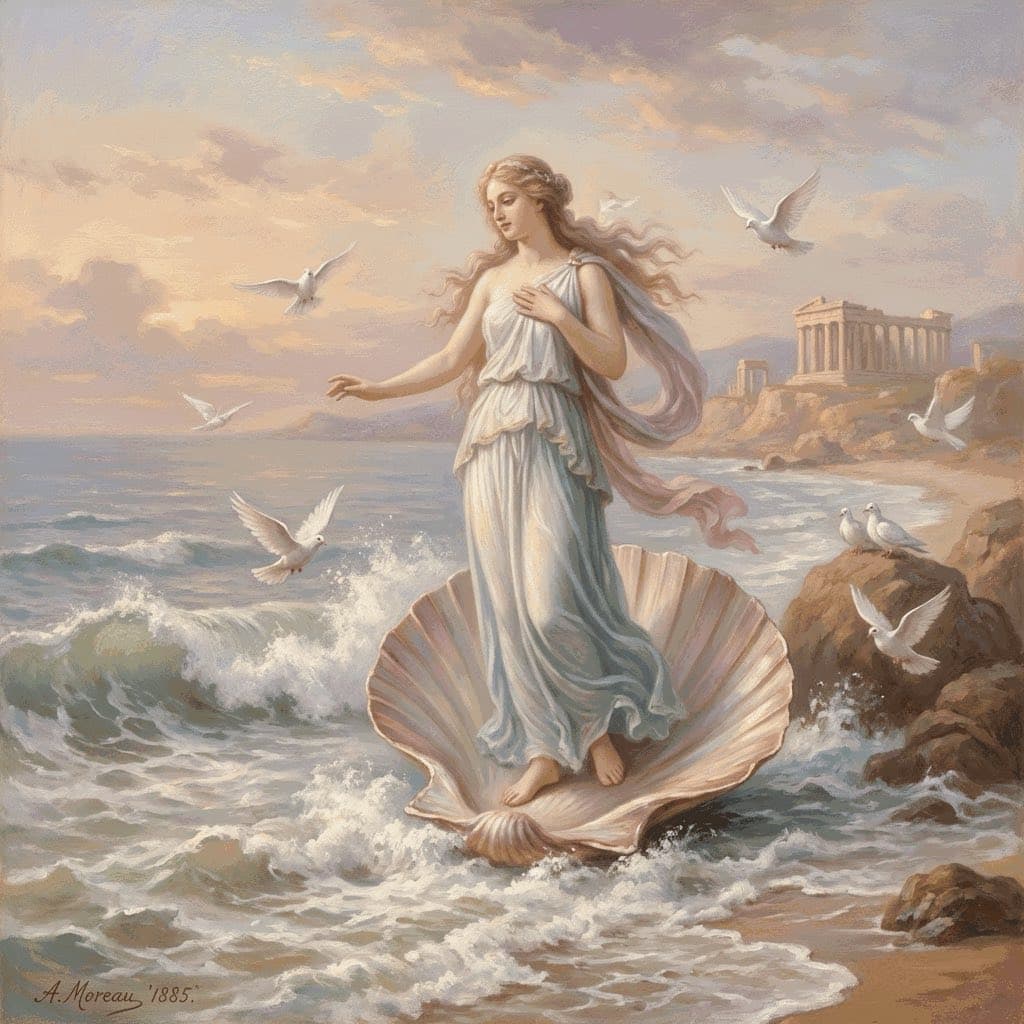
Goddess of love, beauty, and desire. Born from the sea foam after Cronus castrated Uranus and threw his genitals into the sea.

Aphrodite is the irresistible goddess of love and beauty. Though married to Hephaestus, she had many lovers, most notably Ares. She has the power to make anyone fall in love, a power that even Zeus cannot resist.

Read the full Aphrodite entry
About this comparison

Comparisons pair figures that play a similar role across traditions, or that the myths connect within one. A shared role does not, by itself, establish a shared origin.