Canaanite Pantheon (Ugarit)Creature
Litan (Lotan)
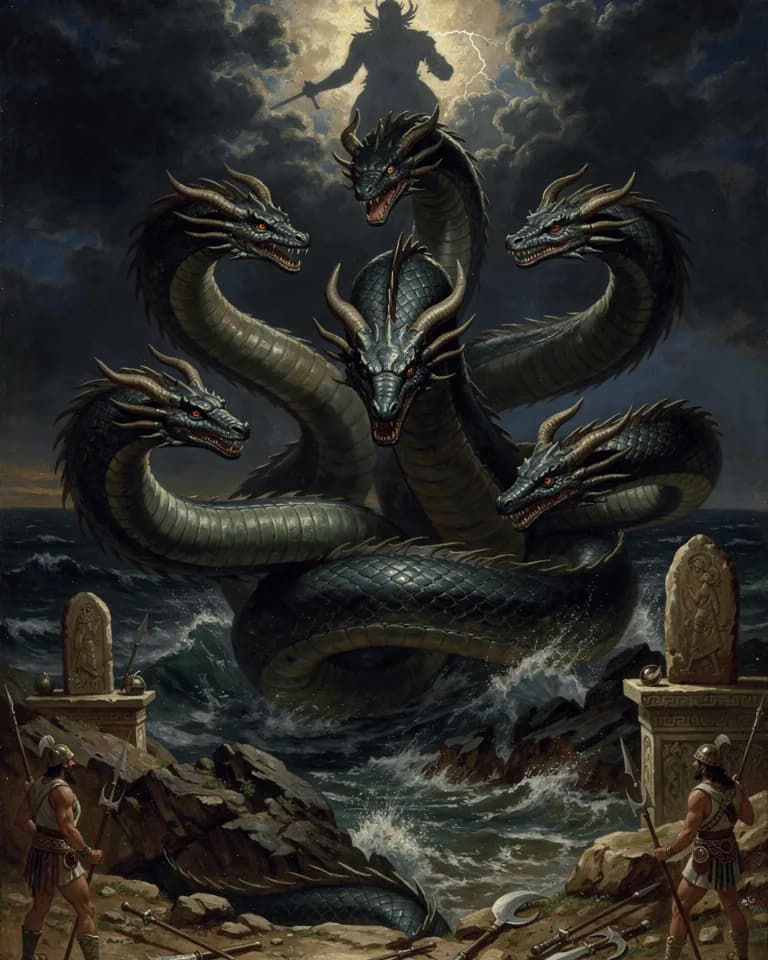
- seven heads
- coiling, twisting motion
- embodies the chaos of the sea
The seven-headed 'fleeing serpent, twisting serpent' whom Baal struck down, recalled by Mot in the Baal Cycle; its Ugaritic epithets reappear almost word for word in the Hebrew Bible's description of Leviathan.
About Litan (Lotan)
The twisting serpent
Litan (ltn, often vocalised Lotan) appears in Mot's message to Baal at the start of KTU 1.5: because Baal struck down Litan, the fleeing serpent, destroyed the twisting serpent, the tyrant with seven heads, the heavens will wither and Baal must come down into Death's throat (paraphrase). The victory over Litan is recalled rather than narrated; no surviving Ugaritic text describes the fight itself.
Anat's claim
In KTU 1.3 III Anat boasts of destroying a series of monsters: Yam, the dragon Tunnan, the twisting serpent, the seven-headed tyrant. The overlap in wording suggests that the Ugaritic poets had a fixed set of epithets for this creature and could assign its defeat to Baal or Anat.
Leviathan
Isaiah 27:1 promises that God will punish "Leviathan the fleeing serpent, Leviathan the twisting serpent", and Psalm 74:14 speaks of crushing the heads of Leviathan. The Hebrew name liwyātān corresponds to Ugaritic ltn, and the epithets match. The biblical passages show that the imagery of the storm-god's battle with a sea serpent remained alive in Levantine poetry for many centuries.
Sources and further reading
Source notes
These references are recorded in the catalog. Their passage wording and translation have not been checked, so quotations are not displayed here.
- Baal Cycle, KTU 1.5 I
About this entry
By Elizabeth Stein for Mythos Atlas. About the author. Editorial notes are grounded in the site's cited sources and can be challenged through the contact page.
The danger rating is an editorial shorthand for how the myths portray the creature, not a claim made by the sources.