Korean TraditionCreature
Sea Dragon of King Munmu
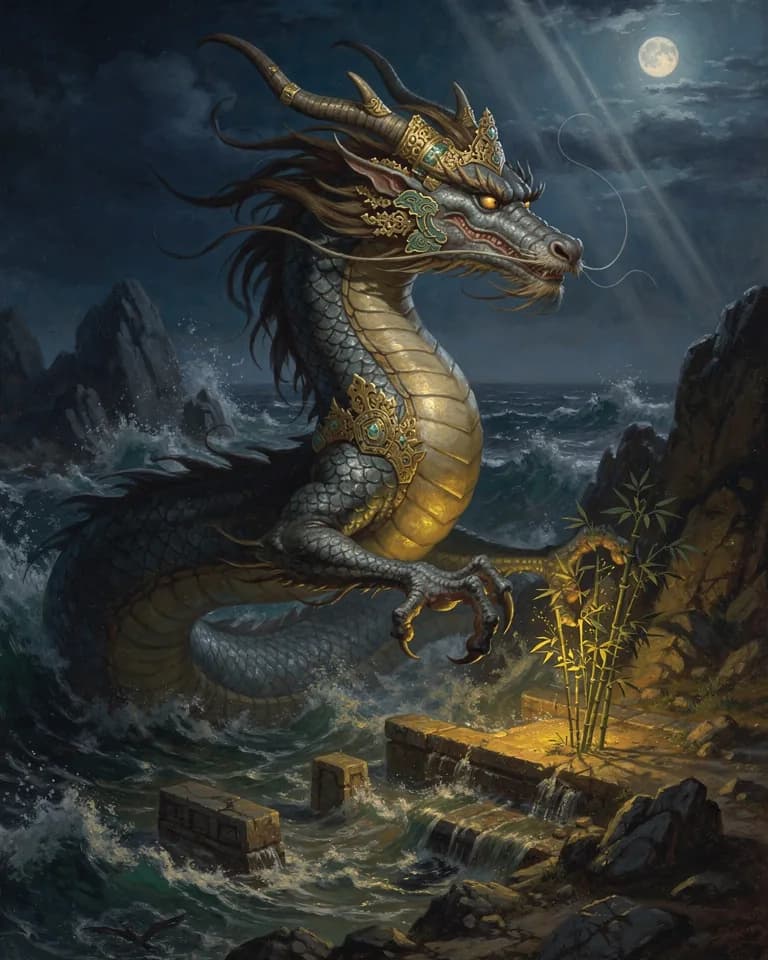
- guarding the kingdom from invaders
- raising storms and darkness
- bestowing sacred treasures
The great dragon of the East Sea that King Munmu of Silla vowed to become after death to protect his kingdom, and who gave his son the bamboo for the flute Manpasikjeok.
About Sea Dragon of King Munmu
A king's vow
The Samguk Yusa reports that King Munmu of Silla (r. 661-681), who completed Silla's unification of most of the Korean peninsula, told the monk Jiui that he wished after death to become a great dragon, to guard the state and honor the Buddhist law, and asked to be buried in the East Sea. The Samguk Sagi records his last instruction to be cremated and his remains placed in the sea.
The dragon's treasure
In 682, the Samguk Yusa says, a floating mountain brought a bamboo to Gameunsa, the temple his son King Sinmun had completed for him, and a dragon appeared to Sinmun with a belt of black jade, explaining that the late king had become a great dragon of the sea and the general Kim Yu-sin a god of heaven, and that they sent the bamboo for a flute to keep the world at peace.
Dragons in Korea
Korean dragons (yong) are generally benevolent powers of water and rain, living in underwater palaces and associated with kingship. Munmu's story made the East Sea dragon a guardian of the nation, and Daewangam, the rock traditionally identified as his tomb, remains a site of pilgrimage and shamanic rites.
Sources and further reading
Source notes
These references are recorded in the catalog. Their passage wording and translation have not been checked, so quotations are not displayed here.
- Iryeon, Samguk Yusa, Book 2, 'King Munmu' (paraphrase)
About this entry
By Elizabeth Stein for Mythos Atlas. About the author. Editorial notes are grounded in the site's cited sources and can be challenged through the contact page.
The danger rating is an editorial shorthand for how the myths portray the creature, not a claim made by the sources.