Korean TraditionCreature
Samjok-o
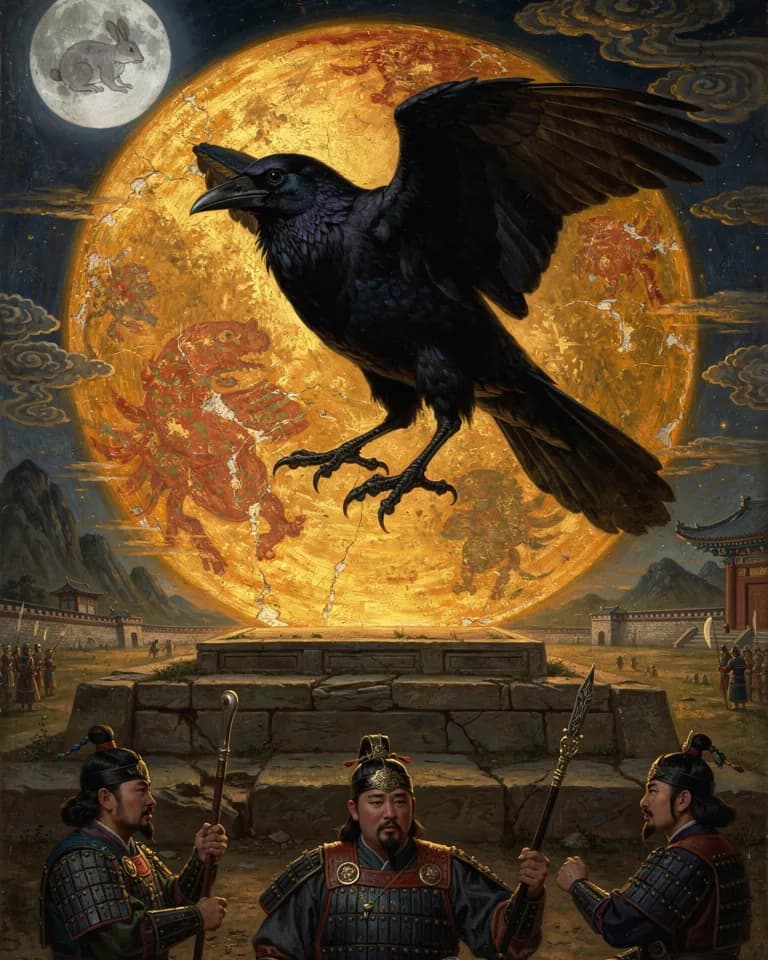
- dwelling in the sun
- symbolizing heavenly and royal power
The three-legged crow that lives in the sun, painted in a solar disk on the walls of Goguryeo tombs, usually paired with a toad or hare in the moon.
About Samjok-o
In Goguryeo tomb murals
The three-legged crow (samjok-o) appears inside a golden sun disk in the painted tombs of Goguryeo (fourth to seventh centuries CE), near Ji'an in China and Pyongyang in North Korea, among them the Ohoebun tombs at Ji'an. It is often painted opposite a moon disk containing a toad or a hare, the pair representing sun and moon, day and night, in the ceiling paintings that turned the tomb into a model of the heavens.
A shared East Asian emblem
The three-legged crow in the sun is known in Chinese art and texts from the Han dynasty onward, and in Japan as the Yatagarasu; in Korea it became particularly associated with Goguryeo and with the heavenly descent of its kings, who claimed the sun and heaven as ancestors. Haemosu, Goguryeo's heavenly founder-father, wears a crown of crow feathers in Yi Gyu-bo's poem.
Modern use
The samjok-o has been proposed and used as a national emblem in modern Korea, and it appears in Korean popular culture as a symbol of Goguryeo's power.
Sources and further reading
Source notes
These references are recorded in the catalog. Their passage wording and translation have not been checked, so quotations are not displayed here.
- Goguryeo tomb murals, Ji'an and Pyongyang regions (description of the paintings)
About this entry
By Elizabeth Stein for Mythos Atlas. About the author. Editorial notes are grounded in the site's cited sources and can be challenged through the contact page.
The danger rating is an editorial shorthand for how the myths portray the creature, not a claim made by the sources.