Egyptian PantheonCreature
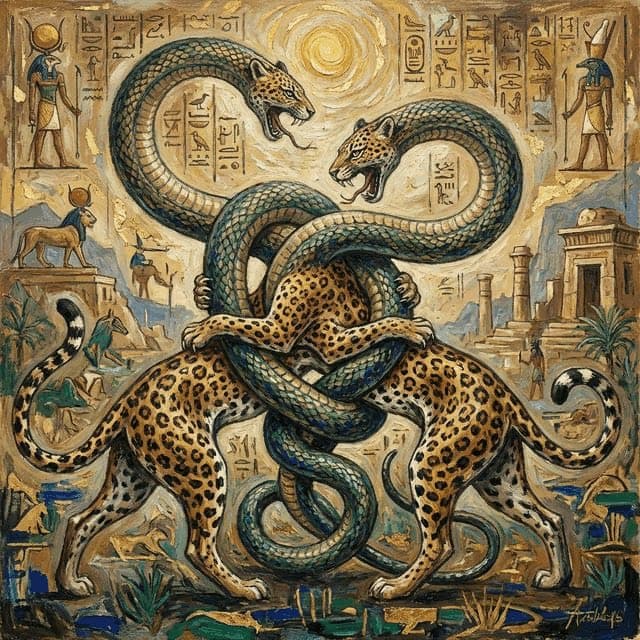
Serpopard
- Serpentine Flexibility
- Predatory Stealth
- Chaos Embodiment
A mythical creature with the body of a leopard and an impossibly long serpentine neck. Depicted on the Narmer Palette, it represents the chaotic forces tamed by the pharaoh.
About Serpopard
Long Necks on the Palette
The serpopard is an art-historical name for the leopard-bodied, serpent-necked beasts whose intertwined necks form a mixing well on the Narmer Palette. No surviving Egyptian story explains them. They belong to late Predynastic visual language of chaos bounded by the king. What we have is the stone; a hunt-myth does not survive.
Mesopotamian cousins
Similar long-necked, feline creatures with entwined necks appear on Mesopotamian cylinder seals of the Uruk period, and art historians see the Egyptian serpopards as a borrowing from that tradition during a time of contact in the late 4th millennium BCE. After the early dynastic period the motif disappears from Egyptian art, which is one reason no narrative about the creature survives.
Quick answers about Serpopard
- What is Serpopard?
- A mythical creature with the body of a leopard and an impossibly long serpentine neck. Depicted on the Narmer Palette, it represents the chaotic forces tamed by the pharaoh.
- Where does Serpopard live?
- The atlas lists Serpopard's habitat as The Chaos Lands.
- What abilities does Serpopard have?
- The atlas lists these abilities for Serpopard: Serpentine Flexibility, Predatory Stealth, and Chaos Embodiment.
Sources and further reading
Source notes
These references are recorded in the catalog. Their passage wording and translation have not been checked, so quotations are not displayed here.
- Narmer Palette, Egyptian Museum, Cairo
About this entry
By Elizabeth Stein for Mythos Atlas. About the author. Editorial notes are grounded in the site's cited sources and can be challenged through the contact page.
The danger rating is an editorial shorthand for how the myths portray the creature, not a claim made by the sources.
Keep exploring
One myth a week, with its sources in a short email. The sign-up form is just below.