Also known as: Amon, Amen, Amun-Ra (syncretic form)
hidden power
creation
kingship
the air (Ogdoad origin)
Originally a primordial member of the Hermopolitan Ogdoad, Amun rose to become the state god of Thebes and, fused with the sun god Ra as Amun-Ra, the supreme deity of Egypt's New Kingdom empire, worshipped at the vast Karnak temple complex.
Amun's name means "the hidden one" or "the invisible one," reflecting his character as a god whose true nature and full power lay beyond ordinary comprehension. In the cosmology of Hermopolis, he was one of the eight primordial deities of the Ogdoad, paired with the goddess Amaunet, representing the hidden, invisible force within creation.
Rise to National God
Amun's importance grew enormously once Thebes became the seat of Egyptian political power in the Middle Kingdom and especially the New Kingdom. There he was worshipped as the chief of the Theban Triad alongside his wife Mut and their son Khonsu. His temple at Karnak became the largest religious building complex in the ancient world, expanded by successive pharaohs over centuries, and the annual Opet Festival carried his cult image in procession between Karnak and Luxor Temple to renew the divine power of kingship.
Amun-Ra
Beginning in the Middle Kingdom and reaching its height in the New Kingdom, Amun was fused with the sun god Ra to form Amun-Ra, hailed as "King of the Gods." New Kingdom hymns, such as those preserved on Papyrus Leiden I 350, describe Amun in language that approaches a kind of theological unity behind the multiplicity of Egypt's gods, portraying him as the hidden power from which Ra and the other deities themselves originate — though this should be understood within Egypt's broader polytheistic framework rather than read as strict monotheism.
The Amarna Interruption and Restoration
Amun's supremacy was directly challenged during the reign of Akhenaten, who suppressed his cult and elevated the sun-disc Aten as the sole object of worship. This religious upheaval was short-lived: Akhenaten's successors, including the young Tutankhamun (whose birth name, Tutankhaten, was itself changed to honor Amun), restored Amun's temples and priesthood, and his cult remained central to Egyptian religion for centuries afterward.
Origin Story
Amun began as one of the eight primordial deities of the Hermopolitan Ogdoad, paired with Amaunet and representing hidden, invisible power within creation. As Thebes rose to political prominence, Amun became the city's patron god and, fused with Ra as Amun-Ra, the supreme state god of the New Kingdom empire.
Gods and Pharaohs from Egyptian Mythology by Geraldine Harris
1982·English
Covers Amun's rise to national god and fusion with Ra
References & further reading
Editorial notes for deeper study (not a full bibliography).
Wilkinson, Richard H. *The Complete Gods and Goddesses of Ancient Egypt* (Thames & Hudson, 2003).
Assmann, Jan. *The Search for God in Ancient Egypt* (Cornell University Press, 2001) — on the New Kingdom hymns to Amun and their theological language.
Browse representative texts and policies on the Sources page.
Worship & Cult
How Amun was venerated in ancient times
Sacred Temples
•Karnak Temple complex at Thebes, the largest religious building complex of the ancient world
•Luxor Temple
•Oracle of Amun at Siwa Oasis
Festivals & Celebrations
Opet Festival, an annual procession between Karnak and Luxor renewing royal and divine power
Worship Practices
Amun's Theban priesthood became immensely wealthy and politically powerful, at times rivaling the pharaoh's own authority. The oracle of Amun at Siwa Oasis, later visited by Alexander the Great, carried enough prestige to confirm or question the legitimacy of rulers.
Domains
hidden power
creation
kingship
the air (Ogdoad origin)
Symbols
ram
goose
double-plumed crown
solar disc (as Amun-Ra)
In the museums
Amun in art
Real objects in public collections, released into the public domain by the museums that hold them. Dates refer to when each object was made. Objects made within the tradition come first, later depictions after.
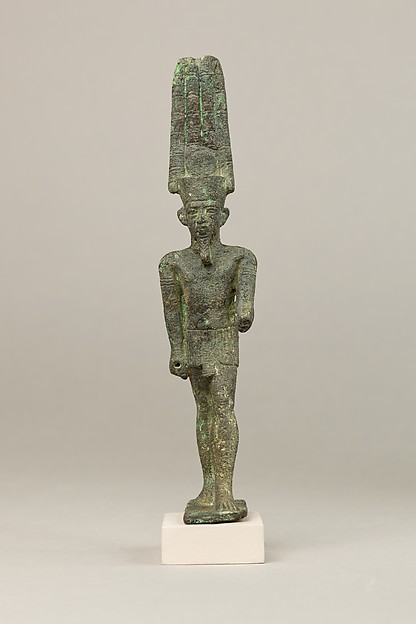
Egyptian, Late Period–Ptolemaic Period · 664–30 BCE · Cupreous metal
A cast metal statuette the museum identifies simply as Amun, wearing the god's characteristic tall plumed crown. Figures like this were dedicated at temples as personal acts of devotion.
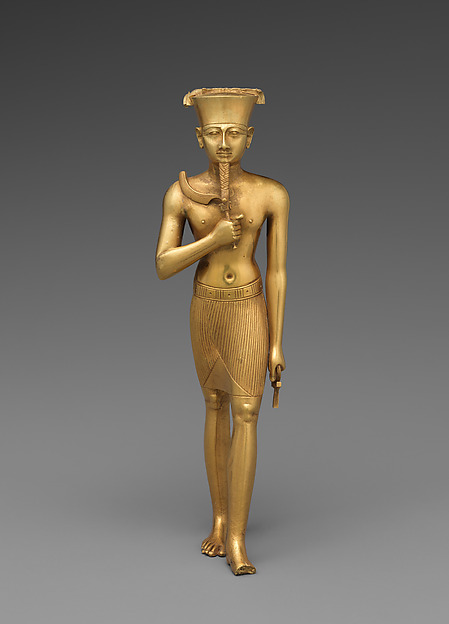
Egyptian, Third Intermediate Period · ca. 945–721 BCE · Gold
A gold statuette of Amun standing in a striding pose, tagged by the museum as depicting the god by name. Gold examples like this were rarer and costlier votive or funerary offerings than the more common bronze figures.
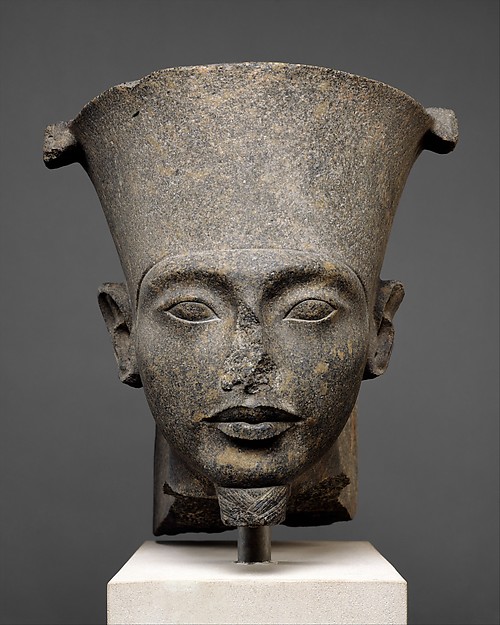
Egyptian, New Kingdom, post-Amarna Period · ca. 1328–1318 BCE · Granodiorite
A granodiorite head from a statue of Amun, dated by the museum to the years after the Amarna Period when his cult was restored to prominence. The scale of the stone points to an original temple statue rather than a personal votive.