Hindu Pantheon
Ganga
गङ्गा(Gaṅgā)
Also known as Ganges, Jahnavi, Bhagirathi, Mother Ganga
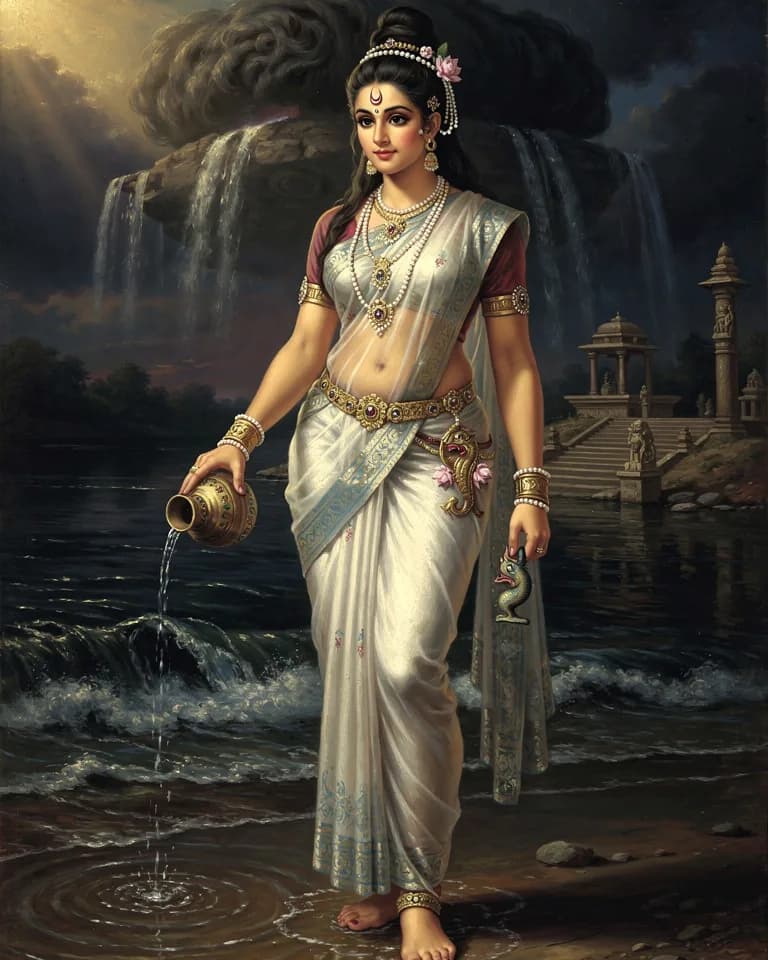
- the river Ganges
- purification
- liberation of the dead
The sacred river Ganges as a goddess, who descended from heaven to purify the ashes of King Sagara's sons and was caught in Shiva's matted hair to break the force of her fall. Bathing in her waters and immersing ashes in them are among the most important acts of Hindu devotion.
About Ganga
Daughter of the Mountain
The Ramayana makes Ganga the elder daughter of Himavat, lord of mountains, and sister of Uma (Parvati). The gods asked for her and took her to heaven, where she flowed as the celestial river.
The Descent
The same epic tells why she came down. The sixty thousand sons of King Sagara, searching for their father's sacrificial horse, were burned to ash by the sage Kapila. Only Ganga's waters could purify their remains. After generations of austerities, their descendant Bhagiratha won her descent, but her fall would have shattered the earth, so Shiva received her in his matted locks and released her gently. Ganga followed Bhagiratha's chariot to the sea and the underworld, and the ashes were redeemed; hence her name Bhagirathi.
Mother of Heroes
In the Mahabharata Ganga takes human form as the wife of King Shantanu and mother of Bhishma. Some versions of Skanda's birth have her carry Shiva's fiery seed, making her one of Kartikeya's mothers.
The Living River
Ganga is present in her river. Pilgrims bathe at Haridwar, Prayagraj, and Varanasi to wash away sin; ashes of the dead are immersed in her waters; and the Kumbh Mela gathers millions at her banks. In the Bhagavad Gita, Krishna names himself as Ganga among rivers.
Origin story
The Ramayana makes Ganga the elder daughter of Himavat and Mena and sister of Uma. Given to the gods, she flowed in heaven until King Bhagiratha's austerities brought her down to earth, broken in her fall by Shiva's hair, to purify the ashes of Sagara's sons.
Across traditions
Parallel figures
Figures who play a role like Ganga's in other traditions.
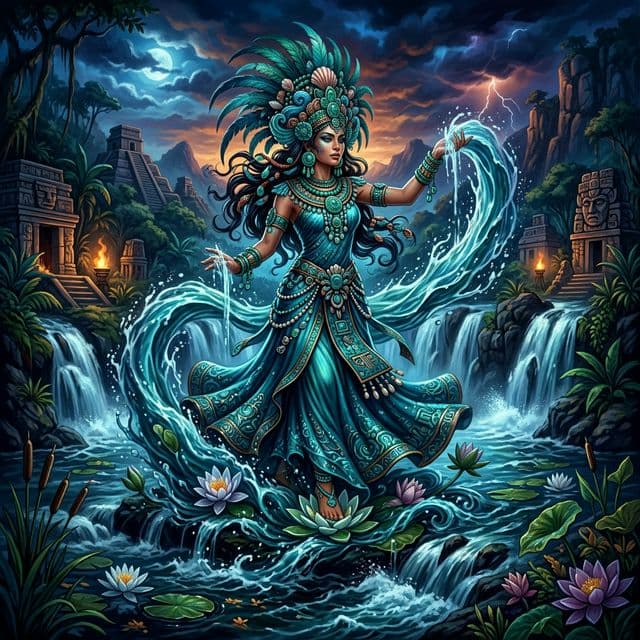 MesoamericanChalchiuhtlicue
Both are river goddesses associated with purification
Compare Ganga and Chalchiuhtlicue side by side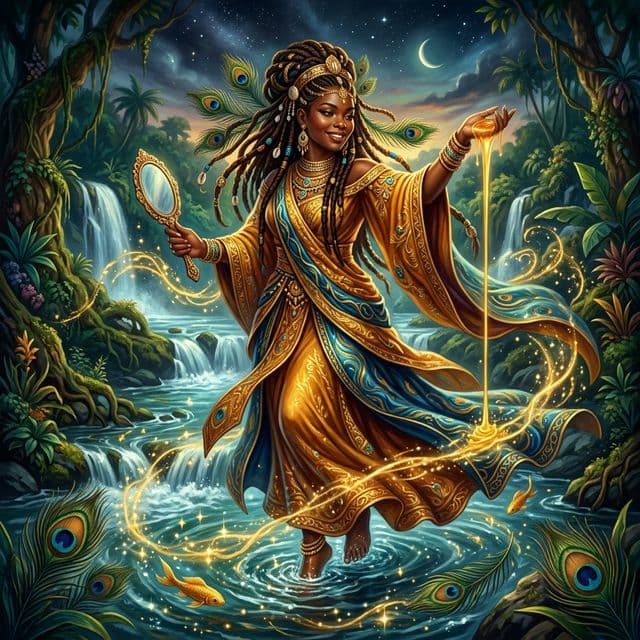 YorubaOshun
Both are goddesses present in a specific sacred river whose waters heal and bless
Compare Ganga and Oshun side by side
Worship and cult
Temples, festivals, and practices recorded for Ganga
Ritual bathing to remove sin, immersion of the ashes of the dead, and carrying sealed pots of Ganga water home for household rites.
Sacred sites
- Gangotri Temple at the river's Himalayan source
- Har Ki Pauri ghat, Haridwar
- Dashashwamedh Ghat, Varanasi
Festivals
- Ganga Dussehra (her descent to earth)
- Kumbh Mela
- Ganga Aarti (daily evening lamp ritual)
Family
Ganga's family at a glance
Sources and further reading
Source notes
These references are recorded in the catalog. Their passage wording and translation have not been checked, so quotations are not displayed here.
- Ramayana of Valmiki, Bala Kanda, Canto XXXVI (trans. Griffith)
- Rigveda 10.75.5 (trans. Griffith)
- Bhagavad Gita, Ch. X (trans. Arnold, 'The Song Celestial')
Further reading
Bala Kanda, the birth of Ganga and her descent to earth
Read online: Ramayana (opens in new tab)Ganga as wife of Shantanu and mother of Bhishma (Adi Parva)
Read online: Mahabharata (opens in new tab)
About this entry
By Elizabeth Stein for Mythos Atlas. About the author. Editorial notes are grounded in the site's cited sources and can be challenged through the contact page.
Parallels are editorial comparisons across traditions: a shared role does not, by itself, establish a shared origin.
Family relationships come from the atlas's kinship records. Ancient sources often disagree on divine genealogy.
Genealogy
Family tree
Ganga's parents, consorts, children and rivals, as recorded in the atlas.