Hindu Pantheon
Kartikeya
कार्त्तिकेय(Kārttikeya)
Also known as Skanda, Murugan, Subrahmanya, Kumara, Shanmukha
- war
- leadership of the divine army
- youth
- victory
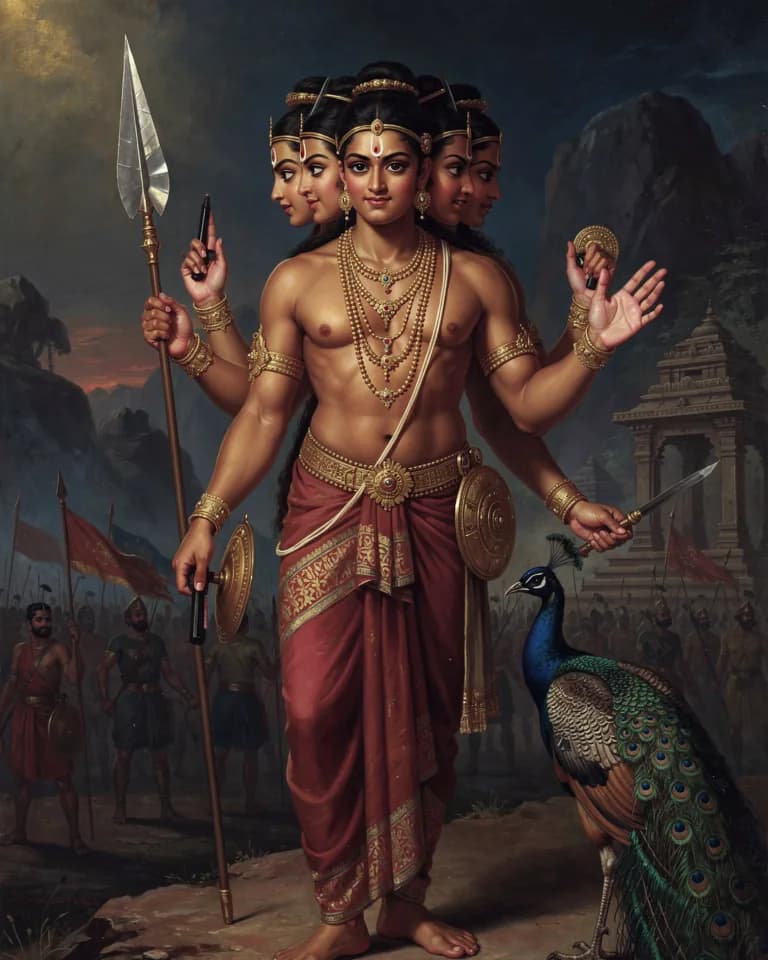
The god of war and commander of the gods' army, son of Shiva, born to destroy the demon Taraka. Raised by the six Krittikas (the Pleiades), he is often shown with six faces; in the Tamil south he is worshipped as Murugan, one of the most beloved gods of the region.
About Kartikeya
Born to Defeat Taraka
The gods, oppressed by the demon Taraka, learned that only a son of Shiva could destroy him. Tellings of the birth vary widely across the Mahabharata, the Ramayana, the Puranas, and Kalidasa's poem Kumarasambhava: Shiva's fiery seed passes through Agni and the river Ganga before the child is born in a bed of reeds and nursed by the six Krittikas, the stars of the Pleiades. From them he takes the name Kartikeya, and from nursing all six at once, his six faces.
General of the Gods
As Skanda he is made commander of the divine army and kills Taraka with his spear. In the Bhagavad Gita, Krishna says that among the leaders of armies he is Skanda. He rides a peacock and carries a rooster on his banner.
Murugan of the Tamil Lands
In Tamil Nadu and among Tamil communities worldwide, the god known as Murugan holds a central place. Early Tamil poetry already celebrates a youthful hill god Murugan, whose cult merged with that of Skanda. His six sacred abodes (Arupadai Veedu), among them Palani and Tiruchendur, draw vast pilgrimages, and the festival of Thaipusam is celebrated from Malaysia to Mauritius.
Family
He is the brother of Ganesha. Northern traditions often present Kartikeya as a celibate youth, while southern traditions give him two consorts, Devasena and Valli.
Origin story
Born to end the demon Taraka, Kartikeya arose from the seed of Shiva, carried by Agni and the river Ganga, and was nursed by the six Krittikas. Parvati accepted him as her son, and the gods made him general of their army.
Across traditions
Parallel figures
Figures who play a role like Kartikeya's in other traditions.
 ChineseNezha
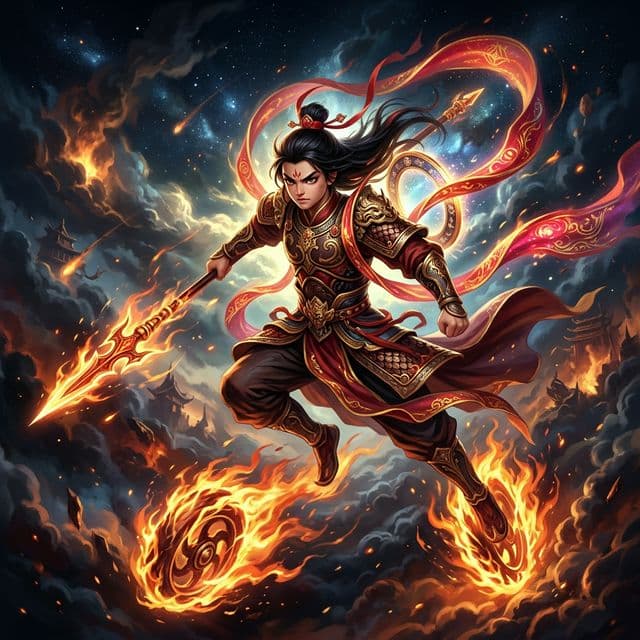
Both are young warrior gods who command divine armies
Compare Kartikeya and Nezha side by side GreekAres
Both are war gods, though Kartikeya is a revered general and savior while Ares is a disliked embodiment of battle-fury
Compare Kartikeya and Ares side by side
Worship and cult
Temples, festivals, and practices recorded for Kartikeya
Devotees carry kavadi (decorated burdens) in fulfillment of vows, especially at Thaipusam, and fast and recite his victories over the demons during Skanda Shashti.
Sacred sites
- Palani Murugan Temple, Tamil Nadu
- Tiruchendur Murugan Temple, Tamil Nadu
- Batu Caves, Malaysia
Festivals
- Thaipusam
- Skanda Shashti
Family
Kartikeya's family at a glance
Sources and further reading
Source notes
These references are recorded in the catalog. Their passage wording and translation have not been checked, so quotations are not displayed here.
- Bhagavad Gita, Ch. X (trans. Arnold, 'The Song Celestial')
- Kalidasa, Kumarasambhava (paraphrase)
Further reading
The Vana and Shalya Parvas recount Skanda's birth and consecration as general
Read online: Mahabharata (opens in new tab)Translated Puranic versions of the birth of Skanda
Read online: Hindu Myths: A Sourcebook (opens in new tab)
About this entry
By Elizabeth Stein for Mythos Atlas. About the author. Editorial notes are grounded in the site's cited sources and can be challenged through the contact page.
Parallels are editorial comparisons across traditions: a shared role does not, by itself, establish a shared origin.
Family relationships come from the atlas's kinship records. Ancient sources often disagree on divine genealogy.
Genealogy
Family tree
Kartikeya's parents, consorts, children and rivals, as recorded in the atlas.