Hindu Pantheon
Purusha
पुरुष(Puruṣa)
Also known as Purusa, Puruṣa, the Cosmic Person
- the cosmos
- sacrifice
- creation
- the social order
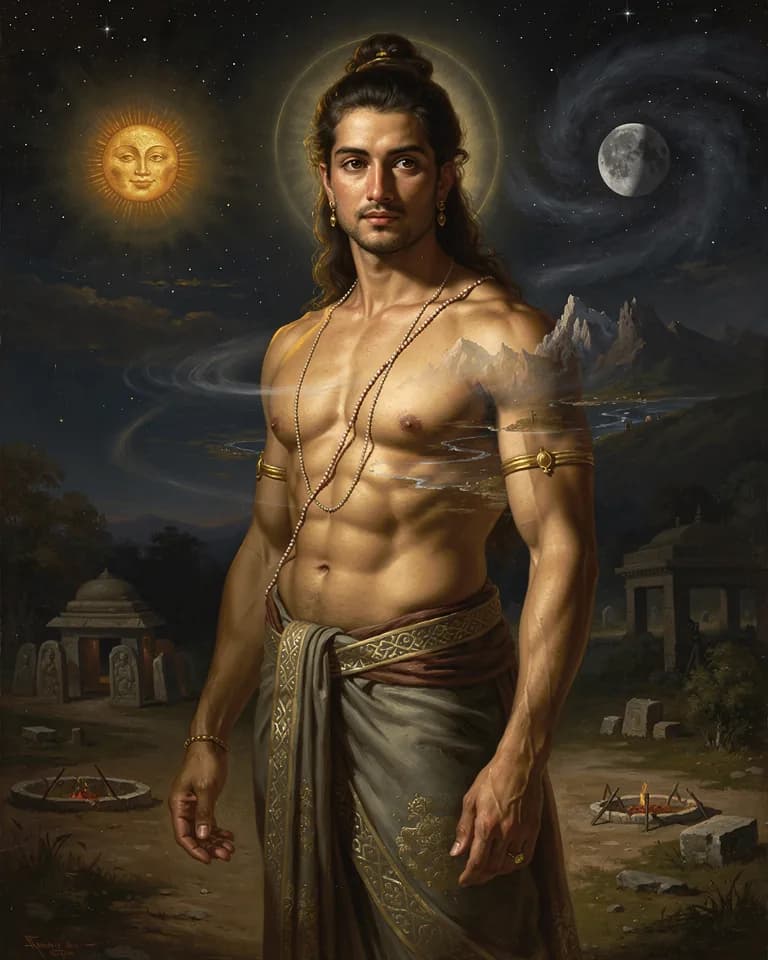
The primordial cosmic being of Rigveda 10.90, the Purusha Sukta, whom the gods sacrificed so that the world could be made from his body: the sun from his eye, the moon from his mind, the sky from his head, the earth from his feet, and the four social classes from his mouth, arms, thighs, and feet.
About Purusha
The Thousand-Headed Person
The Purusha Sukta (Rigveda 10.90) describes a cosmic Person with a thousand heads, eyes, and feet who covers the earth and extends beyond it. All creatures are a quarter of him; three quarters are immortal in heaven.
Creation by Sacrifice
The gods perform a sacrifice with Purusha as the offering. From it come the sacred verses and chants, horses, cattle, goats, and sheep. When he is divided, the Brahmin comes from his mouth, the warrior (Rajanya) from his arms, the Vaishya from his thighs, and the Shudra from his feet. The moon is born from his mind, the sun from his eye, Indra and Agni from his mouth, and wind from his breath; the air, sky, earth, and directions are formed from his body.
Influence and Controversy
This late Rigvedic hymn is the earliest text to name the four varnas together, and it has been cited for millennia to ground social hierarchy in the cosmos, a use that modern reformers have sharply criticized. In the Upanishads and in Samkhya philosophy, Purusha becomes the principle of pure consciousness, and Vaishnava tradition identifies the cosmic Person with Vishnu.
A World Made from a Body
The idea of a world fashioned from a primordial being's body appears elsewhere, from the Norse giant Ymir to the Chinese Pangu, and is a classic subject of comparative mythology.
Origin story
Rigveda 10.90 says that from Purusha was born Viraj, and from Viraj Purusha again, a paradox of mutual origin. The gods then bound him as their sacrificial victim and made the ordered world from his divided body.
Across traditions
Parallel figures
Figures who play a role like Purusha's in other traditions.
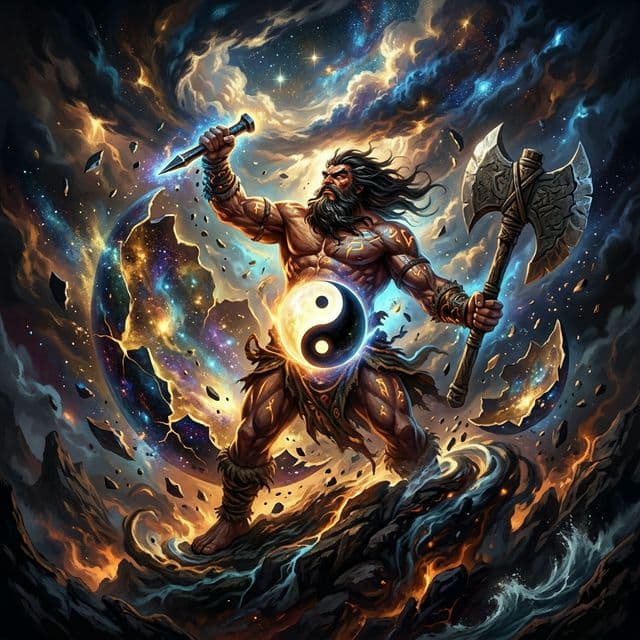 ChinesePangu
Both are cosmic beings whose bodies become the parts of the world
Compare Purusha and Pangu side by side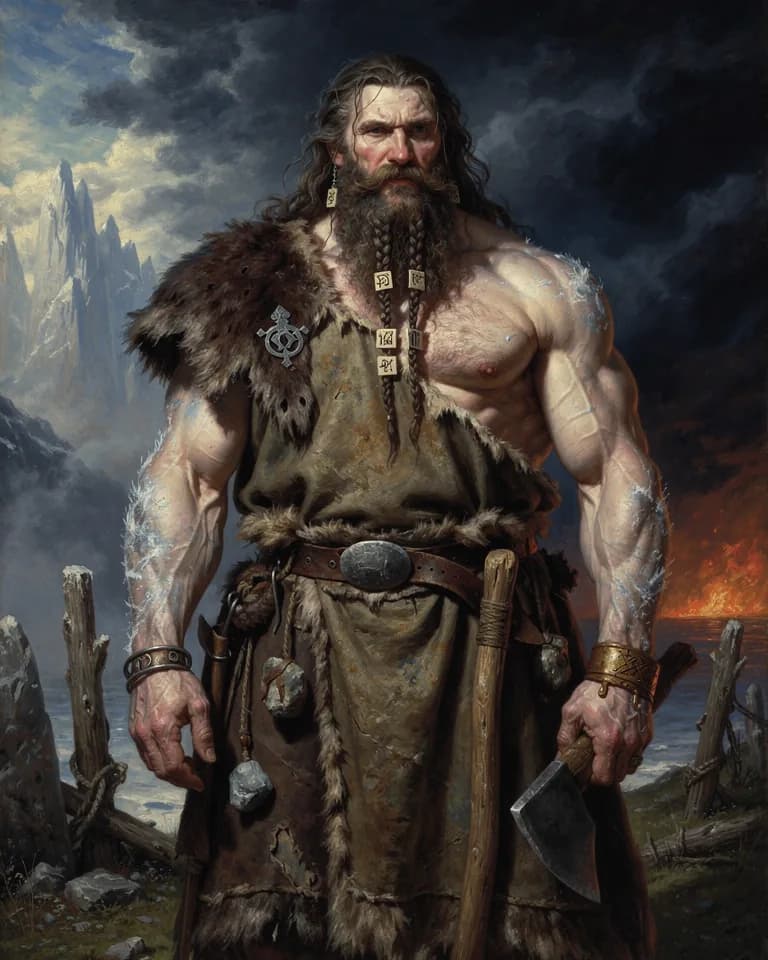 NorseYmir
Both are primordial beings killed or sacrificed by the gods so that the world can be made from their bodies
Compare Purusha and Ymir side by side
Worship and cult
Temples, festivals, and practices recorded for Purusha
The Purusha Sukta is recited in Vedic and temple ritual, including daily worship of Vishnu, rather than Purusha receiving a separate cult.
Sources and further reading
Source notes
These references are recorded in the catalog. Their passage wording and translation have not been checked, so quotations are not displayed here.
- Rigveda 10.90.1 (trans. Griffith)
- Rigveda 10.90.13 (trans. Griffith)
Further reading
The Purusha Sukta, hymn 10.90
Read online: Rigveda (opens in new tab)Translation and commentary on the Vedic creation hymns
Read online: Hindu Myths: A Sourcebook (opens in new tab)
About this entry
By Elizabeth Stein for Mythos Atlas. About the author. Editorial notes are grounded in the site's cited sources and can be challenged through the contact page.
Parallels are editorial comparisons across traditions: a shared role does not, by itself, establish a shared origin.