Canaanite Pantheon (Ugarit)
Shapash
špš(Šapšu)
Also known as Shapshu, Torch of the Gods (nrt ilm)
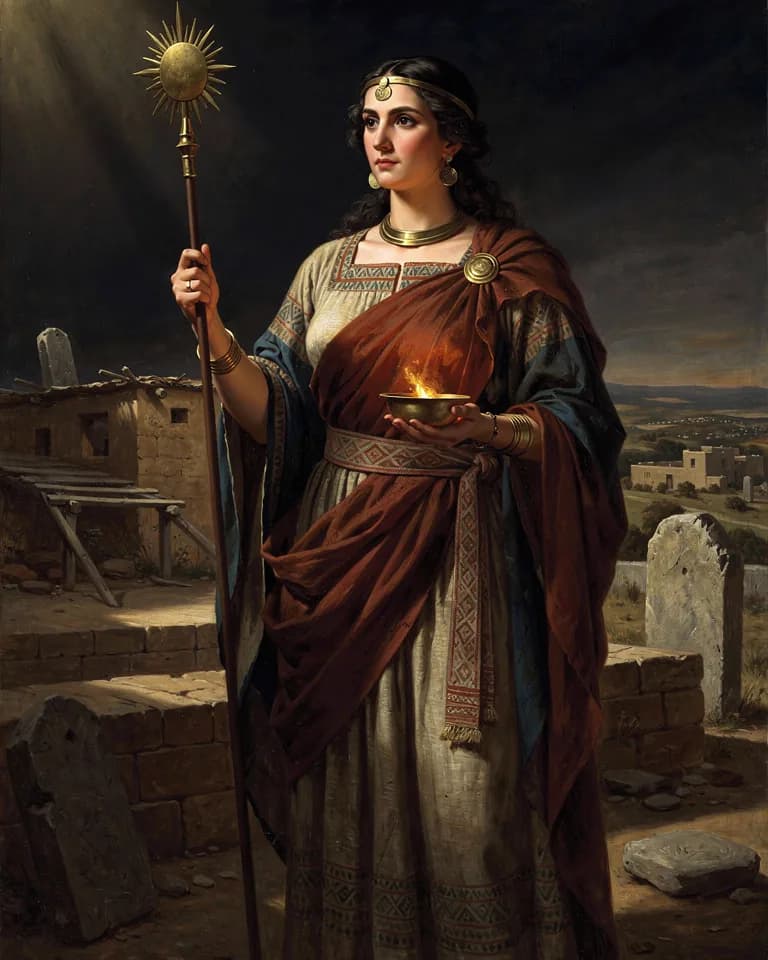
- the sun
- seeing and searching
- passage between the living and the dead
The sun-goddess of Ugarit, 'Torch of the Gods', who sees everything on her daily journey, helps Anat carry Baal's body, searches for him, and warns Mot to yield.
About Shapash
Torch of the Gods
At Ugarit the sun is a goddess, Shapash, the "Torch of the Gods". Because she crosses the sky by day and, in Ugaritic belief, passes through the underworld by night, she can go where other gods cannot, and she acts as a go-between for the realms of the living and the dead.
In the Baal Cycle
Shapash appears at the crucial moments of the cycle's last tablets. She helps Anat lift Baal's body onto Anat's shoulder so that Anat can carry it to Zaphon for burial (KTU 1.6 I). When El dreams that Baal lives, Anat asks Shapash to search for him, and she agrees. When Baal and Mot fight to exhaustion, it is Shapash who warns Mot that El will overturn his throne if he continues, and Mot gives way (KTU 1.6 VI). The cycle closes with a hymn to her, praising her rule over the shades of the dead.
In ritual
Shapash also appears in Ugaritic incantations against snakebite, in which a mare's daughter calls on the sun to carry her message to the gods; and in the royal funerary liturgy (KTU 1.161), where she is called on to accompany the dead king. Her solar role is not simply heavenly; it is a role of crossing.
Across traditions
Parallel figures
Figures who play a role like Shapash's in other traditions.
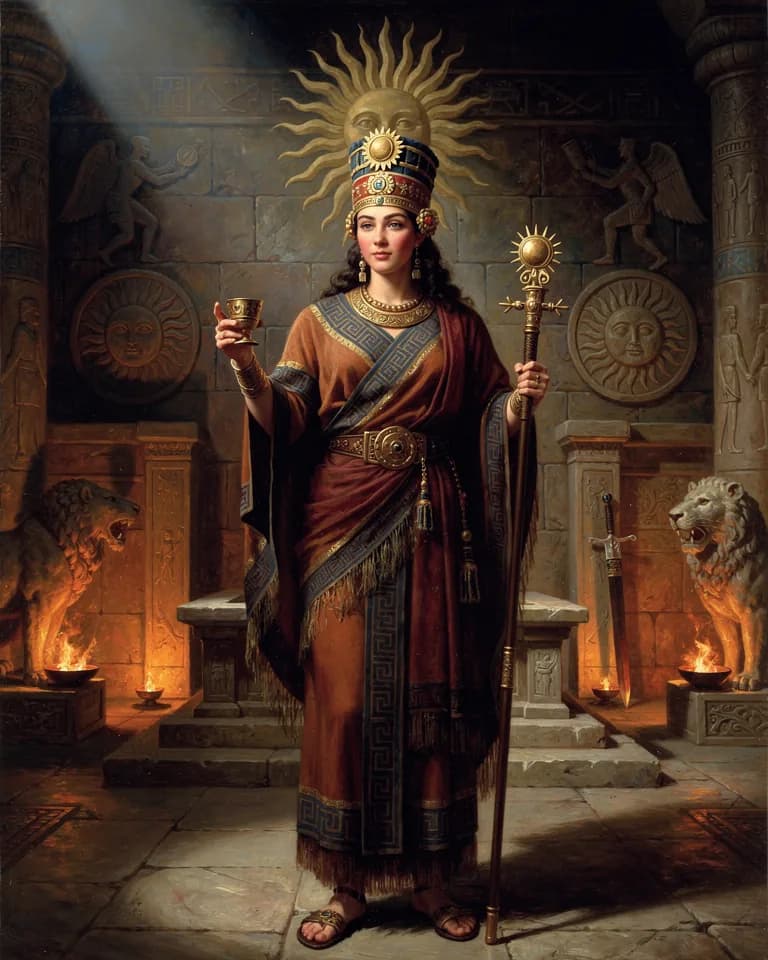 HittiteSun-goddess of Arinna
Both are female sun deities in Late Bronze Age pantheons that also knew a sun passing through the underworld; they belong to different traditions.
Compare Shapash and Sun-goddess of Arinna side by side
In the atlas
Where Shapash appears
Sources and further reading
Source notes
These references are recorded in the catalog. Their passage wording and translation have not been checked, so quotations are not displayed here.
- Baal Cycle, KTU 1.6 I
Appears in
Ancient and classical works featuring this figure.
sun-goddess who helps recover Baal and warns Mot (KTU 1.6 I, VI)
Further reading
Shapash in the last tablets of the cycle
About this entry
By Elizabeth Stein for Mythos Atlas. About the author. Editorial notes are grounded in the site's cited sources and can be challenged through the contact page.
Parallels are editorial comparisons across traditions: a shared role does not, by itself, establish a shared origin.
Genealogy
Family tree
Shapash's parents, consorts, children and rivals, as recorded in the atlas.