Greek Pantheon
Asclepius
Ἀσκληπιός(Asklēpios)
Also known as Asklepios, Aesculapius (Roman)
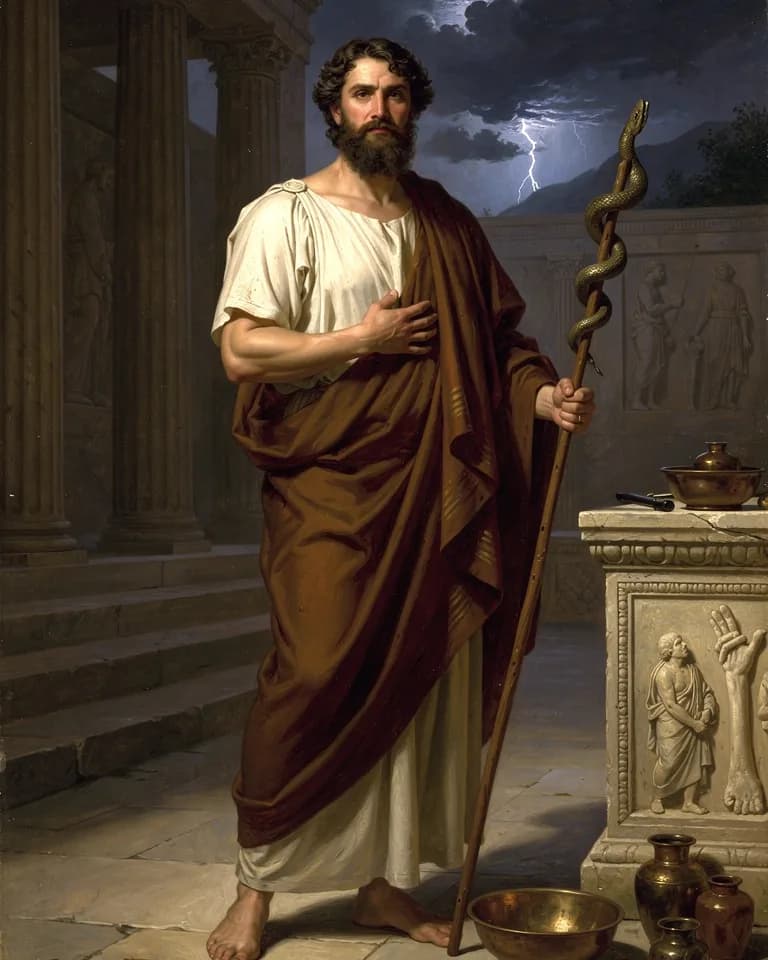
- healing
- medicine
- physicians
The healer god, son of Apollo and the mortal Coronis, trained in medicine by the centaur Chiron. His skill grew so great that he raised the dead, and Zeus struck him with a thunderbolt; he was nonetheless worshipped across the Greek and Roman world at sanctuaries where the sick slept in hope of a cure.
About Asclepius
Son of Apollo
The Homeric Hymn to Asclepius names him son of Apollo and of Coronis, daughter of King Phlegyas, born in the Dotian plain of Thessaly. Pindar's third Pythian Ode tells the darker version: Coronis was unfaithful to Apollo while carrying his child, Artemis killed her, and Apollo snatched the infant from her funeral pyre and gave him to the centaur Chiron to raise and teach.
The Healer Struck Down
In Homer, Asclepius is still a mortal physician-king whose sons Machaon and Podalirius serve as healers at Troy. Later poets make his skill boundless: he raised the dead, and Zeus, fearing the order of mortality overturned, killed him with a thunderbolt. Apollo's revenge on the Cyclopes who forged the bolt led to his year of servitude to Admetus.
Sanctuaries of Healing
Whatever his mythic death, Asclepius became one of the most widely worshipped gods of the Greek world. His great sanctuary at Epidaurus, and others at Kos, Pergamon, and Athens, practiced incubation: the sick slept in a sacred hall hoping the god would heal them or prescribe a cure in a dream. Inscriptions at Epidaurus record the cures claimed. In 293 BCE the cult was brought to Rome, where he was worshipped as Aesculapius on the Tiber Island. His snake-entwined staff remains a symbol of medicine; his daughters included Hygieia (Health) and Panacea (All-Healing).
Origin story
Asclepius was the son of Apollo and Coronis. When Coronis was killed for her infidelity, Apollo rescued the unborn child from her pyre and entrusted him to the centaur Chiron, who taught him the healing arts.
Across traditions
Parallel figures
Figures who play a role like Asclepius's in other traditions.
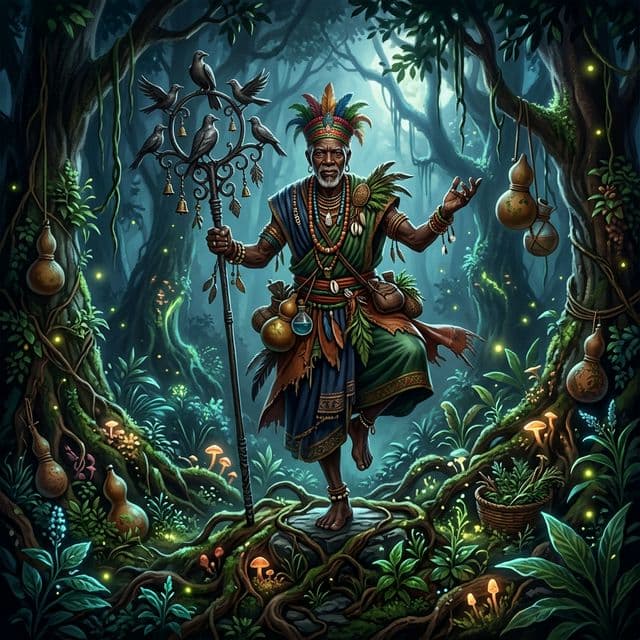 YorubaOsanyin
Both are gods of healing and medicine
Compare Asclepius and Osanyin side by side JapaneseOkuninushi
Both are associated with medicine and healing, and both undergo death and restoration in their myths
Compare Asclepius and Okuninushi side by side CelticDian Cécht
Both are divine physicians whose healing reaches toward restoring the dead
Compare Asclepius and Dian Cécht side by side
Worship and cult
Temples, festivals, and practices recorded for Asclepius
Incubation: the sick purified themselves, offered sacrifice, and slept in the sanctuary's abaton hoping for a healing dream. Votive models of healed body parts and inscribed cure records were left at the shrines.
Sacred sites
- Sanctuary of Asclepius at Epidaurus
- Asclepieion of Kos
- Asclepieion of Pergamon
- Temple of Aesculapius on the Tiber Island, Rome
Festivals
- Asclepieia (festivals at Epidaurus and Athens)
- Epidauria at Athens, within the Eleusinian Mysteries
Family
Sources and further reading
Source notes
These references are recorded in the catalog. Their passage wording and translation have not been checked, so quotations are not displayed here.
- Homeric Hymn 16, To Asclepius (trans. Evelyn-White)
- Pindar, Pythian Ode 3.45-58 (paraphrase)
Further reading
The short Hymn 16 to Asclepius
Read online: Homeric Hymns (opens in new tab)Machaon and Podalirius, the sons of Asclepius who heal the wounded at Troy
Read online: Iliad (opens in new tab)Book 3 on Asclepius raising the dead and his death by thunderbolt
Read online: Bibliotheca (Library) (opens in new tab)
About this entry
By Elizabeth Stein for Mythos Atlas. About the author. Editorial notes are grounded in the site's cited sources and can be challenged through the contact page.
Parallels are editorial comparisons across traditions: a shared role does not, by itself, establish a shared origin.
Family relationships come from the atlas's kinship records. Ancient sources often disagree on divine genealogy.
Genealogy
Family tree
Asclepius's parents, consorts, children and rivals, as recorded in the atlas.