Greek Pantheon
Plutus
Πλοῦτος(Ploutos)
Also known as Ploutos
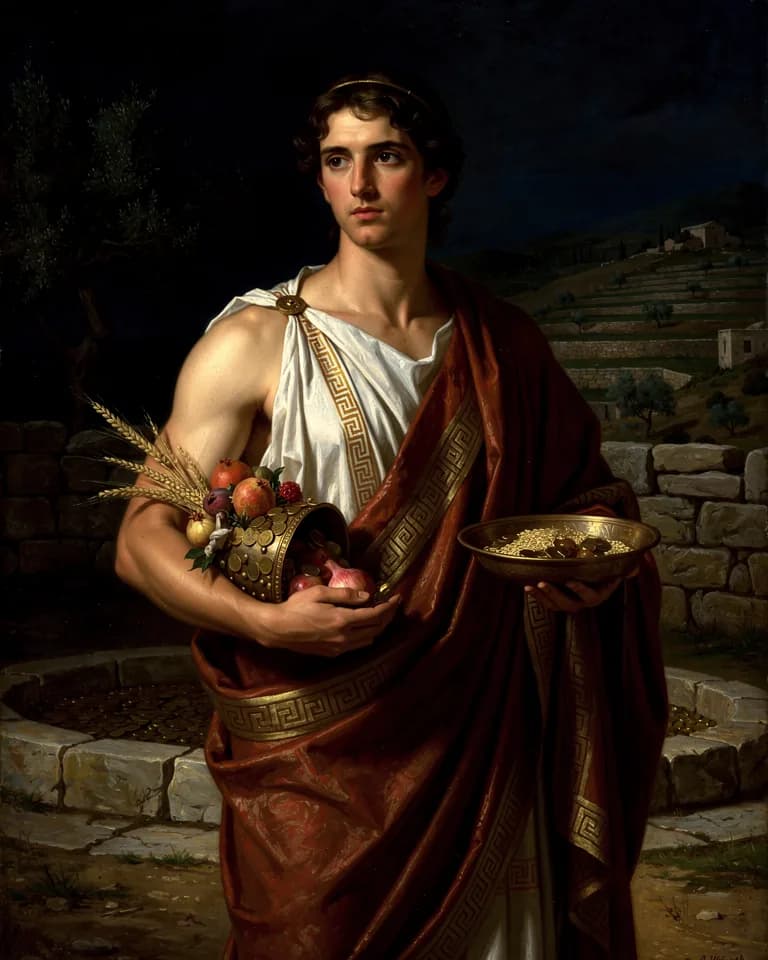
- wealth
- agricultural abundance
The god of wealth, son of Demeter and the hero Iasion, born in a thrice-plowed field on Crete. Originally the wealth of the harvest, he became the personification of riches in general, most memorably as the blind god of Aristophanes' comedy.
About Plutus
Wealth from the Field
Hesiod tells how Demeter lay with the hero Iasion in a thrice-plowed fallow field on Crete and bore Plutus, a kindly god who goes everywhere over land and sea and makes rich whoever finds him. The story roots wealth in grain: in an agrarian world, the harvest was riches.
Blind Wealth
By the Classical period Plutus had become an abstract personification of money and fortune. Aristophanes' last surviving comedy, Plutus (388 BCE), builds its plot on the idea that Zeus blinded him so he could not tell good people from bad, which is why the wicked prosper. When the god's sight is restored at a sanctuary of Asclepius, wealth flows to the honest, and the gods lose their offerings.
Peace Holding Wealth
Plutus is best known in art as a child. Cephisodotus's statue of Eirene (Peace) holding the infant Plutus, set up in Athens in the 370s BCE and known from Roman copies, expressed the idea that prosperity is nurtured by peace. He is distinct from Plouton, a title of Hades as lord of the riches beneath the earth, though ancient writers sometimes played on the similarity.
Origin story
Plutus was born to Demeter and the mortal hero Iasion, who lay together in a thrice-plowed fallow field in Crete. In the version Homer knows, Zeus killed Iasion with a thunderbolt for this union.
Across traditions
Parallel figures
Figures who play a role like Plutus's in other traditions.
 JapaneseDaikokuten
Both are deities of wealth and abundance
Compare Plutus and Daikokuten side by side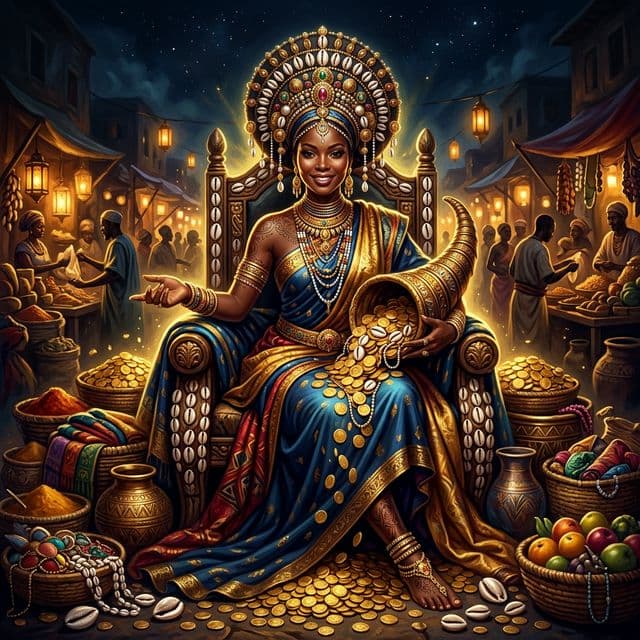 YorubaAje
Both personify wealth as a divine power that chooses whom it enriches
Compare Plutus and Aje side by side HinduLakshmi
Both are divine sources of prosperity, though Lakshmi is a major goddess and Plutus a minor personification
Compare Plutus and Lakshmi side by side
Family
Sources and further reading
Source notes
These references are recorded in the catalog. Their passage wording and translation have not been checked, so quotations are not displayed here.
- Hesiod, Theogony (trans. Evelyn-White)
- Aristophanes, Plutus (paraphrase)
Further reading
The birth of Plutus to Demeter and Iasion
Read online: Theogony (opens in new tab)
About this entry
By Elizabeth Stein for Mythos Atlas. About the author. Editorial notes are grounded in the site's cited sources and can be challenged through the contact page.
Parallels are editorial comparisons across traditions: a shared role does not, by itself, establish a shared origin.
Family relationships come from the atlas's kinship records. Ancient sources often disagree on divine genealogy.
Genealogy
Family tree
Plutus's parents, consorts, children and rivals, as recorded in the atlas.