Greek Pantheon
Eos
Ἠώς(Ēōs)
Also known as Aurora (Roman)
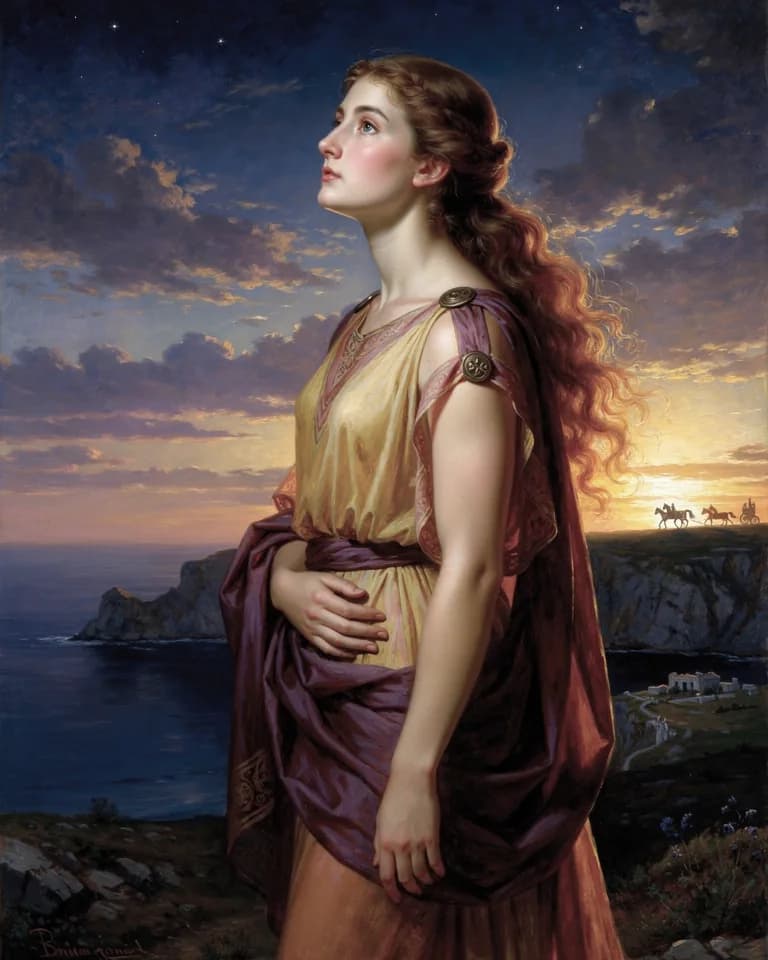
- dawn
- morning light
The goddess of dawn, sister of Helios and Selene, who rises each morning from the bed of her mortal consort Tithonus to bring light to gods and men. Homer's formula 'rosy-fingered Dawn' marks the start of countless days in the Iliad and Odyssey.
About Eos
Rosy-Fingered Dawn
Eos is the dawn made divine. Hesiod names her with Helios and Selene as a child of Hyperion and Theia, and he also makes her mother of the winds and the stars by the Titan Astraeus. In Homer she is chiefly a time-marker: the formula of 'early-born, rosy-fingered Dawn' opens new days again and again in the Iliad and the Odyssey.
Tithonus
Eos is famous for carrying off beautiful young men. The most poignant story, told in the Homeric Hymn to Aphrodite, concerns the Trojan prince Tithonus: Eos asked Zeus to make him immortal but forgot to ask that he stay young. He aged endlessly, until she shut him away in a room where he still babbles on. Their son was Memnon, king of the Ethiopians, whom Achilles killed at Troy in the lost epic Aethiopis.
An Indo-European Dawn
Eos's name is one of the clearest inherited divine names in Greek. It is cognate with the Vedic dawn goddess Uṣas and the Latin Aurora, all from a reconstructed Proto-Indo-European *h₂éwsōs. The shared imagery of a young goddess who opens the doors of the sky, reddens the east, and returns eternally young is a long-standing topic of comparative study.
Origin story
Eos was born to the Titans Hyperion and Theia with her siblings Helios and Selene. Each morning she rises from the streams of Ocean at the eastern edge of the world to announce the sun.
Across traditions
Parallel figures
Figures who play a role like Eos's in other traditions.
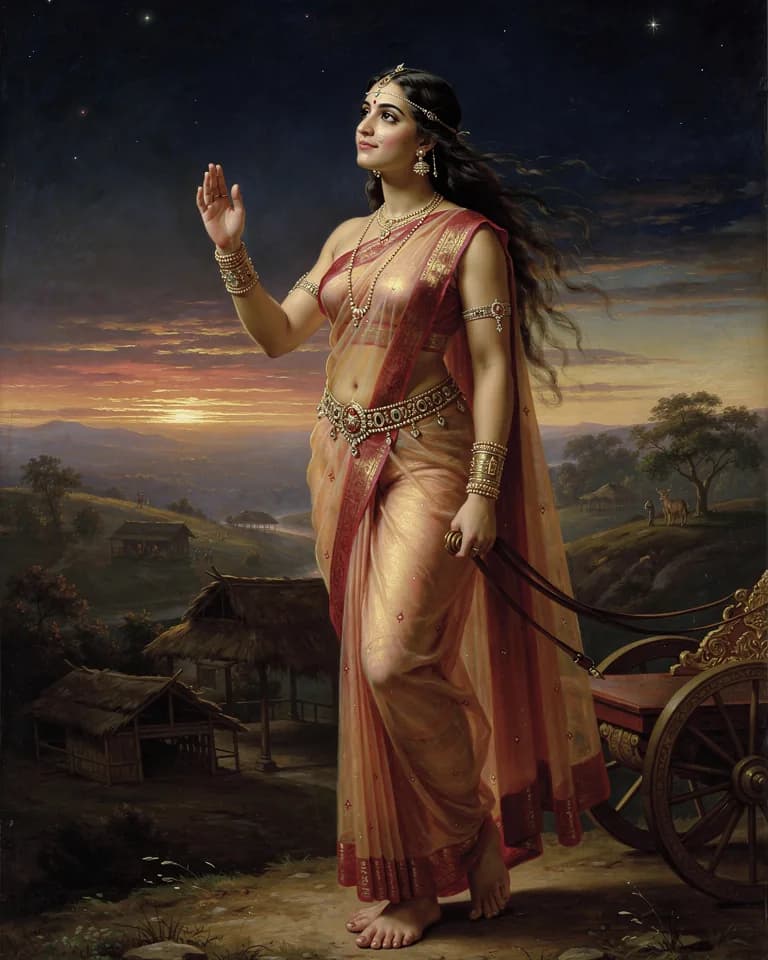 HinduUsha
Eos and Usha share an inherited Indo-European name and much of the same imagery of a youthful dawn who opens the sky
Compare Eos and Usha side by side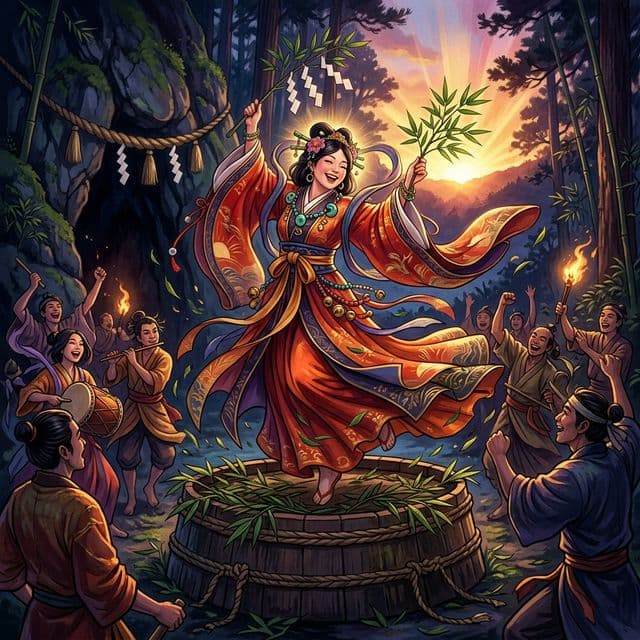 JapaneseAme-no-Uzume
A thematic comparison only: Ame-no-Uzume's dance restores the sun's light, while Eos is the dawn itself
Compare Eos and Ame-no-Uzume side by side
Family
Sources and further reading
Source notes
These references are recorded in the catalog. Their passage wording and translation have not been checked, so quotations are not displayed here.
- Hesiod, Theogony (trans. Evelyn-White)
- Homeric Hymn 5, To Aphrodite (trans. Evelyn-White)
Further reading
The Hymn to Aphrodite, for Eos and Tithonus
Read online: Homeric Hymns (opens in new tab)The formulaic dawns that open each new day of fighting
Read online: Iliad (opens in new tab)
About this entry
By Elizabeth Stein for Mythos Atlas. About the author. Editorial notes are grounded in the site's cited sources and can be challenged through the contact page.
Parallels are editorial comparisons across traditions: a shared role does not, by itself, establish a shared origin.
Family relationships come from the atlas's kinship records. Ancient sources often disagree on divine genealogy.
Genealogy
Family tree
Eos's parents, consorts, children and rivals, as recorded in the atlas.