Hindu Pantheon
Usha
उषस्(Uṣas)
Also known as Ushas, Uṣas
- dawn
- awakening
- renewal of days
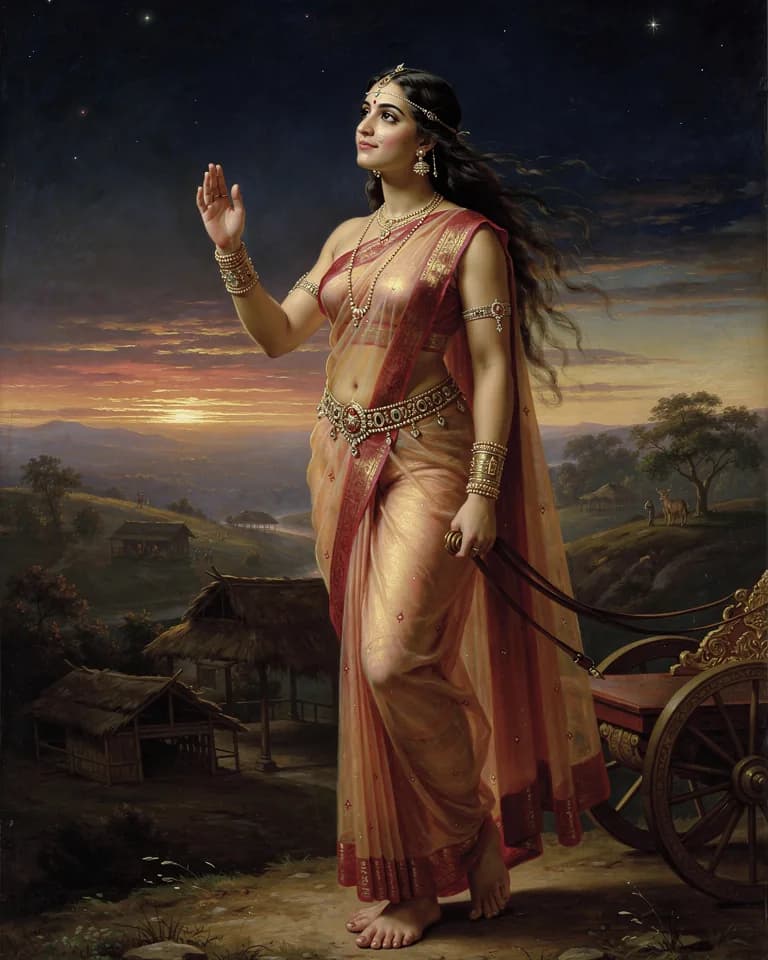
The Vedic goddess of dawn, praised in some twenty hymns of the Rigveda as a radiant young woman who drives away darkness, wakes every living creature, and returns each morning ever young while the generations of mortals pass away.
About Usha
The Most Praised Goddess
Usha is among the most celebrated goddesses of the Rigveda, which addresses about twenty hymns to her. She is the daughter of Heaven, sister of Night, and the brilliant maiden who unbars the doors of the sky. Her light rouses people to their work and to sacrifice: she causes Agni's fire to be kindled at the morning rite.
Ever Young, Ever Returning
The hymns dwell on a poignant contrast. Usha is ancient, yet each morning she is born anew; the men who watched earlier dawns are gone, and those who will watch later dawns are still to come. Rigveda 1.113 turns this into a meditation on time and mortality.
An Indo-European Dawn
Her name is cognate with Greek Eos and Latin Aurora, from a reconstructed Proto-Indo-European dawn goddess. Shared images, such as the reddening east, the chariot, and the youthful goddess who opens heaven, make her central to comparative study of Indo-European myth.
After the Vedas
Usha did not keep her prominence in later Hinduism, where the solar Surya and the great goddesses overshadowed her. The morning twilight prayers and the dawn hymns recited in Vedic ritual preserve her memory.
Origin story
Usha is called the daughter of Dyaus (Heaven) and the sister of Ratri (Night), with whom she shares an unending path, the two alternating across the sky.
Across traditions
Parallel figures
Figures who play a role like Usha's in other traditions.
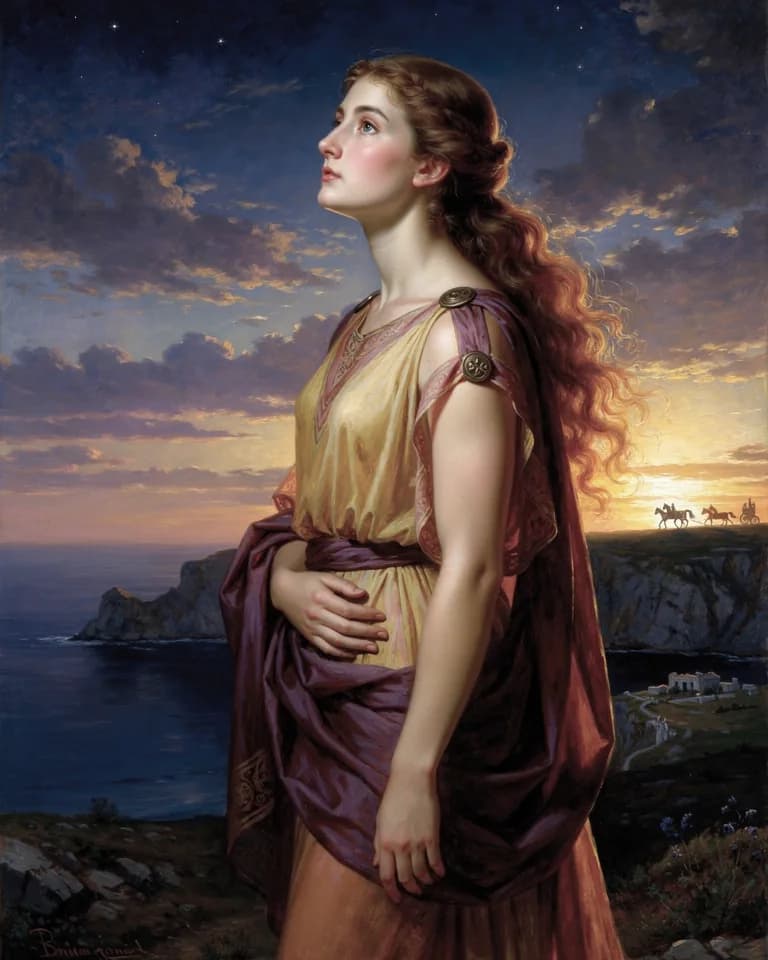 GreekEos
Usha and Eos share an inherited Indo-European name and the image of a youthful dawn who opens the sky
Compare Usha and Eos side by side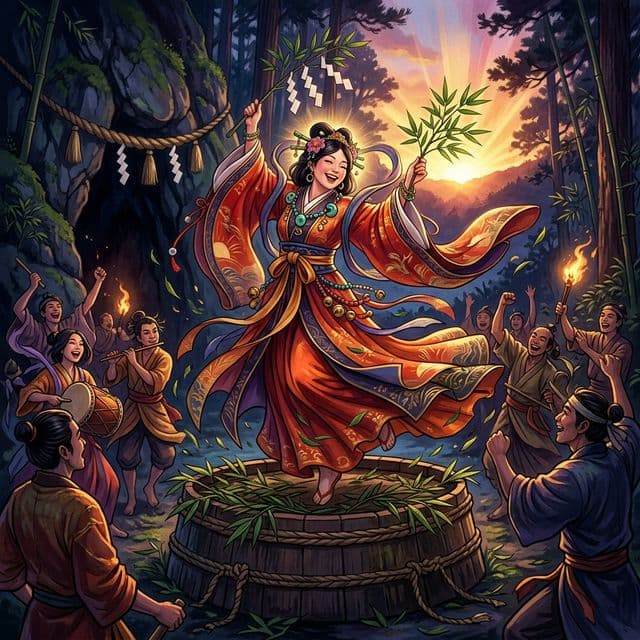 JapaneseAme-no-Uzume
A thematic comparison of figures associated with dawn; this is not evidence of a shared origin
Compare Usha and Ame-no-Uzume side by side
Worship and cult
Temples, festivals, and practices recorded for Usha
Invoked in the Vedic morning sacrifice, when the fire is kindled at dawn; her hymns are recited in the morning litany of Soma ritual. She has no major temple cult in later Hinduism.
Sources and further reading
Source notes
These references are recorded in the catalog. Their passage wording and translation have not been checked, so quotations are not displayed here.
- Rigveda 1.113.1 (trans. Griffith)
- Rigveda 1.113.11 (trans. Griffith)
Further reading
The dawn hymns, including 1.48, 1.92, and 1.113
Read online: Rigveda (opens in new tab)Context for the Vedic dawn among the early gods
Read online: Hindu Myths: A Sourcebook (opens in new tab)
About this entry
By Elizabeth Stein for Mythos Atlas. About the author. Editorial notes are grounded in the site's cited sources and can be challenged through the contact page.
Parallels are editorial comparisons across traditions: a shared role does not, by itself, establish a shared origin.
Genealogy
Family tree
Usha's parents, consorts, children and rivals, as recorded in the atlas.