In the museums97 objects
Museum Collection
Public-domain works from the Metropolitan Museum of Art that depict the figures and myths in this atlas, with ancient objects made within each tradition set ahead of later artistic reception.
(opens the museum record)
Ancient object
Bronze statuette of Herakles (opens the museum record)
An Italic representation of the hero. The museum places it among statuettes showing Herakles advancing with club and bow; it does not identify a particular labour.
(opens the museum record)
Ancient object
Marble relief fragment with scenes from the Trojan War (opens the museum record)
This small relief belongs to the tabulae iliacae, which depict Trojan War scenes. The museum identifies a signature by Theodoros on the reverse. It documents Roman engagement with the story, not an event from the war.
(opens the museum record)
Ancient object
Statuette of Osiris (opens the museum record)
This figure shows Osiris in mummy form with the crook and flail of kingship. It provides evidence for his representation in Egyptian religious art, rather than depicting the full account of his death and restoration.
(opens the museum record)
Ancient object
Foundation figure of Ur-Namma holding a basket (opens the museum record)
The inscription identifies this figure with a temple of Inanna built or restored by Ur-Namma. It shows the ruler, not Inanna, and provides context for her worship rather than illustrating her descent to the underworld.
 (opens the museum record)
Ancient object
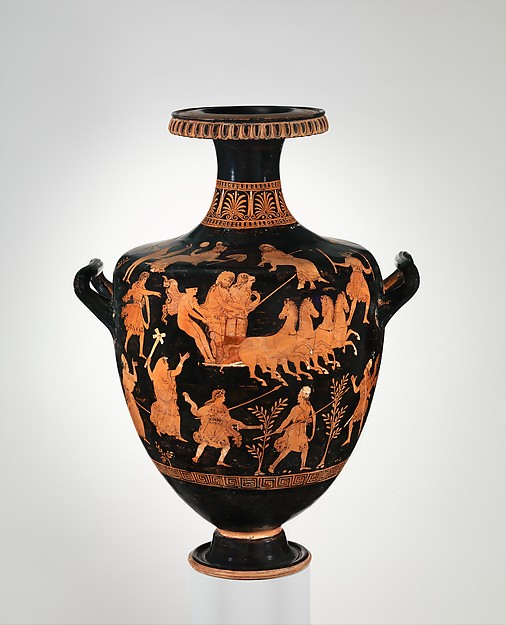
Terracotta hydria (water jar) (opens the museum record)
A South Italian water jar whose painted frieze the museum tags as showing Hecate alongside Zeus, Athena, Aphrodite, and Eros. It documents her place among the Olympian company in fourth-century Apulian vase painting.
 (opens the museum record)
Ancient object
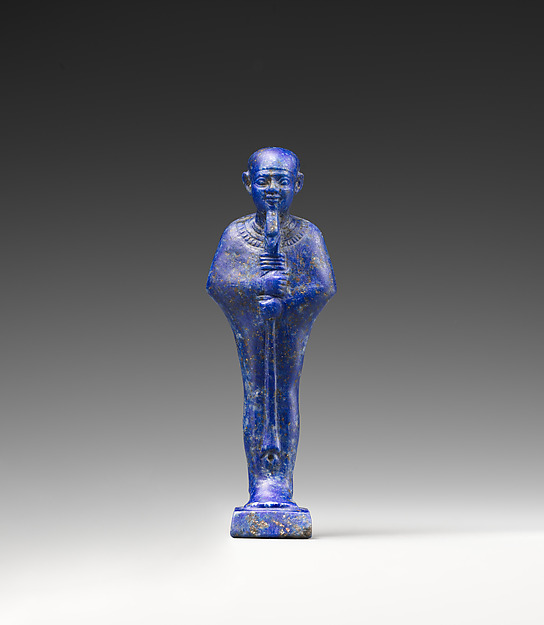
Cult Image of the God Ptah (opens the museum record)
A lapis lazuli statuette identified by the museum as a cult image of Ptah, shown in his standard mummiform pose holding a staff. Small images like this were placed in shrines or temples as votive offerings.
 (opens the museum record)
Ancient object
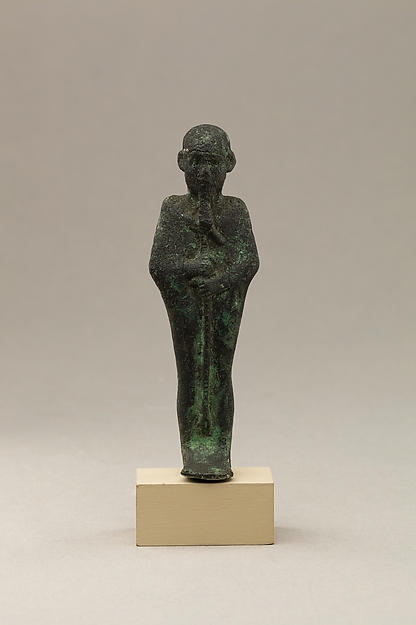
Ptah (opens the museum record)
A cast metal statuette the museum catalogs simply as Ptah, showing the god's characteristic close-fitting cap and mummiform body. Votive figures of this type were mass-produced for temple donation in the Late Period.
 (opens the museum record)
Ancient object
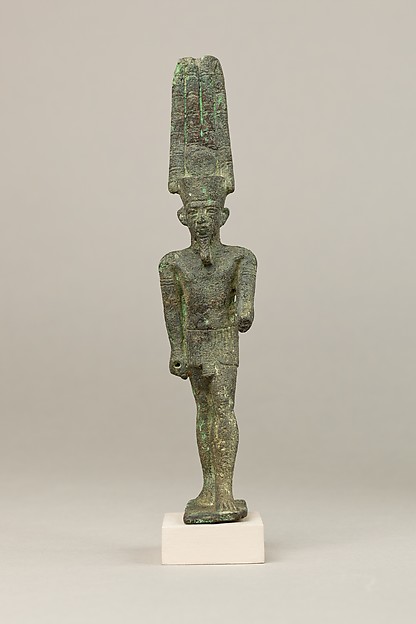
Amun (opens the museum record)
A cast metal statuette the museum identifies simply as Amun, wearing the god's characteristic tall plumed crown. Figures like this were dedicated at temples as personal acts of devotion.
 (opens the museum record)
Ancient object
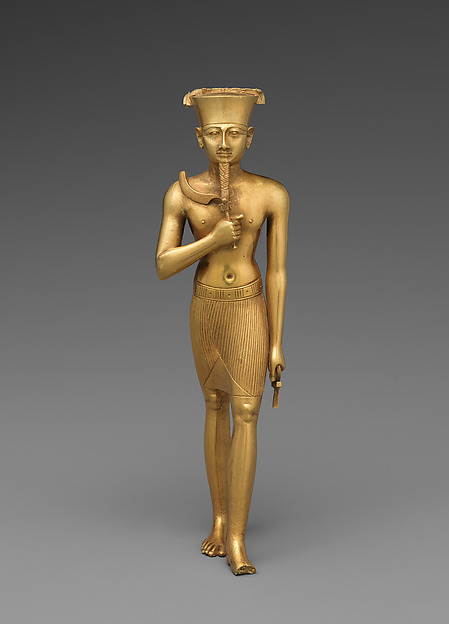
Statuette of Amun (opens the museum record)
A gold statuette of Amun standing in a striding pose, tagged by the museum as depicting the god by name. Gold examples like this were rarer and costlier votive or funerary offerings than the more common bronze figures.
 (opens the museum record)
Ancient object
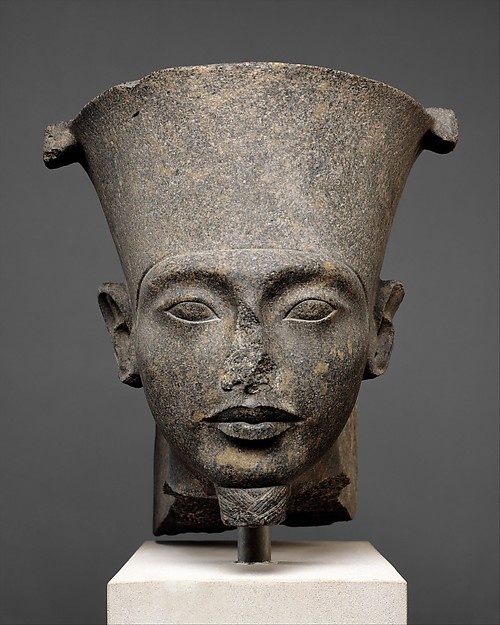
Head of the god Amun (opens the museum record)
A granodiorite head from a statue of Amun, dated by the museum to the years after the Amarna Period when his cult was restored to prominence. The scale of the stone points to an original temple statue rather than a personal votive.
 (opens the museum record)
Ancient object
Bes amulet (opens the museum record)
A faience amulet of the dwarf god Bes, tagged by the museum with his name. Bes amulets were worn for protection, especially of households, women in childbirth, and children.
 (opens the museum record)
Ancient object
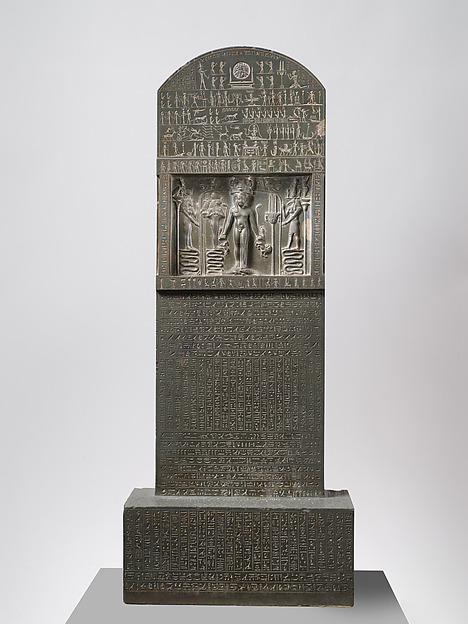
Magical Stela with Horus the Child (opens the museum record)
The Metternich Stela, a magical healing stela carved with spells against venomous bites; the museum tags it with figures including Bes and Horus the Child, whose image dominates the front. Owners would pour water over the inscribed surface and drink the water as a cure.
 (opens the museum record)
Ancient object
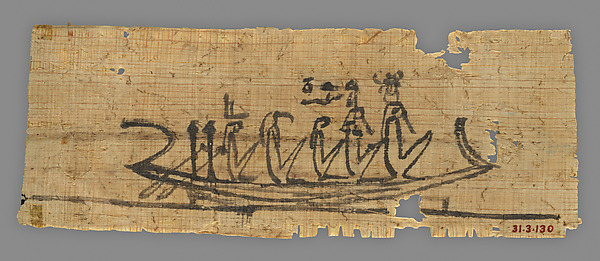
Papyrus fragment with a painting of Khepri, Shu, Tefnut, Thoth, and Isis in a solar boat (opens the museum record)
A fragment from a funerary papyrus painted with a scene of deities in a solar boat; the museum's own title lists Shu among the figures depicted, alongside Khepri, Tefnut, Thoth, and Isis.
 (opens the museum record)
Ancient object
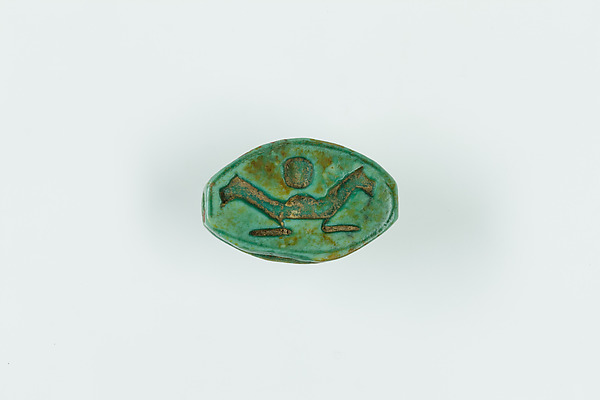
Cowroid with Outward-facing Merged Lions and Sun Disk (opens the museum record)
A glazed steatite cowroid seal whose inscription and design the museum catalogs as invoking Re, Shu, and Tefnut alongside a sun disk and lions. It served as an amuletic seal rather than a temple image.
(opens the museum record)
Ancient object
Terracotta column-krater (vase for mixing wine and water) (opens the museum record)
An Attic column-krater whose painted scene the museum tags as including Zeus among other figures. Large mixing vessels like this were used at the symposium, the Greek drinking party where mythological imagery was common.
(opens the museum record)
Ancient object
Terracotta Nolan neck-amphora (jar) (opens the museum record)
An Attic neck-amphora whose painted figure the museum's record tags as Zeus, together with a bow and arrow, an unusual attribute for him. Nolan amphorae like this were a favored shape for single mythological figures in the Classical period.
 (opens the museum record)
Ancient object
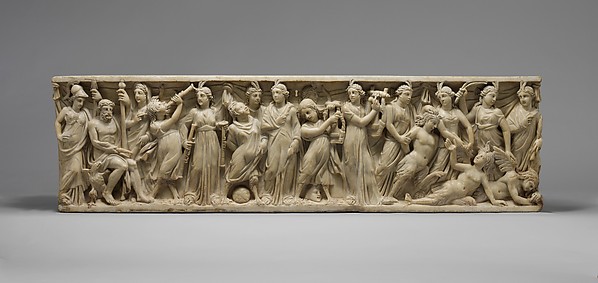
Marble sarcophagus with the contest between the Muses and the Sirens (opens the museum record)
Fragments of a Roman marble sarcophagus carved with the contest between the Muses and the Sirens; the museum's tags list Hera among the figures on the surrounding frieze. The relief shows how Greek mythological subjects continued to furnish Roman funerary art centuries later.
 (opens the museum record)
Ancient object
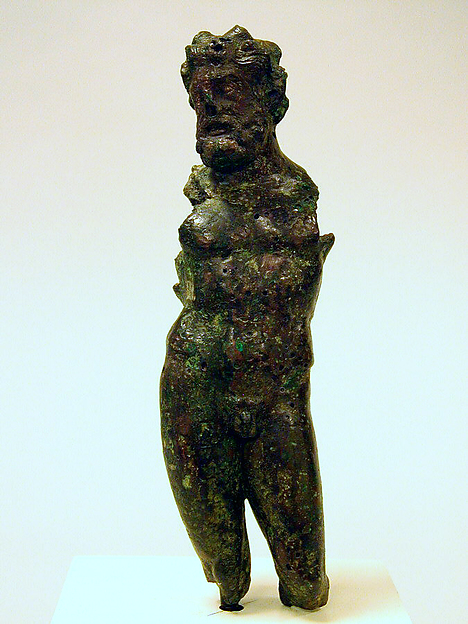
Bronze statuette of a god, possibly Poseidon (opens the museum record)
A Hellenistic bronze statuette the museum identifies as possibly depicting Poseidon, shown in a striding pose that would originally have held an attribute such as a trident. The tentative identification reflects how sea deities and river gods shared similar iconography.
 (opens the museum record)
Ancient object
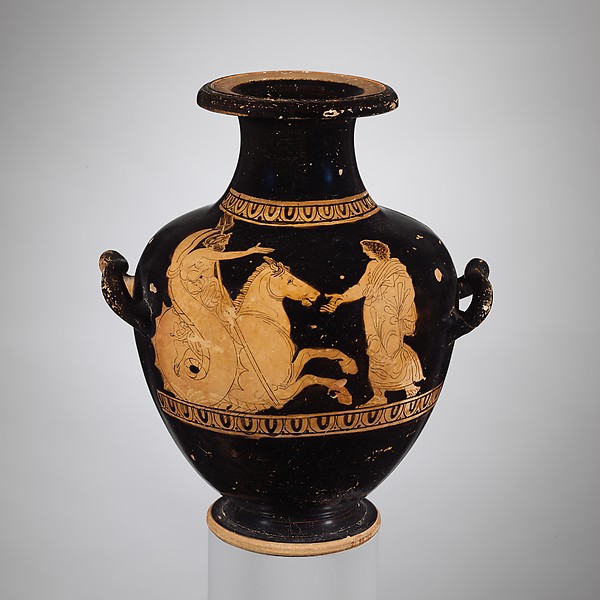
Terracotta hydria: kalpis (water jar) (opens the museum record)
An Attic water jar painted with a scene the museum tags as showing Poseidon among seahorses. The imagery reflects his domain over the sea on a vessel shape used for carrying water.
 (opens the museum record)
Ancient object
Terracotta kylix (drinking cup) (opens the museum record)
An Archaic Attic drinking cup painted with a battle scene the museum tags as including Poseidon among warriors, horses, and an Iliad-related subject. Poseidon's involvement in the Trojan War appears throughout the Iliad.
 (opens the museum record)
Ancient object
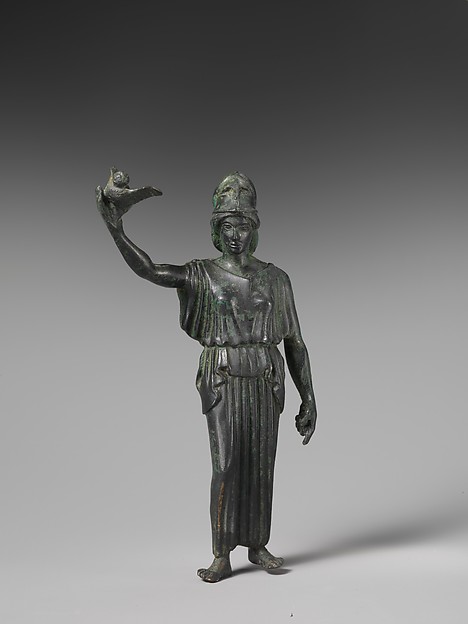
Bronze statuette of Athena (opens the museum record)
A Roman bronze statuette the museum catalogs simply as Athena, shown helmeted in her role as goddess of war and wisdom. Small bronzes like this circulated widely as household or votive images across the Roman world.
 (opens the museum record)
Ancient object
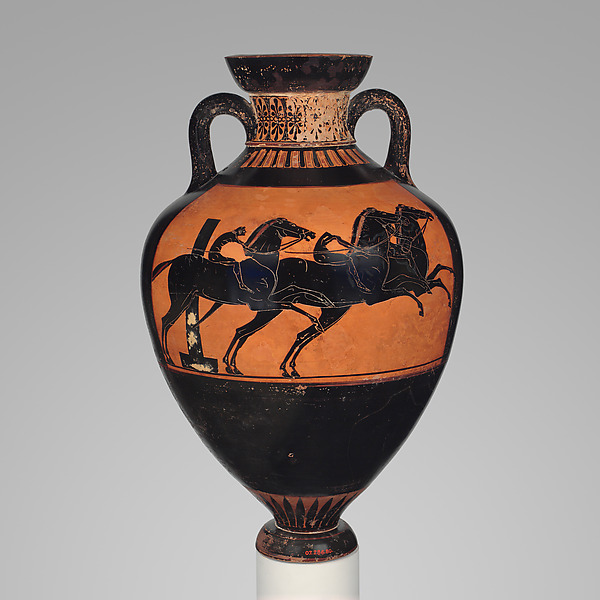
Bronze statuette of Athena flying her owl (opens the museum record)
A Classical Greek bronze statuette the museum titles as Athena flying her owl, her sacred bird and symbol of wisdom. The pairing of goddess and owl was one of her most recognizable attributes in Greek art.
 (opens the museum record)
Ancient object
Terracotta Panathenaic prize amphora (jar) (opens the museum record)
An Archaic Panathenaic prize amphora, the type of vessel filled with olive oil and awarded to victors at the Panathenaic Games in Athens; the museum tags its painted side as showing Athena, the festival's patron goddess.
 (opens the museum record)
Ancient object
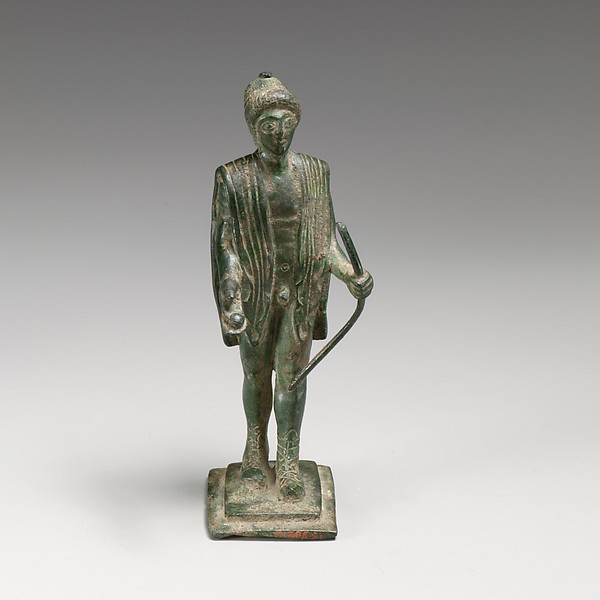
Bronze statuette of Apollo (opens the museum record)
A Classical Greek bronze statuette the museum catalogs as Apollo. Bronze figurines of the god were common votive gifts at his sanctuaries.
 (opens the museum record)
Ancient object
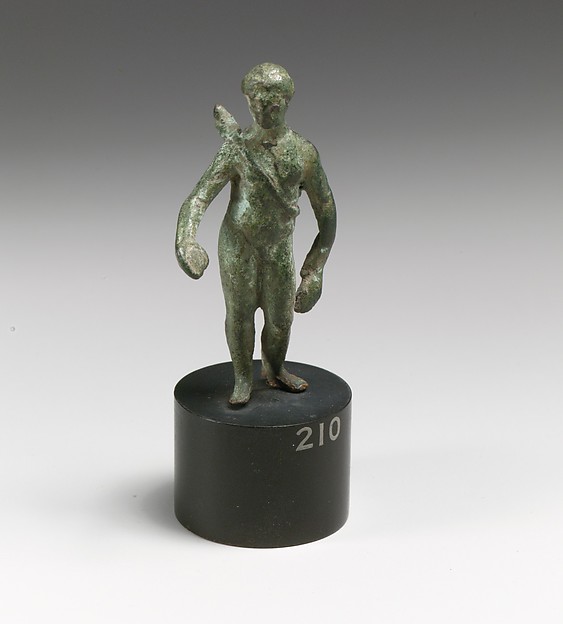
Bronze statuette of Apollo (opens the museum record)
A Roman bronze statuette the museum titles as Apollo with a quiver, referencing his role as archer god. Roman households and shrines used small bronzes like this for private devotion.
 (opens the museum record)
Ancient object
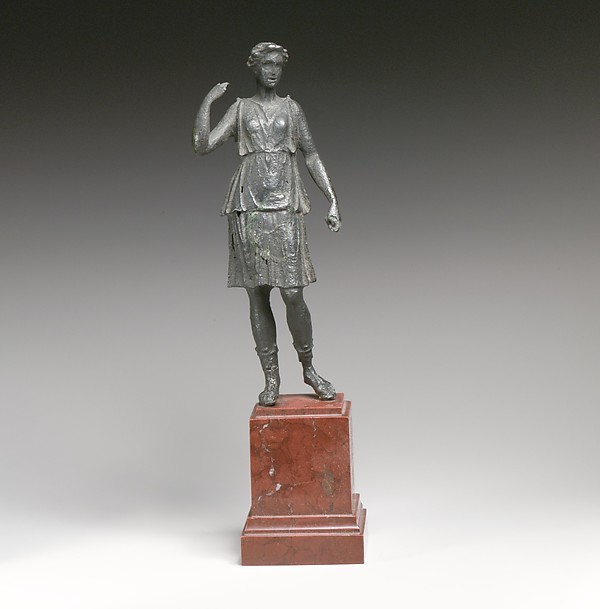
Bronze statuette of Artemis (opens the museum record)
A Hellenistic bronze statuette the museum catalogs as Artemis, goddess of the hunt and wilderness. Figures of this type were common temple and household dedications.
 (opens the museum record)
Ancient object
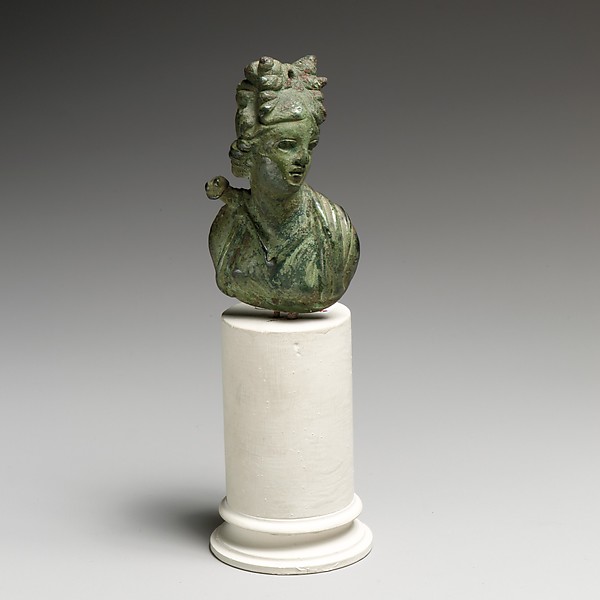
Bronze bust of Artemis (opens the museum record)
A Roman bronze bust the museum identifies as Artemis. Portrait-style busts of deities were used as decorative fittings as well as objects of devotion.
 (opens the museum record)
Ancient object
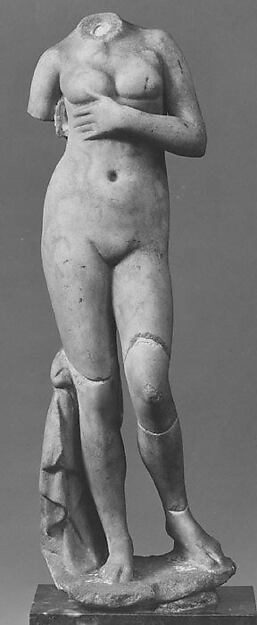
Marble statuette of Aphrodite (opens the museum record)
A Hellenistic Greek marble statuette the museum catalogs as Aphrodite. Small-scale marble statuettes of the goddess were popular for private display in the Hellenistic period.
 (opens the museum record)
Ancient object
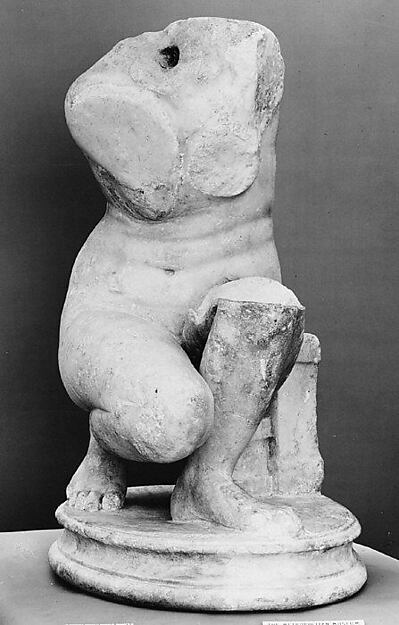
Marble statue of a crouching Aphrodite (opens the museum record)
A Roman marble statue the museum identifies as a crouching Aphrodite, a popular type derived from a lost Hellenistic original showing the goddess bathing. The crouching pose was copied widely across the Roman world.
 (opens the museum record)
Ancient object
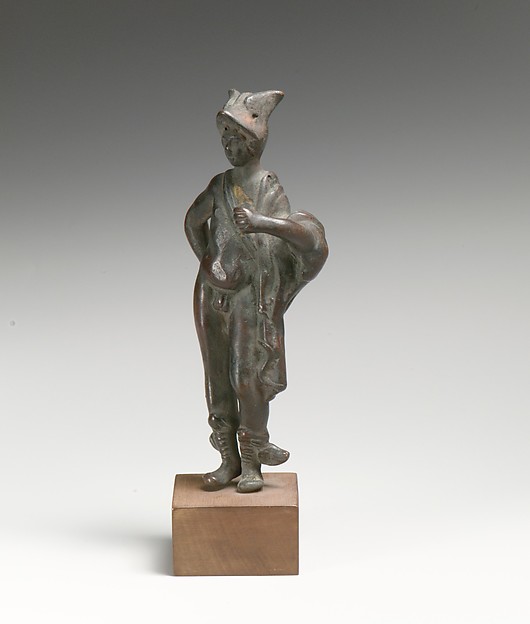
Bronze statuette of Hermes (opens the museum record)
A bronze statuette the museum catalogs as Hermes, messenger god and patron of travelers and trade. Its Greek-or-Roman dating reflects how the type continued across the transition between the two cultures.
 (opens the museum record)
Ancient object
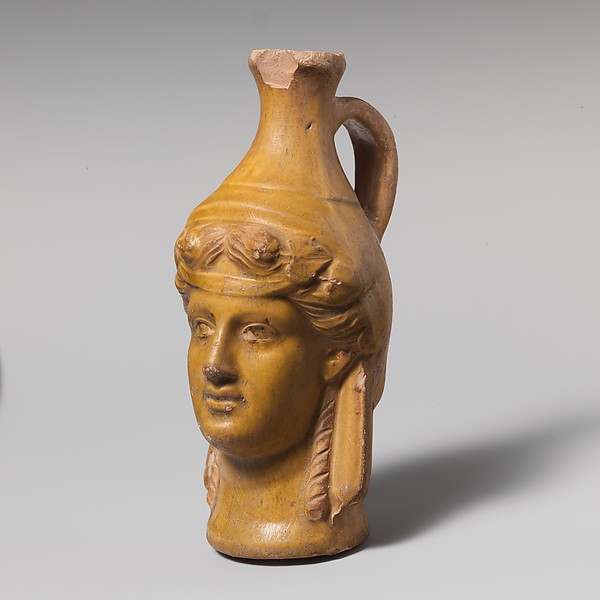
Terracotta jug in the form of Dionysos (opens the museum record)
A terracotta jug shaped as the head of Dionysos, tagged by the museum with his name. Vessels formed as deity heads were a specialty of Hellenistic pottery workshops.
 (opens the museum record)
Ancient object
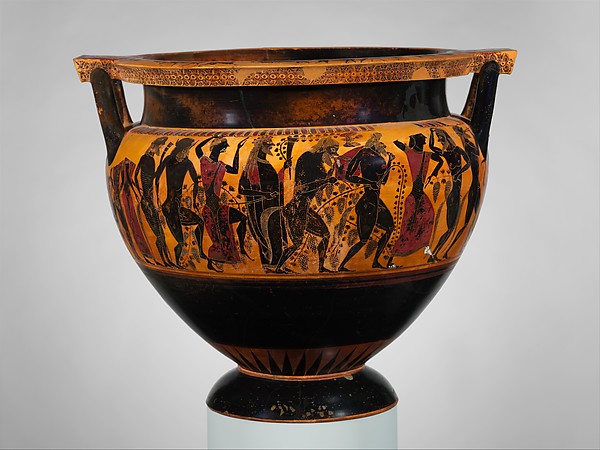
Terracotta column-krater (bowl for mixing wine and water) (opens the museum record)
An Archaic Attic mixing bowl painted with a scene the museum tags as showing Dionysos with maenads and satyrs, his usual retinue of ecstatic followers. Vessels of this shape mixed wine and water at the symposium, fitting for imagery of the wine god.
 (opens the museum record)
Ancient object
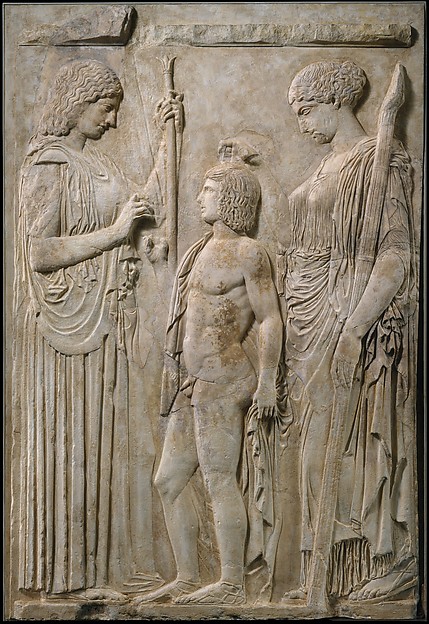
Ten marble fragments of the Great Eleusinian Relief (opens the museum record)
Fragments of the Great Eleusinian Relief, a Roman marble copy of a lost Greek original; the museum's tags identify Demeter and Persephone among the figures. The relief reflects imagery from the Eleusinian Mysteries, the cult centered on Demeter and her daughter.
 (opens the museum record)
Ancient object
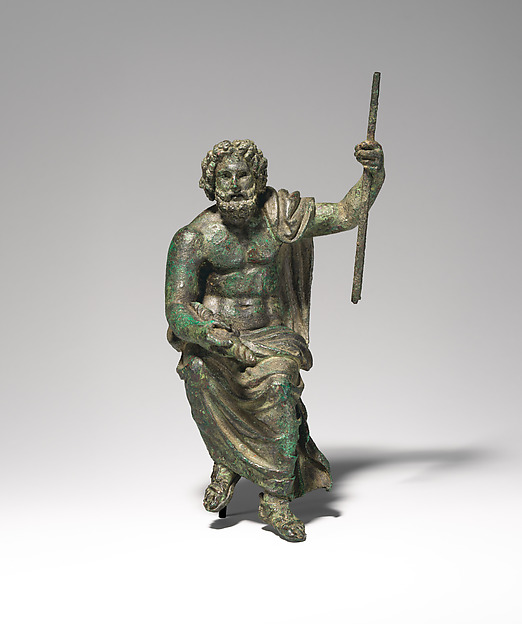
Bronze statuette of Jupiter Capitolinus (opens the museum record)
A Roman bronze statuette the museum titles as Jupiter Capitolinus, referencing the cult image of Jupiter enshrined on Rome's Capitoline Hill. Statuettes of this type reproduced the pose of the great temple statue for private worship.
 (opens the museum record)
Ancient object
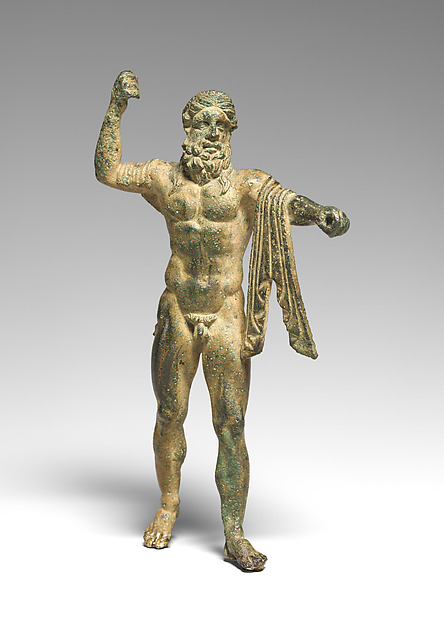
Bronze statuette of Jupiter Capitolinus (opens the museum record)
A second Roman bronze statuette the museum titles as Jupiter Capitolinus, showing the same enthroned type associated with the god's Capitoline cult statue.
 (opens the museum record)
Ancient object
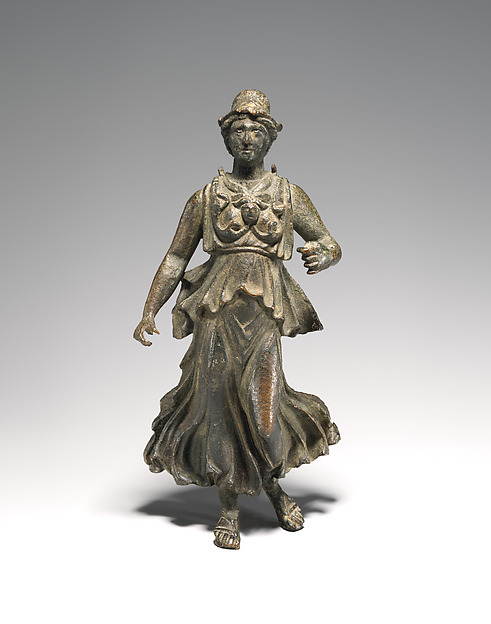
Bronze statuette of Neptune (opens the museum record)
A Roman bronze statuette the museum catalogs as Neptune, god of the sea. The figure's now-missing attribute would originally have been a trident.
 (opens the museum record)
Ancient object
Bronze statuette of Minerva (opens the museum record)
A Roman bronze statuette the museum catalogs as Minerva, the Roman goddess of war and wisdom equated with Athena. Small bronzes of this kind were common household devotional objects.
 (opens the museum record)
Ancient object
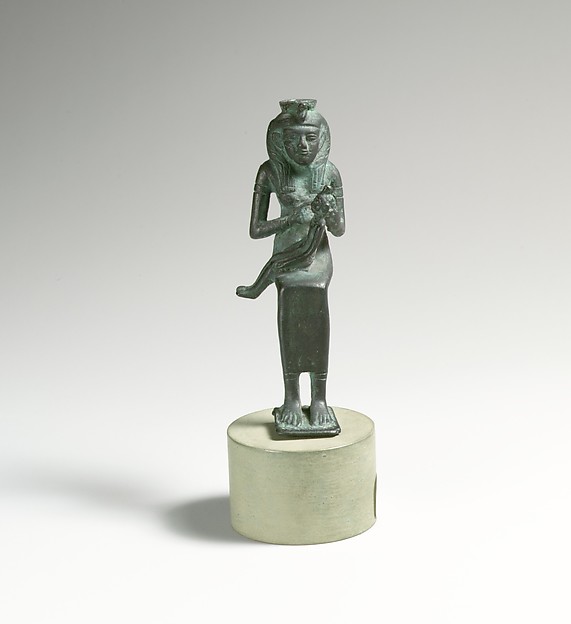
Marble statue of Aphrodite, the so-called Venus Genetrix (opens the museum record)
A Roman marble statue of the so-called Venus Genetrix type, named by the museum in its own title. The type descends from a cult statue associated with Venus as ancestress of the Julian imperial line.
 (opens the museum record)
Ancient object
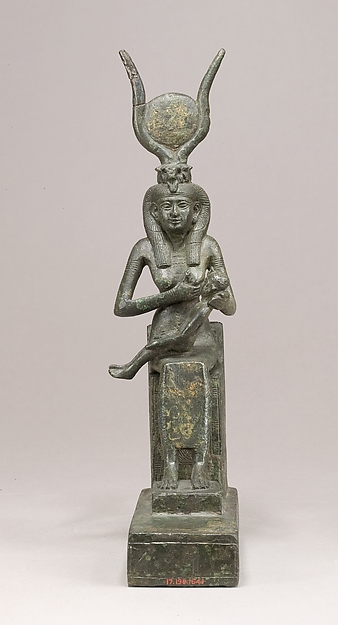
Bronze statuette of Isis with infant Horus (opens the museum record)
A bronze statuette showing Isis nursing the infant Horus, a widely produced devotional type from the Late Period onward. The museum's own title names both figures.
 (opens the museum record)
Ancient object
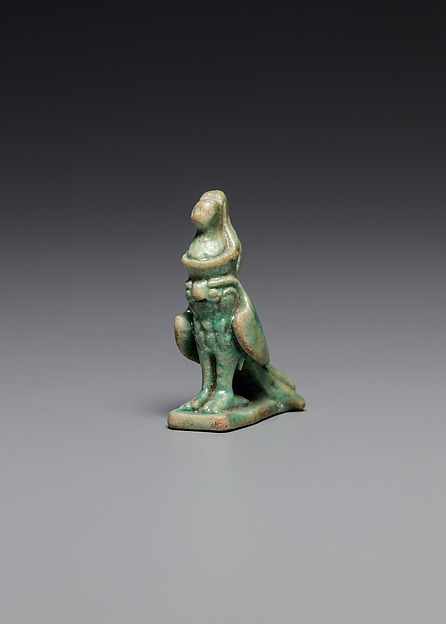
Isis nursing Horus (opens the museum record)
A second bronze figure of Isis nursing Horus, one of the most common devotional images in later Egyptian religion. Such figures were placed in shrines by worshippers seeking the goddess's maternal protection.
 (opens the museum record)
Ancient object
Horus falcon (opens the museum record)
A faience amulet in the form of the Horus falcon wearing the double crown, tagged by the museum with his name. Falcon amulets invoked Horus's protection and his association with kingship.
 (opens the museum record)
Ancient object
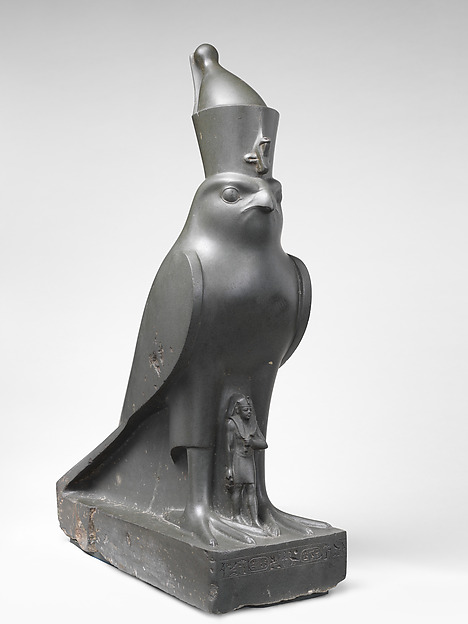
Statue of Horus as a falcon protecting King Nectanebo II (opens the museum record)
A stone statue showing Horus as a falcon protecting King Nectanebo II, who stands beneath the god's wings. The museum's title identifies both the god and the specific king he shelters.
 (opens the museum record)
Ancient object
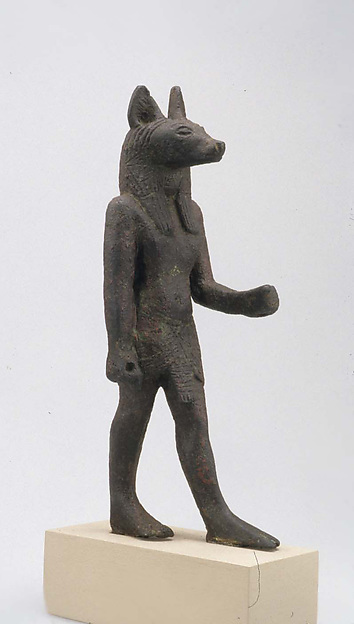
Anubis (opens the museum record)
A cast metal statuette the museum catalogs simply as Anubis, god of embalming and the dead, in his jackal-headed form. Such figures were dedicated by worshippers concerned with proper burial and the afterlife.
 (opens the museum record)
Ancient object
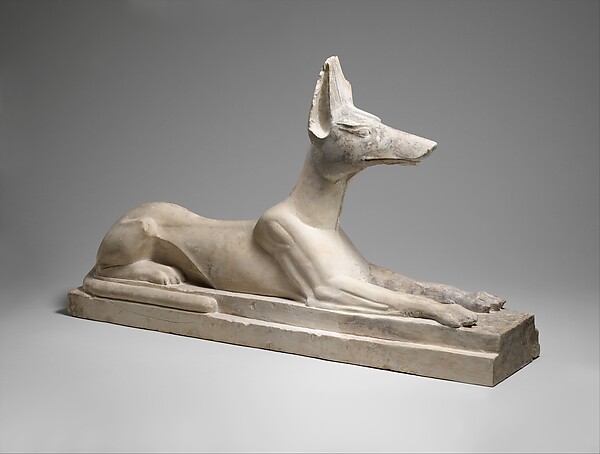
Statue of Anubis as a recumbent canid (opens the museum record)
A limestone statue of Anubis as a recumbent canid, originally painted black, the color associated with fertile Nile silt and rebirth. Statues of this type guarded tombs and funerary equipment.
 (opens the museum record)
Ancient object
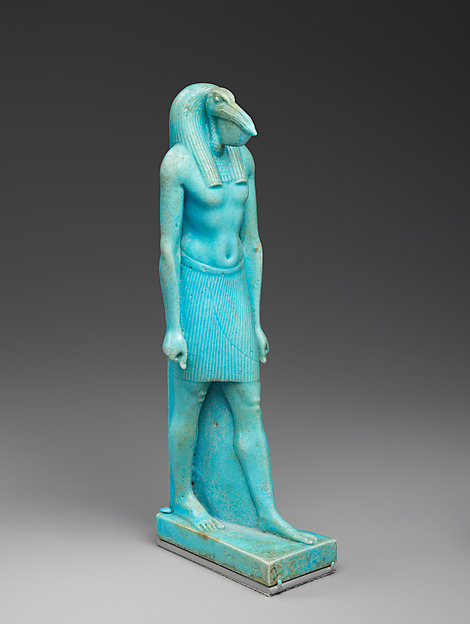
Striding Thoth (opens the museum record)
A faience statuette the museum titles as Striding Thoth, shown in his ibis-headed form as god of writing and knowledge. Faience figures of Thoth were common votive gifts at his cult centers.
 (opens the museum record)
Ancient object
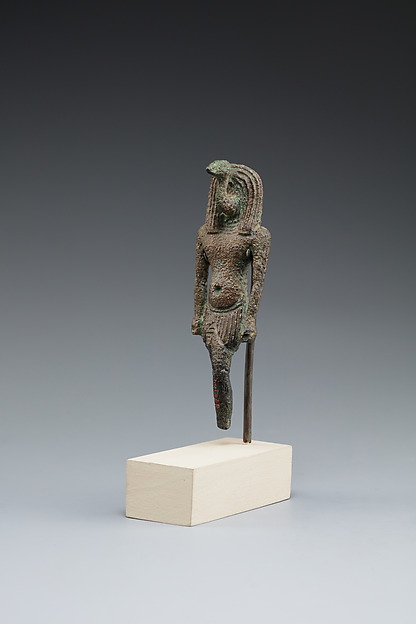
Ibis-headed god, Thoth (opens the museum record)
A bronze statuette the museum identifies as the ibis-headed god Thoth. Thoth's ibis form referenced the bird's association with wisdom and the recording of knowledge.
 (opens the museum record)
Ancient object
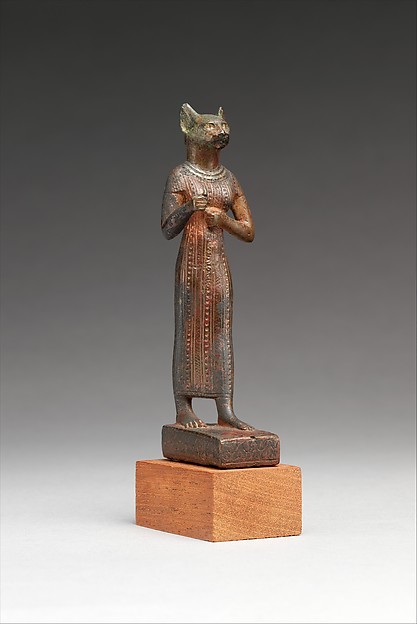
Bastet (opens the museum record)
A bronze figure of Bastet inlaid with precious metal, catalogued by the museum under her name. Cat-headed images of Bastet were popular votive and household objects associating her with protection and fertility.
 (opens the museum record)
Ancient object
Bastet (opens the museum record)
A cast metal figure of Bastet, one of many produced in the Late and Ptolemaic Periods when her cult at Bubastis drew large numbers of pilgrims and votive offerings.
 (opens the museum record)
Ancient object
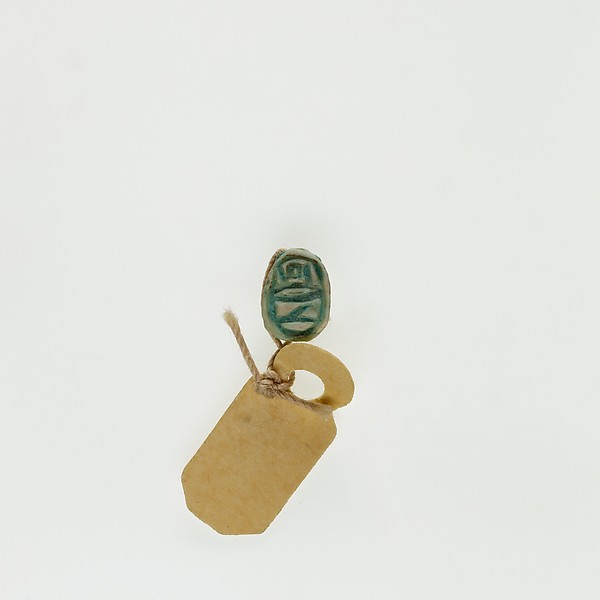
Scarab Inscribed with a Blessing Related to Re (opens the museum record)
A green glazed steatite scarab inscribed with a blessing formula invoking Re. Scarabs like this were worn as amulets or used as seals, carrying the god's name rather than a figural image of him.
 (opens the museum record)
Ancient object
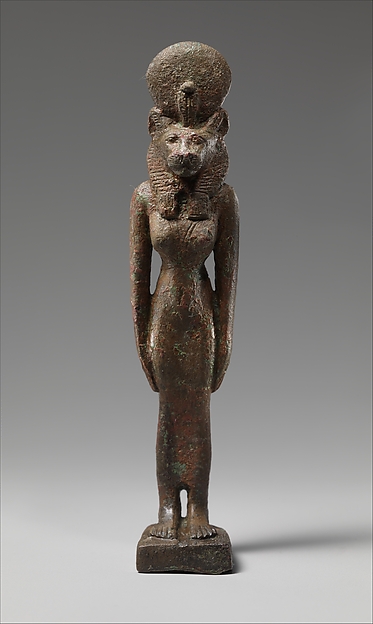
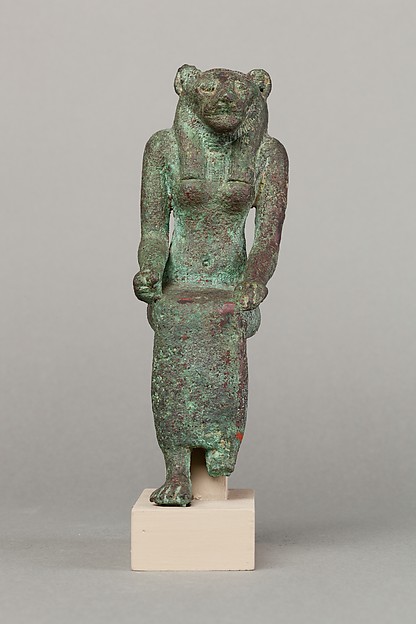
Lion-Headed Goddess (opens the museum record)
A cast metal statuette of a lion-headed goddess the museum tags as Sekhmet, the fierce protector deity associated with war and healing. Bronze figures of Sekhmet were dedicated by worshippers seeking her dual powers of destruction and protection.
 (opens the museum record)
Ancient object
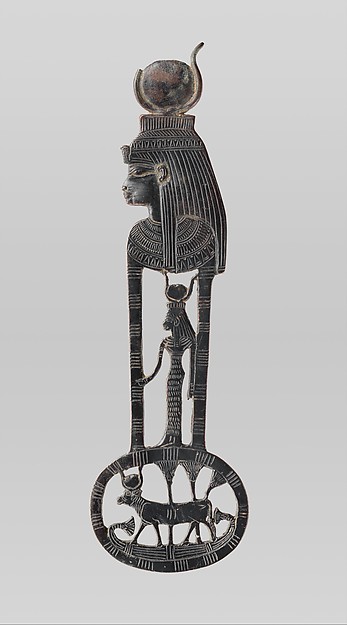
Lion-headed goddess (opens the museum record)
A second lion-headed goddess statuette tagged by the museum as Sekhmet, part of the large body of Late Period bronze votive figures dedicated to her.
 (opens the museum record)
Ancient object
Menat counterpoise with figures of Hathor as a woman and a cow (opens the museum record)
A menat counterpoise, the weight balancing a beaded ceremonial necklace used in Hathor's cult, cast with images of the goddess as both a woman and a cow. The museum's own title names Hathor directly.
 (opens the museum record)
Ancient object
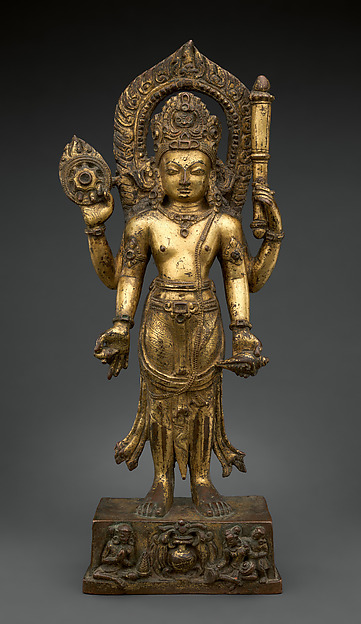
Bronze statuette of Osiris (opens the museum record)
A second bronze statuette of Osiris in his mummiform pose, holding the crook and flail. Figures like this were among the most commonly dedicated votive bronzes in the Late Period, reflecting Osiris's central role in beliefs about the afterlife.
 (opens the museum record)
Ancient object
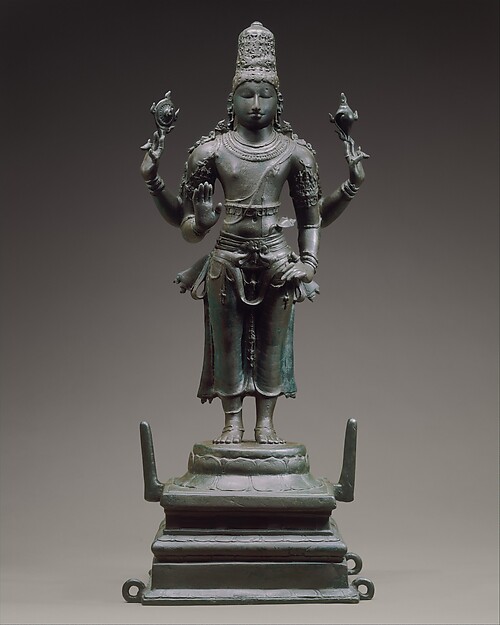
Vishnu (opens the museum record)
A gilded copper-alloy figure of Vishnu from Nepal's Kathmandu Valley, dated by inscription to 1105 CE. The museum catalogs it simply as Vishnu, standing in his four-armed form holding his usual attributes.
 (opens the museum record)
Ancient object
Standing Vishnu (opens the museum record)
A Chola-period bronze of Vishnu standing in a formal frontal pose, cast in South India for temple processional use. Chola bronzes of this kind were carried in festival processions rather than kept fixed in a shrine.
(opens the museum record)
Ancient object
Shiva as Lord of Dance (Nataraja) (opens the museum record)
A Chola bronze of Shiva as Nataraja, Lord of the Dance, encircled by a ring of flame. This is one of the most celebrated forms of Hindu bronze sculpture, cast for temple processions in South India.
 (opens the museum record)
Ancient object
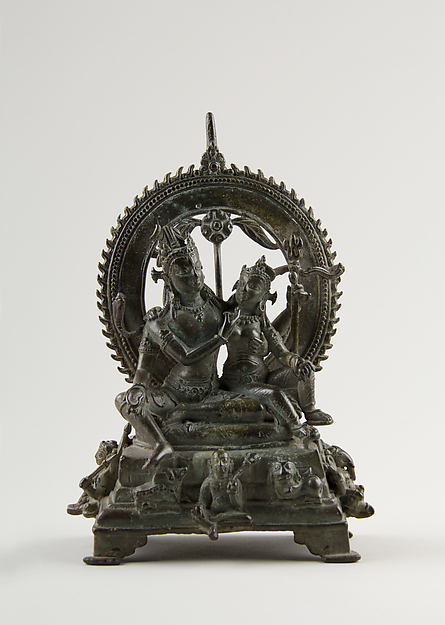
Shiva Seated with Uma (Umamaheshvara) (opens the museum record)
A Pala-period bronze showing Shiva seated with his consort Uma, a form known as Umamaheshvara. It reflects the eastern Indian bronze-casting tradition centered in Bihar and Bengal.
 (opens the museum record)
Ancient object
Yashoda with the Infant Krishna (opens the museum record)
A Chola bronze showing Krishna's foster mother Yashoda holding the infant Krishna, tagged by the museum with his name. The tender maternal subject was a popular one in South Indian temple bronzes.
 (opens the museum record)
Ancient object
Seated Ganesha (opens the museum record)
A Thai bronze of a seated, elephant-headed Ganesha, tagged by the museum with his name. Ganesha's worship spread from India across Buddhist and Hindu Southeast Asia.
 (opens the museum record)
Ancient object
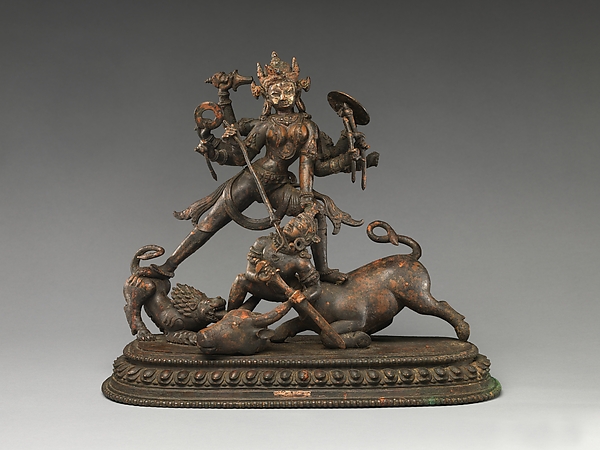
The Goddess Durga Slaying Mahisha (opens the museum record)
A Nepali bronze the museum titles as the goddess Durga slaying Mahisha, the buffalo demon. The subject depicts her defining myth, in which she was created by the gods to defeat a demon none of them could kill alone.
 (opens the museum record)
Ancient object
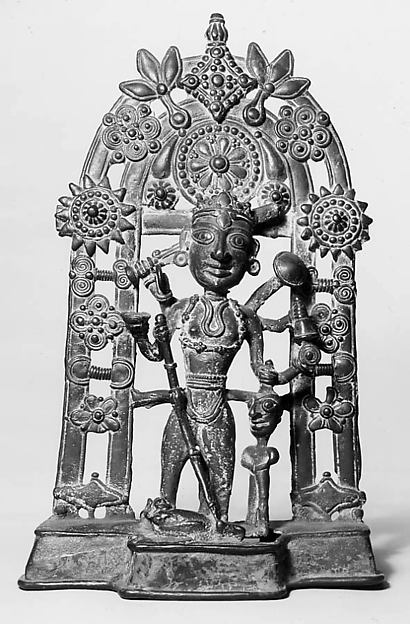
Durga Mahishasura (opens the museum record)
A bronze figure the museum titles Durga Mahishasura, showing the goddess triumphing over the same buffalo demon. Images of this victory were widely produced across medieval India.
 (opens the museum record)
Ancient object
Hanuman Conversing (opens the museum record)
A Chola-period bronze the museum titles Hanuman Conversing, showing the monkey god in a gesture of speech. Hanuman's devotion to Rama made him one of the most widely worshipped figures from the Ramayana.
 (opens the museum record)
Ancient object
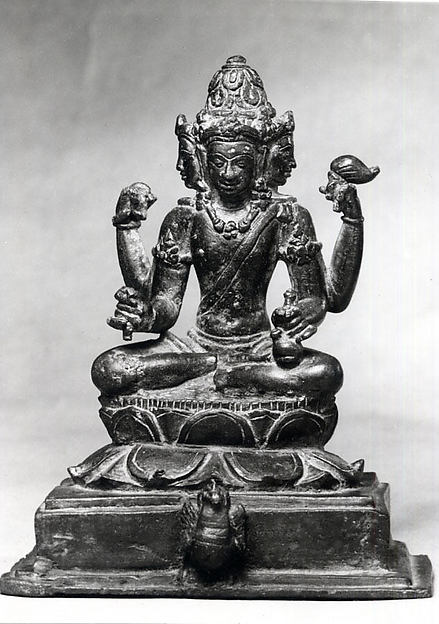
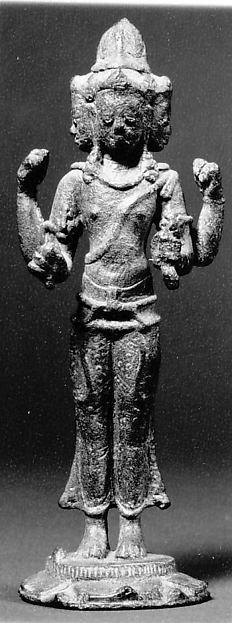
Seated Brahma (opens the museum record)
A Central Javanese bronze the museum titles Seated Brahma, showing the creator god enthroned on a lotus. It reflects the spread of Hindu bronze-casting traditions to Java.
 (opens the museum record)
Ancient object
Brahma with Silver Eyes (opens the museum record)
A Javanese bronze the museum titles Brahma with Silver Eyes, its inlaid eyes a refinement typical of fine Central Javanese metalwork.
 (opens the museum record)
Ancient object
Bodhisattva Avalokiteshvara (Guanyin) (opens the museum record)
A Yuan-dynasty wood sculpture the museum titles Bodhisattva Avalokiteshvara (Guanyin), dated by inscription to 1282. Guanyin, the East Asian form of the bodhisattva of compassion, became one of the most widely venerated figures in Chinese Buddhism.
 (opens the museum record)
Ancient object
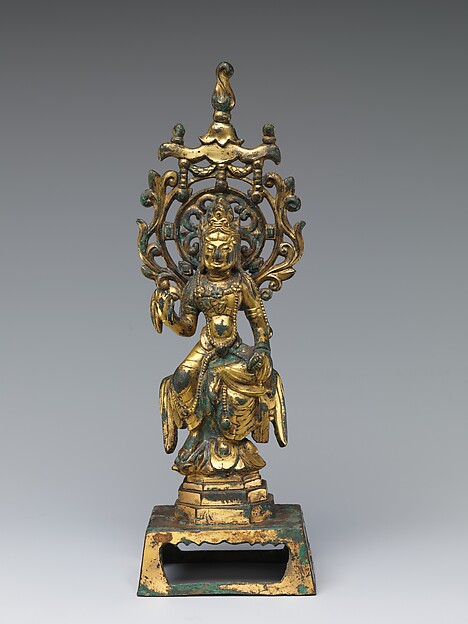
Bodhisattva Avalokiteshvara (Guanyin) (opens the museum record)
A gilt bronze figure from the Five Dynasties period the museum titles Bodhisattva Avalokiteshvara (Guanyin), an early example of the type before the fully Sinicized feminine form became standard.
 (opens the museum record)
Ancient object
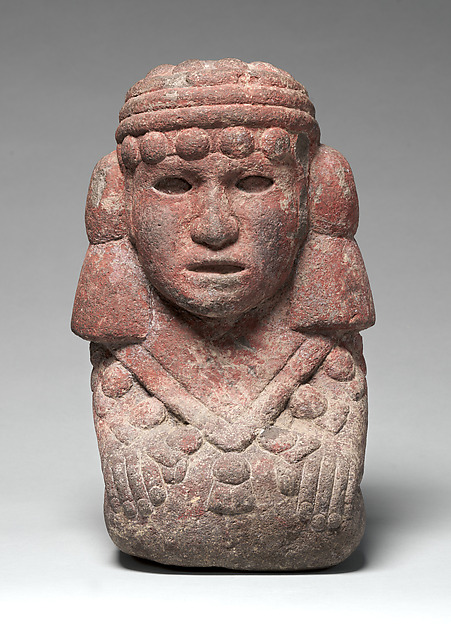
Chalchiuhtlicue (opens the museum record)
A Mexica (Aztec) basalt figure the museum catalogs simply as Chalchiuhtlicue, goddess of lakes, rivers, and running water. Stone images like this were carved in the century before the Spanish conquest.
 (opens the museum record)
Ancient object
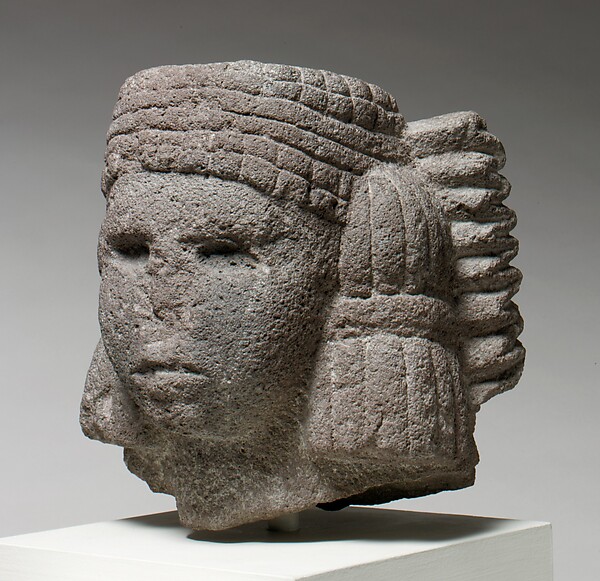
Head of a Water Deity (Chalchiuhtlicue) (opens the museum record)
A basalt head the museum titles Head of a Water Deity (Chalchiuhtlicue), broken from a larger figure of the Mexica water goddess.
 (opens the museum record)
Ancient object
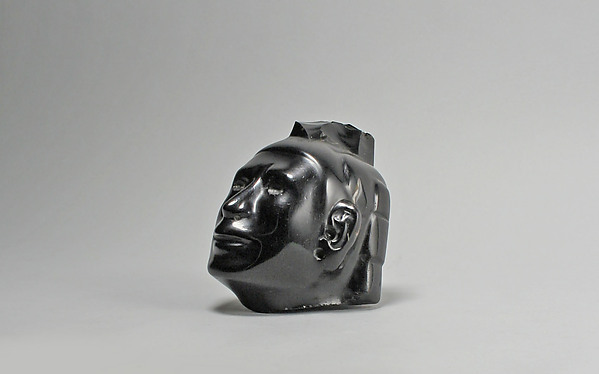
Head from a figure, Xochipilli-Macuilxochitl (opens the museum record)
An obsidian head the museum titles Head from a figure, Xochipilli-Macuilxochitl, naming the Mexica flower prince associated with music, pleasure, and the arts, closely linked with the god Macuilxochitl.
 (opens the museum record)
Ancient object
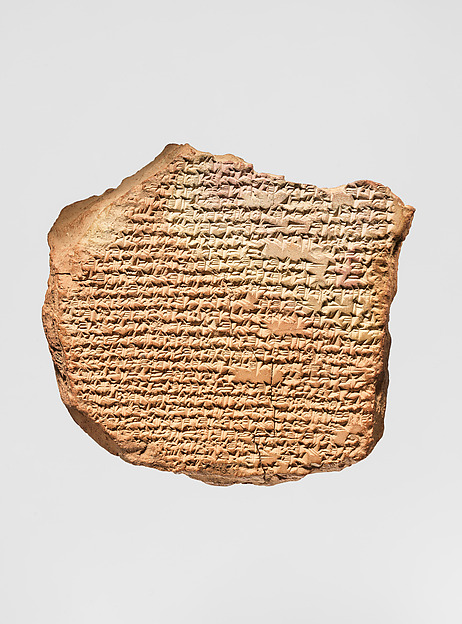
Cuneiform tablet: hymn to Marduk (opens the museum record)
A cuneiform clay tablet the museum catalogs as a hymn to Marduk, chief god of the Babylonian pantheon. The tablet is a textual rather than figural attestation of his worship.
 (opens the museum record)
Ancient object
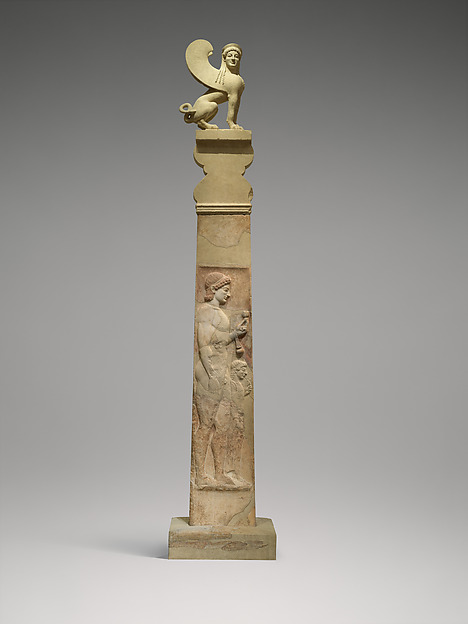
Marble stele (grave marker) with a youth and little girl, and a capital and finial in the form of a sphinx (opens the museum record)
An Archaic Attic grave stele topped by a small sphinx finial, tagged by the museum with the creature's name. Sphinxes were common protective figures on Greek funerary monuments.
 (opens the museum record)
Ancient object
Sphinx of Amenhotep III, possibly from a Model of a Temple (opens the museum record)
A faience sphinx bearing the name of Amenhotep III, possibly from a model temple. Egyptian sphinxes combined a lion's body with a royal human head to guard sacred sites.
 (opens the museum record)
Ancient object
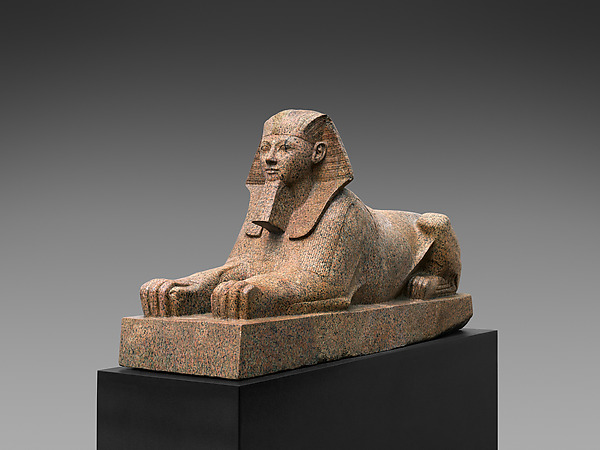
Sphinx of Hatshepsut (opens the museum record)
A granite sphinx carved with the features of Queen Hatshepsut, one of the best-known royal sphinxes in the museum's Egyptian collection.
 (opens the museum record)
Ancient object
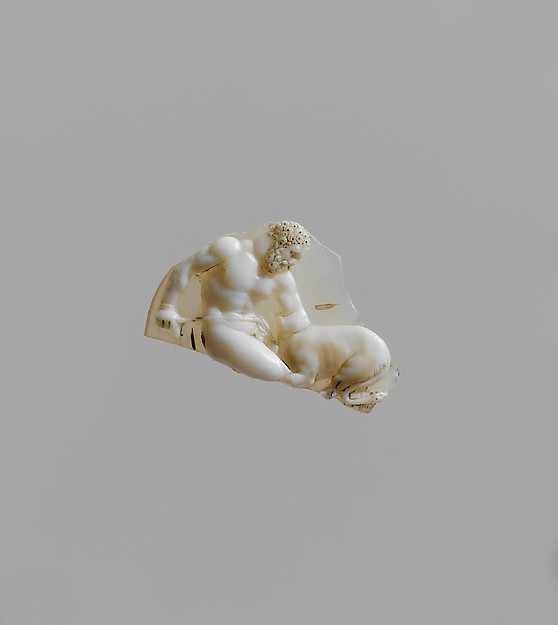
Sardonyx cameo fragment with Hercules tying up Cerberus (opens the museum record)
A sardonyx cameo fragment the museum titles Hercules Tying Up Cerberus, showing the hero's final labor of capturing the three-headed hound of the underworld.
 (opens the museum record)
Ancient object
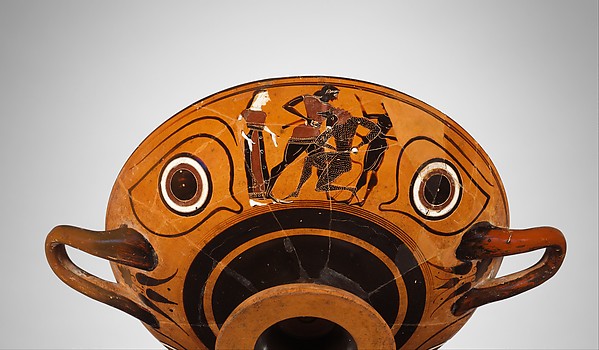
Terracotta kylix: eye-cup (drinking cup) (opens the museum record)
Between painted eyes, Theseus confronts the Minotaur, with youths and maidens as spectators. The scene appears on both sides of the cup.
 (opens the museum record)
Ancient object
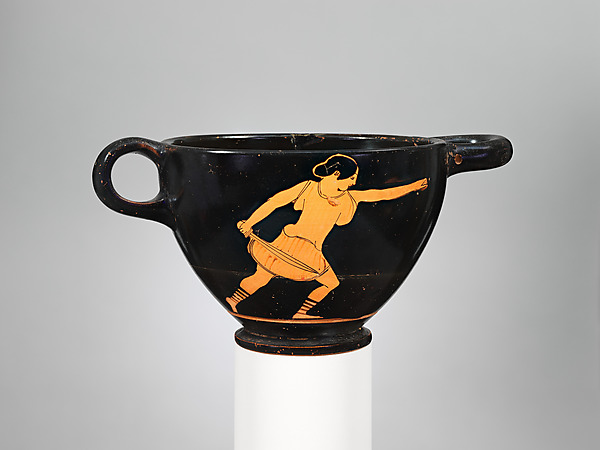
Terracotta skyphos (deep drinking cup) (opens the museum record)
Theseus appears on one side and the Minotaur on the other. The museum describes the figures as separate protagonists rather than a continuous narrative.
 (opens the museum record)
Ancient object
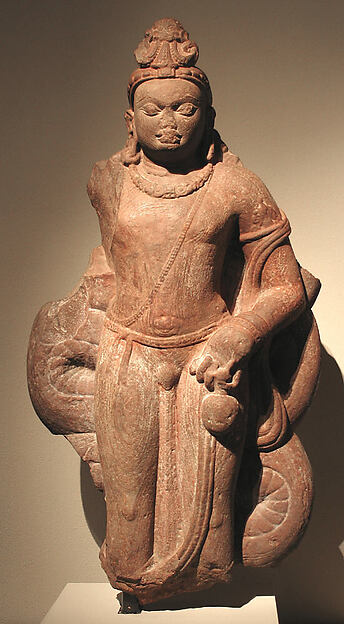
Standing Nagaraja (Serpent King) (opens the museum record)
A Gupta-period red sandstone figure the museum titles Standing Nagaraja (Serpent King), a divine serpent-being whose cobra hood rises behind his head.
 (opens the museum record)
Ancient object
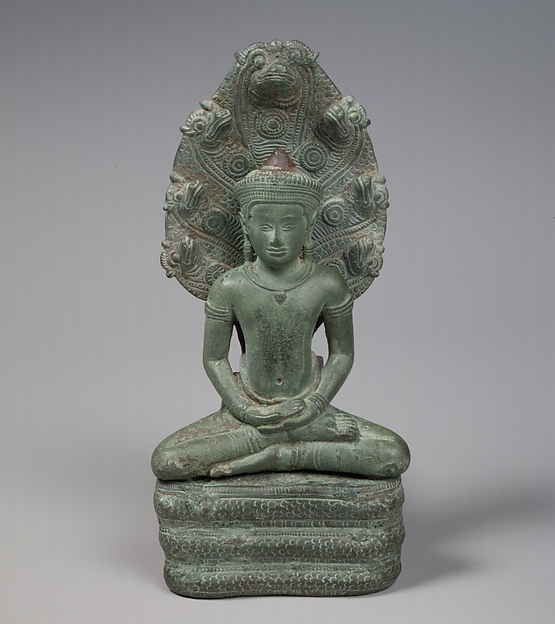
Buddha Sheltered by a Naga (opens the museum record)
A Khmer bronze the museum titles Buddha Sheltered by a Naga, showing the multi-headed serpent Mucalinda protecting the meditating Buddha, a well-known episode from Buddhist legend.
 (opens the museum record)
Ancient object
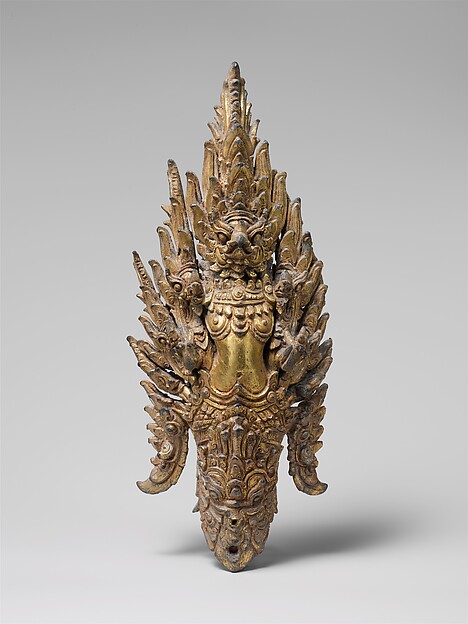
Garuda Finial (opens the museum record)
A gilt bronze finial in the form of Garuda, the half-man, half-bird creature and mount of Vishnu, made in Thailand for architectural decoration.
 (opens the museum record)
Ancient object
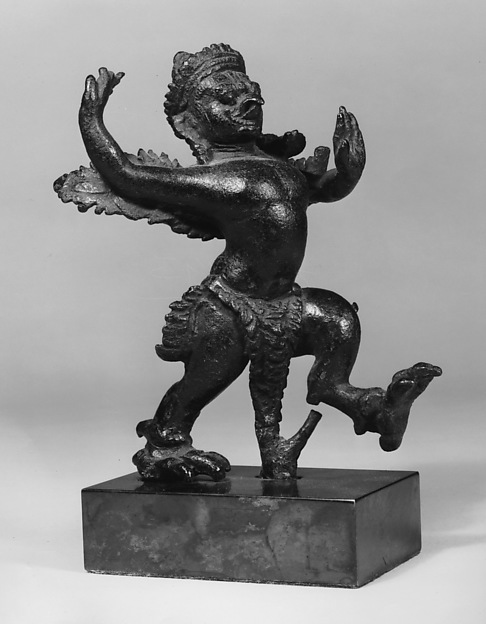
Striding Garuda (The Royal Solar Bird) (opens the museum record)
A Thai bronze the museum titles Striding Garuda (The Royal Solar Bird), showing the creature in an active pose rather than as a static architectural ornament.
(opens the museum record)
Later European depiction
Perseus with the Head of Medusa (opens the museum record)
Canova's sculpture presents Perseus holding Medusa's head. Made in the early nineteenth century, it shows the myth's later artistic reception rather than an ancient depiction.
 (opens the museum record)
Later depiction
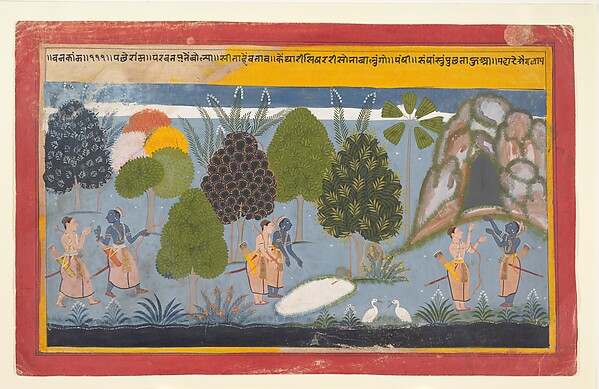
Rama and Lakshmana Search in Vain for Sita: Illustrated folio from a dispersed Ramayana series (opens the museum record)
A Rajasthani manuscript illustration from a dispersed Ramayana series showing Rama and Lakshmana searching for Sita after her abduction. It reflects the story's reception in Mewar court painting rather than an ancient attestation.
 (opens the museum record)
Later depiction
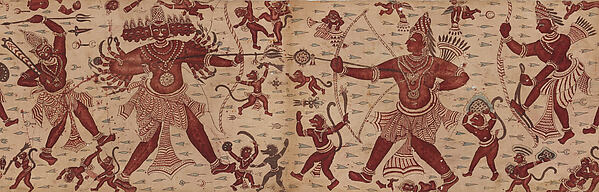
The Combat of Rama and Ravana (opens the museum record)
A painted and dyed cotton hanging from the Coromandel Coast depicting the battle between Rama and Ravana. The museum's own title names both figures directly.
 (opens the museum record)
Later depiction
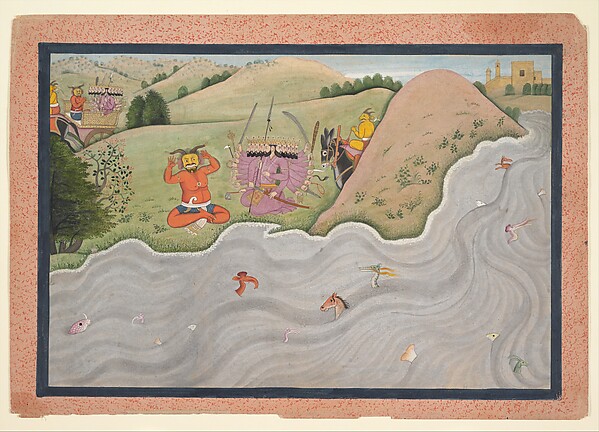
The Demon Marichi Tries to Dissuade Ravana; Illustrated folio from a dispersed Ramayana series (opens the museum record)
A Kangra-school folio from a dispersed Ramayana series showing the demon Marichi trying to talk Ravana out of his plan. The museum's title names Ravana explicitly as the recipient of the advice.
 (opens the museum record)
Later depiction
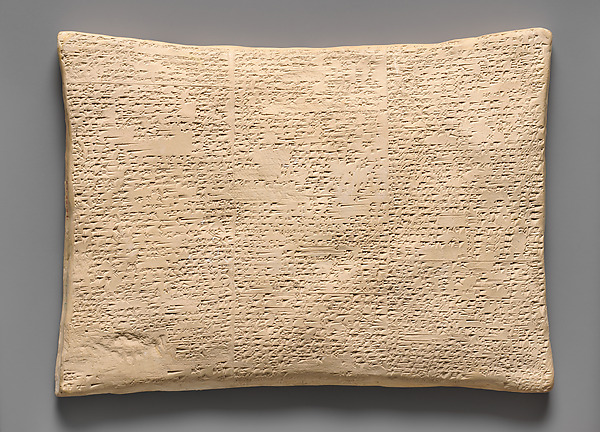
Cast reconstruction of Babylonian Flood Tablet (opens the museum record)
A nineteenth-century plaster cast reproducing the Babylonian Flood Tablet, the Gilgamesh Epic tablet in which Utnapishtim recounts surviving the great flood. The cast documents how the deciphered tablet circulated among museums after its 1872 translation, not an ancient depiction of Utnapishtim himself.
 (opens the museum record)
Later European depiction
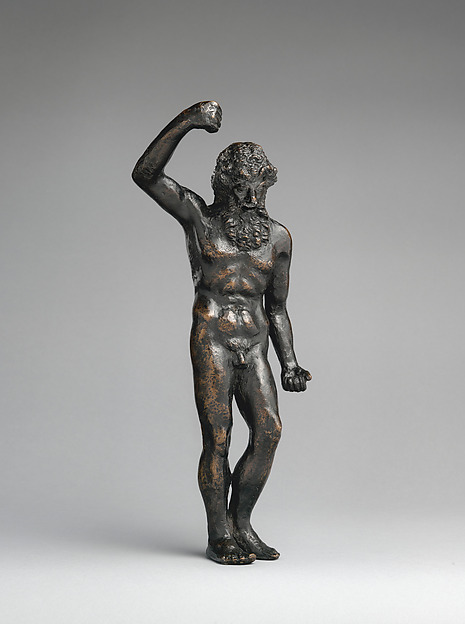
Neptune (opens the museum record)
A mid-sixteenth-century Italian bronze statuette by Severo Calzetta da Ravenna depicting Neptune. It reflects the Renaissance revival of classical sea-god imagery in collectors' bronzes, not an ancient cult image.
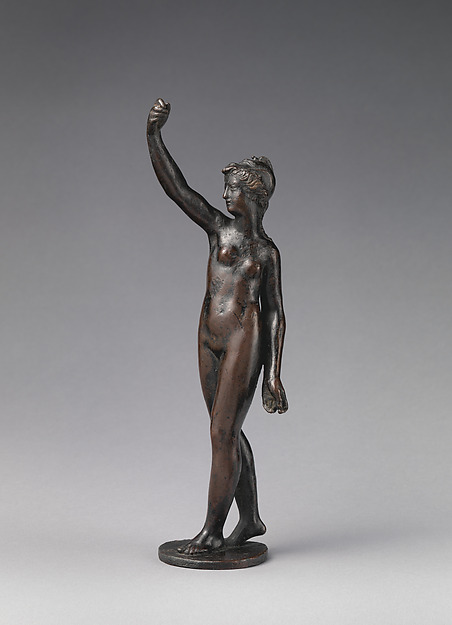 (opens the museum record)
Later European depiction
Minerva (opens the museum record)
A sixteenth-century Italian bronze statuette attributed to Benvenuto Cellini depicting Minerva. It belongs to the Renaissance fashion for small classical-style bronzes made for collectors rather than an ancient cult object.
 (opens the museum record)
Later European depiction
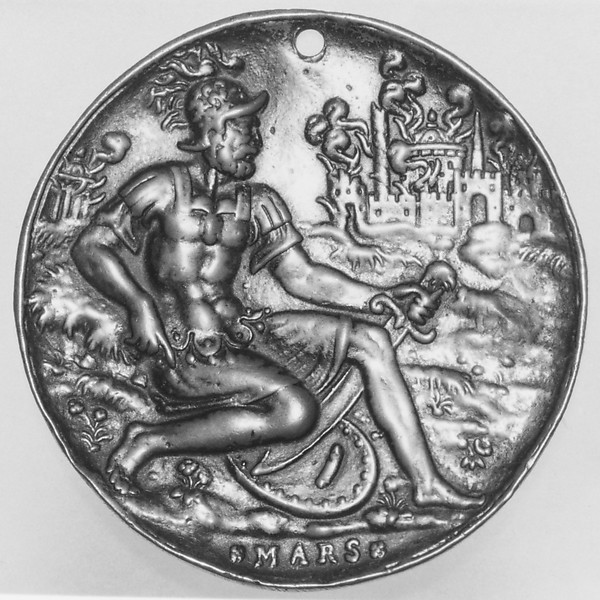
Mars (opens the museum record)
A bronze plaquette of about 1610 by the French goldsmith François Briot depicting Mars with shield and sword, tagged by the museum with the god's name. Plaquettes like this were decorative collectors' objects modeled on classical armed figures.
 (opens the museum record)
Later depiction
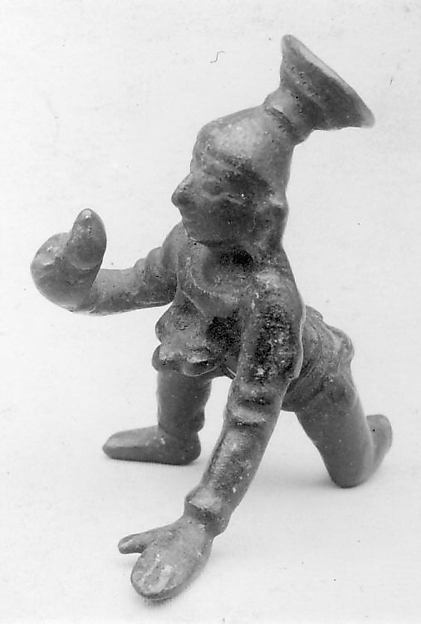
Krishna (opens the museum record)
A South Indian bronze portable idol the museum catalogs simply as Krishna, made for personal devotional use. Portable images like this were carried and dressed in household worship.
 (opens the museum record)
Later depiction
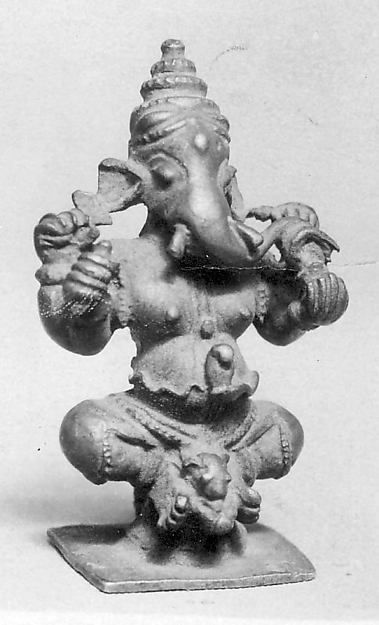
Ganesha (opens the museum record)
A South Indian bronze figurine of Ganesha, part of the continuous tradition of casting the elephant-headed god for household and temple shrines.
 (opens the museum record)
Later depiction
Luring the Sun Goddess Amaterasu Out of a Cave with Music; Death of the Historical Buddha (opens the museum record)
A pair of Meiji-period hanging scrolls whose title the museum gives as Luring the Sun Goddess Amaterasu Out of a Cave with Music, depicting the myth in which the other gods coax her out of hiding to restore light to the world.
 (opens the museum record)
Later depiction
The God Izanagi and Goddess Izanami (opens the museum record)
An Edo-period hanging scroll the museum titles The God Izanagi and Goddess Izanami, depicting the primordial couple credited in Shinto myth with creating the islands of Japan.
 (opens the museum record)
Later depiction
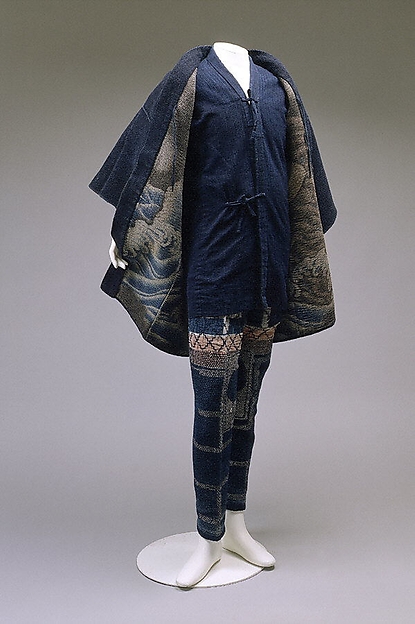
Fireman’s Jacket (Hikeshi-Banten) with Susanoo-no-mikoto Deity Scene (opens the museum record)
A quilted cotton fireman's jacket dyed with a scene the museum titles as depicting Susanoo-no-mikoto. Edo-period firemen commissioned dramatic mythological and heroic scenes for the linings of their protective coats.
 (opens the museum record)
Later depiction
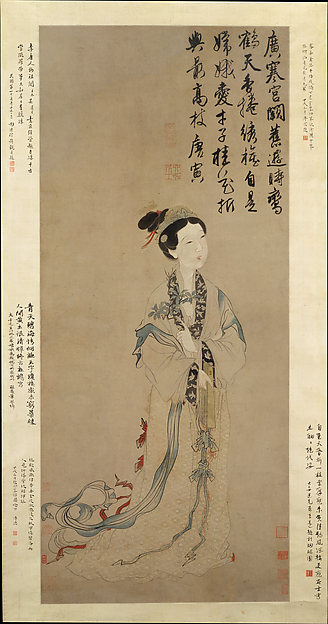
The Moon Goddess Chang E (opens the museum record)
A Ming-dynasty hanging scroll the museum titles The Moon Goddess Chang E, showing the goddess who, in the best-known version of her myth, drank an elixir of immortality and rose to live on the moon.
 (opens the museum record)
Later depiction
The Monkey King Songokū, from the Chinese novel Journey to the West (opens the museum record)
A Japanese surimono print titled by the museum The Monkey King Songoku, from the Chinese novel Journey to the West, using the Japanese reading of Sun Wukong's name. It shows the Chinese Monkey King's story reaching Japanese print culture in the early nineteenth century.
 (opens the museum record)
Later depiction
Mirror With the Design of a Nine-Tailed Fox (opens the museum record)
An Edo-period Japanese print the museum titles Mirror With the Design of a Nine-Tailed Fox, depicting the shapeshifting kitsune associated in folklore with trickery and transformation.
 (opens the museum record)
Later depiction
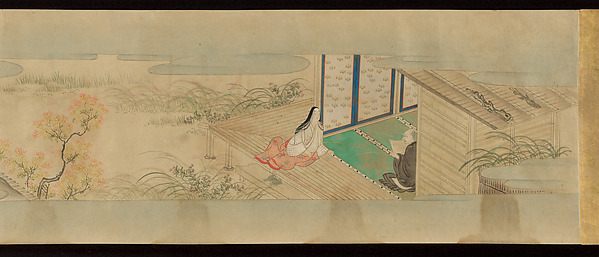
Tale of the Fox (Kitsune no sōshi) (opens the museum record)
An illustrated Edo-period handscroll titled Tale of the Fox (Kitsune no soshi), a narrative built around a shapeshifting kitsune. The handscroll documents the fox's role as a recurring figure in Japanese storytelling.
About the museum collection
Every work in this gallery is a documented object in the public-domain open-access program of the Metropolitan Museum of Art, verified by accession number and curator credit. Unlike the project's own illustrations and engraved archival plates, these photographs show real bronzes, marble reliefs, manuscripts, vessels, and ceremonial objects.
Works are grouped into three historical contexts: Ancient object (made within the historical culture that worshipped or told the myth), Later depiction (later works created inside the continuing tradition, such as Edo woodblocks or Rajput manuscripts), and Later European depiction (Renaissance through nineteenth-century reception). You can also browse how the atlas distinguishes real objects from illustrations on the Sources page.